
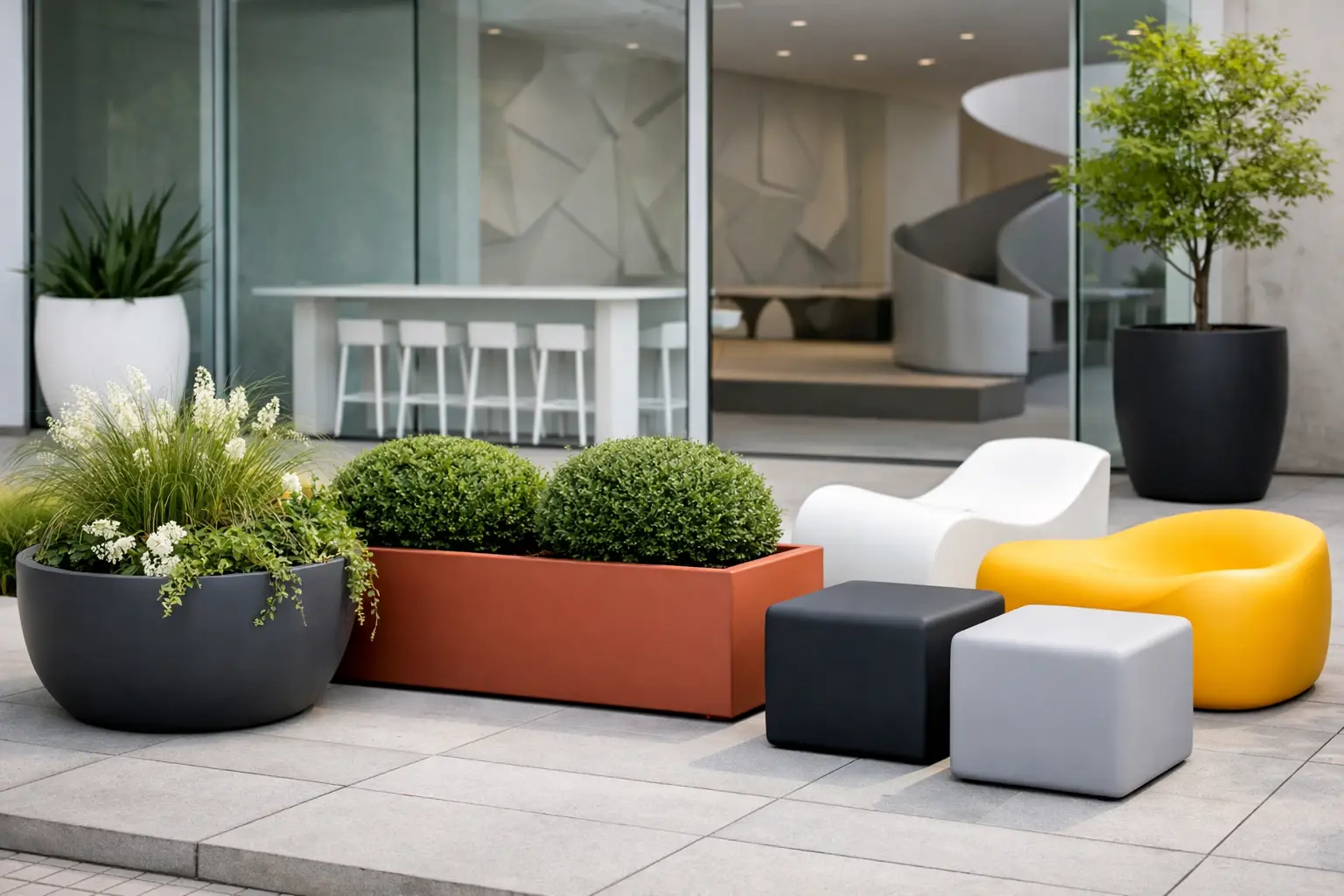
A planter in a public space does more than hold soil. It defines circulation, softens hardscape, protects edges, reinforces brand identity, and in many projects, becomes part of the architecture itself. That is why choosing the best outdoor planters for public spaces is less about picking a shape from a catalog and more about specifying an object that performs under pressure while still delivering visual impact.
For architects, landscape designers, and commercial specifiers, the real question is not simply which planter looks good in a rendering. It is which planter will still look intentional after constant foot traffic, weather exposure, cleaning cycles, and seasonal planting changes. In plazas, campuses, hospitality terraces, retail environments, and civic forecourts, a planter has to work hard.
What makes the best outdoor planters for public spaces
The strongest specifications usually begin with function, not style. Public spaces demand planters that can handle UV exposure, moisture, temperature shifts, and accidental impact without becoming tired-looking too quickly. Material choice matters, but so does geometry, wall thickness, weight, drainage strategy, and how the planter integrates with the broader site language.
Scale is one of the first filters. A small decorative planter can disappear in a large plaza, while an oversized monolith can overpower a tighter hospitality terrace. The best pieces feel proportionate to the architecture and the pedestrian experience. They create presence without becoming visual noise.
Durability is the second filter, but durability is not a single metric. A planter may be structurally strong yet vulnerable to surface fading, staining, or chips that are difficult to repair. In public environments, that distinction matters. A good specification balances structural performance with finish longevity and maintainability.
Then there is planting logic. Deep-rooted shrubs, seasonal flowers, ornamental grasses, and small trees all ask different things from the container. If the planter looks extraordinary but does not support irrigation, drainage, root space, and maintenance access, the result will fail in use. Design-led projects still need horticultural realism.
Material selection shapes performance
Concrete planters are a familiar choice for civic and urban projects because they communicate permanence and substantiality. They are often useful where weight is an advantage, especially in exposed public areas where movement or theft is a concern. The trade-off is that concrete can feel visually heavy, and depending on the mix and finish, it may crack, stain, or weather unevenly over time.
Metal planters, especially powder-coated aluminum or steel, bring crisp lines and a sharper contemporary expression. They fit well in retail, hospitality, and mixed-use settings where precision matters. But metal specifications need close attention to finish quality, corrosion resistance, heat gain, and detailing. In sunny climates, dark metal surfaces can become extremely hot, which affects both plant health and user comfort near seating zones.
Fiberglass is often chosen for its lighter weight and clean finish. It can be useful when rooftop installations, terraces, or structural load limitations drive the project. The challenge is that not all fiberglass performs equally in demanding public settings. Inferior versions can dull, crack, or feel too thin for high-contact spaces.
Stone and terracotta can create a strong sense of authenticity, particularly in heritage contexts or hospitality projects with a more tactile palette. Still, they are not universal solutions. Natural materials can be beautiful, but they may also introduce higher weight, variable porosity, and more maintenance complexity than some contemporary projects want.
Advanced coated forms offer a different route, especially when a project needs bold geometry rather than standard rectilinear tubs. For designers working with sculptural public environments, coated fabrication opens possibilities that traditional planter categories often cannot support. It becomes possible to specify curves, monolithic silhouettes, integrated seating, or brand-specific shapes without giving up on commercial practicality.
Design should support movement, not fight it
The best outdoor planters for public spaces do not sit in isolation. They choreograph how people move, pause, gather, and orient themselves. That makes form a strategic decision.
Linear planters are effective for edge definition. They can separate pedestrian flow from café seating, create soft security buffers, or frame approach routes without introducing visual clutter. Round and organic forms tend to feel more social and relaxed, especially in plazas or leisure settings where the planter is part of a more fluid landscape composition.
Large sculptural planters can also act as anchors in oversized sites where benches and smaller objects are easily lost. But scale has to be calibrated carefully. If the planter blocks sightlines, complicates maintenance access, or creates awkward pinch points, the statement is not worth it.
This is where customization becomes valuable. Public projects rarely operate in perfect standard dimensions. There may be unusual setbacks, branded zones, façade curves, or mixed-use thresholds that call for a more tailored response. A custom planter allows the object to resolve several design problems at once – greenery, zoning, identity, and spatial rhythm.
Drainage, liners, and maintenance are not secondary details
Too many planter selections are made on aesthetics first, with technical requirements treated as an afterthought. In public space, that approach gets expensive fast.
Drainage is essential, but the right solution depends on the installation context. A freestanding planter in an open plaza has different drainage requirements than a planter on a waterproofed podium deck or hotel terrace. If excess water has nowhere appropriate to go, both the planter and the surrounding surface can become liabilities.
Removable liners can simplify seasonal change-outs and long-term maintenance, especially in hospitality and retail projects where appearance must stay sharp year-round. They also help when large outer forms are architecturally important but the planting program changes frequently. The outer shell maintains the design language while the liner handles practical planting operations.
Access matters too. Public-space maintenance teams need realistic ways to clean surfaces, inspect drainage, replace plantings, and manage irrigation. A beautiful specification that is difficult to service often ends up looking neglected faster than expected.
When customization outperforms standard products
There is nothing wrong with standard planters when the project is straightforward and budget efficiency is the top priority. But many public-facing environments are not straightforward. They are brand-driven, highly visible, and expected to create a memorable spatial experience.
That is where custom fabrication starts to justify itself. A planter can echo architectural curves, match a hospitality concept, integrate with seating elements, or carry a distinctive color strategy that standard off-the-shelf products rarely deliver. In experiential retail, cultural venues, and design-led public plazas, this level of alignment can make the difference between furnishing a space and actually shaping it.
For specifiers, the key is working with manufacturers that understand both form and execution. Complex geometry is only valuable if the finish quality, stability, and install logic are equally resolved. Bold ideas need disciplined production behind them.
Sixinch approaches this intersection particularly well because coated foam fabrication allows unusual forms to move from concept to production without losing visual clarity. For public projects that want planters to read as sculptural architectural elements rather than generic accessories, that flexibility changes the design conversation.
How to specify the right planter for a public project
Start with the site conditions. Exposure, traffic intensity, maintenance access, and structural constraints will eliminate some options quickly. Then define the planter’s role. Is it decorative, spatial, protective, programmatic, or all four?
Next, test material and finish against actual use rather than ideal use. A boutique courtyard and a transit-adjacent plaza may both want a clean contemporary planter, but they do not need the same construction logic. Weight, anchoring, finish resilience, and service strategy may differ significantly.
Then look at planting requirements with the same rigor as the object design. Root depth, irrigation, drainage, and seasonal rotation should shape the specification early. Plant failure is often blamed on maintenance, but weak container planning is just as often the source.
Finally, assess whether the project benefits from customization. If the planter needs to support placemaking, reinforce a strong brand environment, or integrate with other site elements, a bespoke solution may create better long-term value than forcing a standard product into a more ambitious design brief.
A smarter way to think about value
The cheapest planter is rarely the least expensive option over time. Public spaces expose every shortcut. A finish that degrades quickly, a shape that complicates cleaning, or a planting setup that drains poorly can create replacement costs and visual fatigue long before the rest of the site matures.
The better measure of value is how well the planter holds its design intent in real use. Does it keep its silhouette, finish, and relevance after years of weather and interaction? Does it support the planting program without constant compromise? Does it contribute to the public experience in a way that feels deliberate rather than generic?
The best outdoor planters for public spaces answer yes to all three. They are durable, yes, but they are also spatial tools and visual statements. When chosen well, they do not just decorate a site. They give it structure, character, and a reason to be remembered.
If a public project is asking for more than background furniture, the planter deserves to be treated like architecture – because in the best spaces, that is exactly what it becomes.
1 comment