
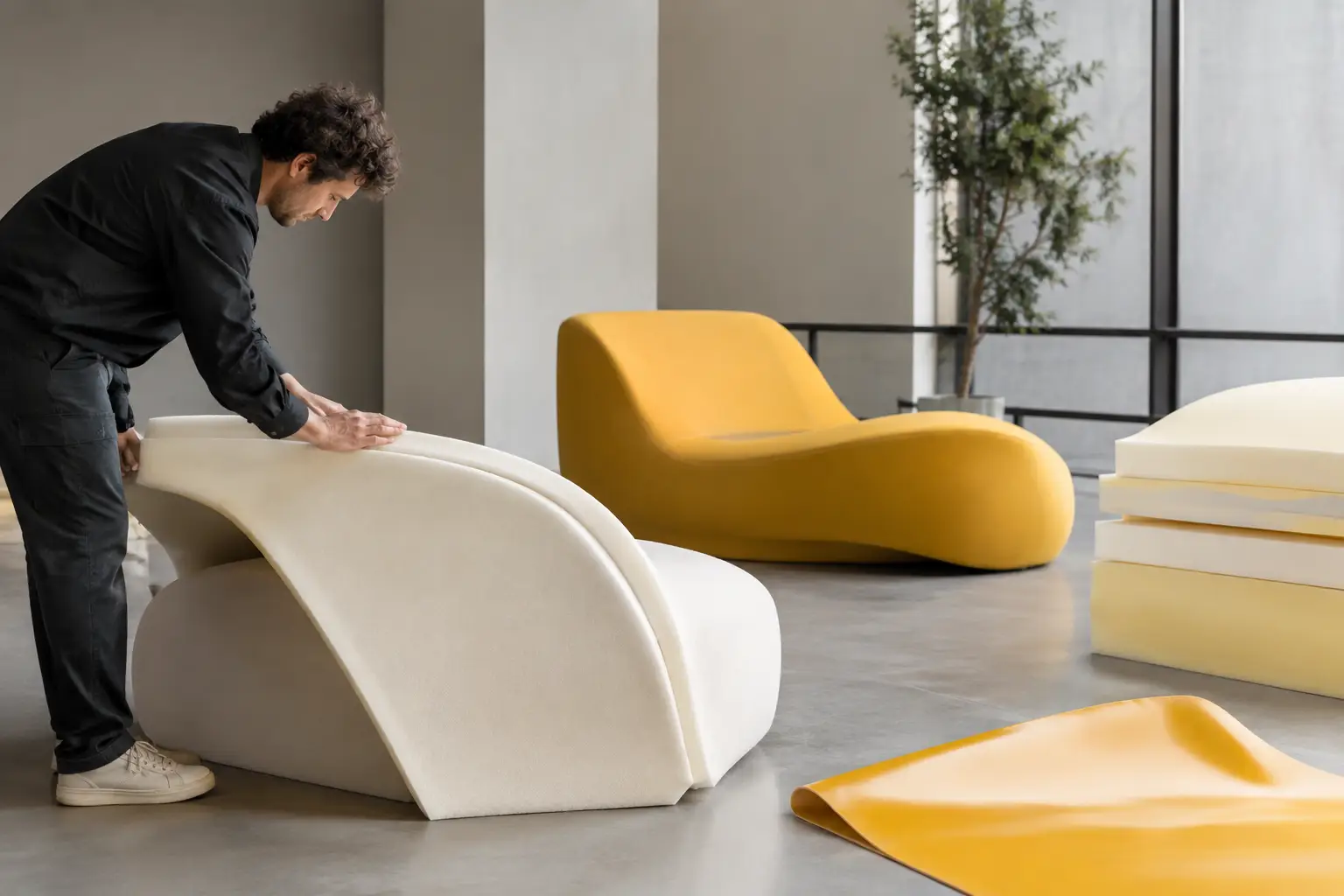
A memorable lobby bench, sculptural lounge seat, or oversized planter rarely begins with a standard product specification. The designer furniture manufacturing process begins where a concept must become a real object: stable, repeatable, comfortable, durable, and visually uncompromised. For architects and designers, the critical question is not simply whether a form can be made. It is whether it can be made well enough to perform in the setting it was designed to transform.
In design-led commercial spaces, furniture is often part of the architecture. It defines circulation, creates moments of pause, carries a brand color, or gives a public area its identity. That places much higher demands on manufacturing than a catalog item with a limited selection of fabrics and finishes. The route from sketch to installed piece requires design interpretation, material intelligence, prototyping, and disciplined production control.
From Concept to a Manufacturable Form
The first stage is not production. It is translation. A drawing, rendering, or physical model may communicate an intended silhouette, but it does not always reveal the details that determine whether the object can be fabricated and used successfully. Scale, wall thickness, internal support, access points, joining methods, drainage requirements, and expected loading all need to be resolved before manufacturing begins.
This is where design freedom becomes practical engineering. A low, continuous seating landscape may need to accommodate several people without losing its smooth profile. A freestanding sculptural element may require a concealed structure to remain stable. A planter intended for a terrace faces different requirements than the same form used in a hotel atrium. The visual idea remains central, but it must be supported by decisions that account for use, location, and longevity.
For bespoke work, a strong manufacturer does not treat technical review as a reason to flatten the design. The purpose is to identify how the original intent can survive contact with material reality. Sometimes that means adjusting an internal geometry while preserving the exterior line. Sometimes it means separating a large form into transportable sections with joints designed to disappear. The best solution depends on the project, not a generic rulebook.
Material Choice Shapes the Result
Material selection is never an afterthought in expressive furniture. It determines the tactile quality of the object, its visual weight, how it ages, and which shapes are feasible. Upholstery, timber, metal, molded plastic, fiberglass, and coated foam each offer different strengths and constraints.
Coated foam fabrication is particularly valuable when the design calls for soft volumes, continuous curves, rounded edges, or forms that would be difficult to upholster cleanly. Foam can be shaped into complex geometries, then finished with a resilient coating that creates a unified skin over the object. The result can be playful or architectural, minimal or highly graphic, depending on the color, texture, scale, and form.
That flexibility should not be confused with unlimited interchangeability. Foam density, reinforcement, coating specification, and the intended environment must work together. A quiet residential lounge and a busy airport waiting area may share a visual language, yet their performance demands are very different. Good manufacturing starts by acknowledging those differences early.
The Designer Furniture Manufacturing Process in Practice
Once the design is approved for production, fabrication moves from digital information and prototypes into carefully controlled making. At Sixinch, this process is built around the relationship between shaped foam, hand-applied coating expertise, and project-specific execution.
Building the Core Structure
The manufacturing sequence usually starts with the core. Foam components are cut, shaped, assembled, and refined to achieve the required volume. Depending on the object, internal structures or reinforcements may be introduced to support load, maintain dimensional stability, or create secure fixing points.
Precision matters at this stage because minor inconsistencies can become highly visible in a finished monolithic form. Unlike a heavily segmented upholstered sofa, a coated object has few places to conceal an uneven line or poorly resolved connection. The core has to be clean before surface work begins.
Complex pieces may also be developed as modular components. This can make an ambitious installation more practical to manufacture, ship, move through elevators, and install on site. Modularity is not simply a logistical compromise. When it is planned properly, it can preserve visual continuity while giving a project team more control over layout, replacement, and future adaptation.
Applying the Coated Finish
The coating stage gives shaped foam its distinctive finished character. Specialized handcrafted application creates a durable outer layer while retaining the soft, sculptural expression of the form beneath it. The finish can be specified in a wide spectrum of colors, helping seating, planters, and architectural elements become part of a project’s spatial palette rather than an afterthought.
This work requires judgment. An even coating is essential, but so is the treatment of edges, curves, corners, seams, and transitions between components. A finish that looks convincing under workshop lighting must also hold up visually under daylight, hospitality lighting, or the constant scrutiny of a retail environment.
Surface texture and sheen influence the perception of the object. A matte finish can make a bold volume feel calm and architectural. A more expressive color can turn the same geometry into a focal point. Specifiers should consider these decisions alongside flooring, wall materials, lighting temperature, and maintenance expectations, not after the furniture has been selected.
Quality Checks Before Delivery
Quality control is not a final glance at the completed piece. It runs through the process. Dimensions are checked against approved information, surfaces are inspected for consistency, and structural details are reviewed in relation to the object’s intended use. For custom work, sample approval and prototype assessment are especially useful because they establish a shared reference for color, scale, comfort, and finish.
This is also the point where practical project details deserve attention. Will the piece pass through the building entrance? Does it require floor fixing? Is it intended for indoor use, covered exterior areas, or full outdoor exposure? What cleaning approach is appropriate for the selected finish and setting? These questions are routine, but overlooking them can undermine an otherwise excellent design.
Why Prototyping Protects the Design
For unconventional furniture, a prototype is often the fastest route to confidence. Renderings can communicate proportion and atmosphere, but they cannot fully demonstrate comfort, tactile response, perceived scale, or the way a curved form meets the floor. A physical sample also makes color and finish decisions more reliable.
Not every project requires a full-scale prototype. For a large installation, a sectional mockup or material sample may be sufficient. For a signature seating element in a flagship hospitality space, full-scale testing may be the smarter investment. The decision depends on complexity, quantity, budget, and the cost of making changes after production has begun.
Prototyping also gives designers room to make productive refinements. A backrest may need a few more degrees of recline. A bench may look visually light but need a slightly revised base to feel stable. A color may shift under the project’s lighting scheme. These are not failures of the original concept. They are the normal, valuable work of turning an idea into an object people will use.
Specify for the Actual Environment
The strongest custom furniture specifications are clear about the context of use. A design brief should describe more than dimensions and color. It should identify the type of space, expected traffic, installation conditions, cleaning requirements, and whether the object is likely to be moved frequently or remain permanently fixed.
For hospitality, comfort and cleanability may lead the conversation. For public spaces, durability, stability, and resistance to constant use often take priority. Retail projects may place greater emphasis on brand color, quick installation, and a form that photographs with impact. Outdoor applications introduce exposure, drainage, temperature shifts, and UV considerations. There is no universal specification because there is no universal environment.
The same principle applies to customization. More options are valuable only when they serve the project. A tailored dimension, integrated logo, unusual color, or entirely new silhouette should reinforce how the space is meant to feel and function. Custom manufacturing is most effective when it is directed by a clear design purpose.
Furniture That Carries the Spatial Idea
Designer furniture earns its place in a project when it does more than occupy a footprint. It can guide movement through a lounge, soften a hard architectural shell, establish a visual rhythm across a public area, or turn a waiting zone into a deliberate experience. Manufacturing is what gives that ambition a dependable physical form.
The most successful projects bring the manufacturer into the conversation before every choice has been locked. That leaves room to protect the silhouette, select the right construction, and solve installation realities without sacrificing the element that made the concept worth building in the first place.