
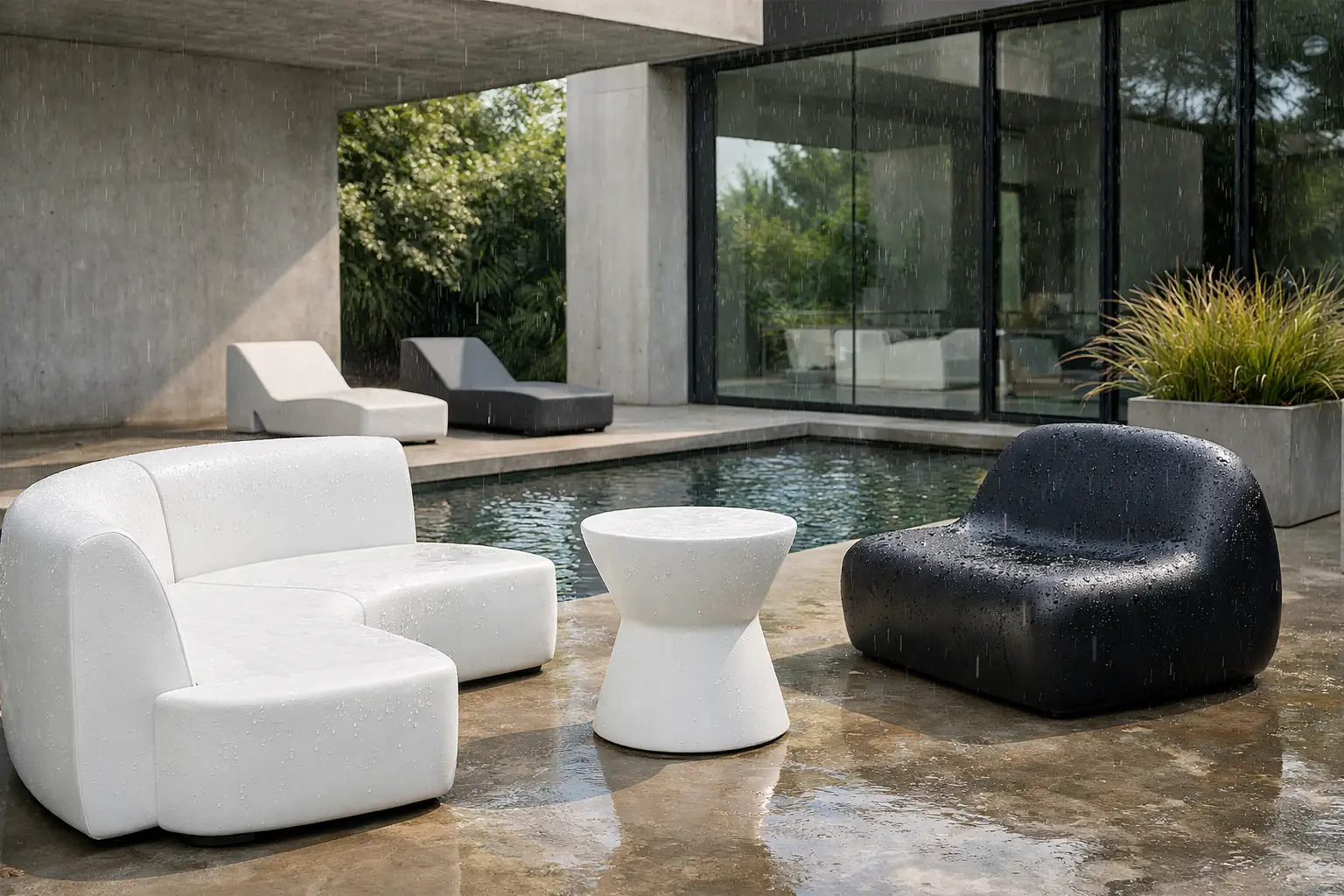
A sculptural bench on a terrace can look perfect on installation day and tired six months later if the material choice was wrong. That is why the question can outdoor foam furniture withstand weather matters less as a yes-or-no prompt and more as a specification exercise. Outdoor performance depends on what the foam is, how it is protected, where it is installed, and how precisely the piece is fabricated.
For architects, hospitality developers, and landscape designers, the real issue is not whether foam belongs outdoors in theory. It is whether a specific foam furniture system is engineered to hold its shape, resist water intrusion, tolerate UV exposure, and maintain visual impact in the conditions your project will actually face. When those variables are handled correctly, outdoor foam furniture can perform remarkably well. When they are not, failure is usually fast and visible.
Can outdoor foam furniture withstand weather in real projects?
Yes, but not all foam furniture is built for the same environment. The phrase outdoor foam furniture covers everything from basic cushion inserts inside textile covers to highly engineered coated-foam forms designed for commercial terraces, pool decks, roof gardens, and public-facing landscapes. Those are completely different product categories, and they should not be judged by the same standard. By selecting our FLEX PLUS coating – https://sixinch.eu/surface-flexplus – you are ensured ofthe correct coating for outdoor usage.
Traditional soft outdoor seating often relies on fabric covers and internal foam cores. It can be comfortable and visually light, but it is also more vulnerable to water retention, seam fatigue, mildew, and long drying times. By contrast, coated foam furniture is designed as an integrated object. The foam provides the form, while the outer coating creates a protective skin that helps the piece resist moisture, UV, abrasion, and heavy use.
That distinction matters because weather does not attack furniture in only one way. Rain is obvious, but standing water, freeze-thaw cycles, direct sun, airborne pollution, chlorine, sunscreen residue, and repeated cleaning all shape long-term performance. Outdoor furniture succeeds when the entire construction is designed around those realities, not when an indoor material is simply moved outside.
What actually determines weather resistance?
The first factor is foam density and quality. Foam that lacks structural integrity will deform, compress, or break down over time, especially in high-traffic hospitality or public settings. Outdoor use demands more than softness. It demands dimensional stability, especially when the design includes bold curves, monolithic seating volumes, or custom sculptural geometries.
The second factor is the protective surface. In coated foam furniture, the coating is not a decorative afterthought. It is the working barrier between the environment and the core material. A well-developed coating system helps resist UV degradation, repels moisture, and stands up to frequent contact. It also allows designers to specify forms that would be difficult to achieve in conventional framed furniture without sacrificing a clean, seamless visual language.
Then there is fabrication quality. Edges, transitions, joints, and drainage logic all influence durability. Water always finds weak points. If a piece includes recessed areas where rain can collect, complex geometry without proper runoff, or poorly resolved seams, weathering accelerates. Strong outdoor performance is usually a result of disciplined detailing rather than a single miracle material.
Placement matters too. A covered hospitality patio in Southern California places different demands on furniture than an exposed rooftop in Chicago or a marine environment in Florida. Sun intensity, freeze risk, and exposure to salt or chemicals all change the specification conversation. Weather resistance is never generic.
Sun, rain, and temperature shifts: the real stress test
UV exposure is often underestimated because the damage is gradual. A furniture piece may remain structurally sound while the surface loses color depth, elasticity, or visual sharpness. For design-led environments, that is still failure. In outdoor commercial projects, aesthetic endurance matters as much as physical survival.
Rain creates a different set of issues. The concern is not only whether the furniture gets wet. The concern is whether water penetrates, lingers, and compromises the material over time. A coated, closed-surface object can outperform textile-based seating simply because it minimizes absorption and dries faster. That makes a real difference in hospitality and public-space applications where furniture must return to service quickly.
Temperature fluctuation adds another layer. Materials expand, contract, harden, and soften depending on heat and cold. In climates with strong seasonal swings, outdoor foam furniture needs a construction method that can handle repeated thermal movement without cracking, splitting, or losing form. This is where engineered coating systems and controlled manufacturing become decisive.
Where outdoor foam furniture performs best
Outdoor foam furniture is especially compelling in design environments where shape matters as much as function. Think hospitality lounges, poolside zones, rooftop venues, branded outdoor activations, museum courtyards, retail landscapes, and campus gathering areas. In these settings, designers are rarely looking for furniture that disappears. They want seating that defines the space.
Foam-based fabrication allows for soft geometry, continuous volume, and custom silhouettes that feel more architectural than conventional. That opens up opportunities for integrated benches, oversized loungers, playful public objects, and sculptural seating landscapes. When those forms are paired with a weather-resistant coating system, the result can be both expressive and practical.
This is also where a specialist manufacturer has a clear advantage. A company like Sixinch does not approach foam as filler hidden inside upholstery. It treats foam as a design medium and pairs it with advanced coating expertise to create finished objects built for visual impact and real-world use.
The trade-offs designers should understand
No outdoor material is maintenance-free, and foam furniture is no exception. Even high-performing coated surfaces need cleaning, inspection, and appropriate use. If a project team expects zero upkeep in a harsh environment, the problem is usually the expectation, not the product.
There are also tactile trade-offs. Coated foam furniture delivers a distinct finish and a strong formal presence, but it does not feel like deep, sink-in upholstery. That difference can be a strength in commercial environments where crisp form, easy cleaning, and durability matter more than domestic softness. Still, it should be understood early in the design process.
Another variable is damage tolerance. A quality coating resists wear well, but sharp abuse, vandalism, or impact can still compromise the surface. In heavily exposed public settings, product selection should account for user behavior, supervision levels, and maintenance access. Good specification always includes honest thinking about how people will treat the furniture, not just how it will photograph.
How to specify outdoor foam furniture with confidence
Start by asking what kind of exposure the piece will face every day. Is it fully exposed to rain? Is it poolside? Will it sit in direct sun for eight hours? Is it used seasonally or year-round? Those questions shape everything from form development to finish selection.
Next, look at the construction as a system. Ask about the foam type, the coating technology, UV stability, water resistance, cleanability, and how the piece handles drainage. If the design includes custom geometry, make sure the shape itself supports outdoor performance. Flat horizontal surfaces and deep pockets may look minimal on paper but can create preventable water issues on site.
It is also worth considering who will maintain the furniture. A resort with a facilities team can manage regular cleaning and seasonal inspections. A public plaza with limited maintenance support may need a simpler form and a tougher specification. Good outdoor design is always tied to operational reality.
Finally, think beyond survival. The best outdoor furniture does not just endure weather. It keeps its character. It holds color, retains edge definition, and continues to support the spatial concept that justified specifying it in the first place.
So, can outdoor foam furniture withstand weather?
Yes – if it is designed, coated, and fabricated specifically for outdoor use. The material category itself is not the issue. Performance comes down to engineering, detailing, and fit for context.
For design professionals, that should be good news. It means foam furniture is not limited to indoor statements or temporary installations. With the right material intelligence behind it, it can become a durable outdoor element that brings comfort, graphic clarity, and sculptural presence to spaces that demand more than standard seating.
The strongest outdoor pieces are the ones that treat weather as part of the design brief from day one. That is where expressive form stops being a risk and starts becoming an advantage.
2 comments