
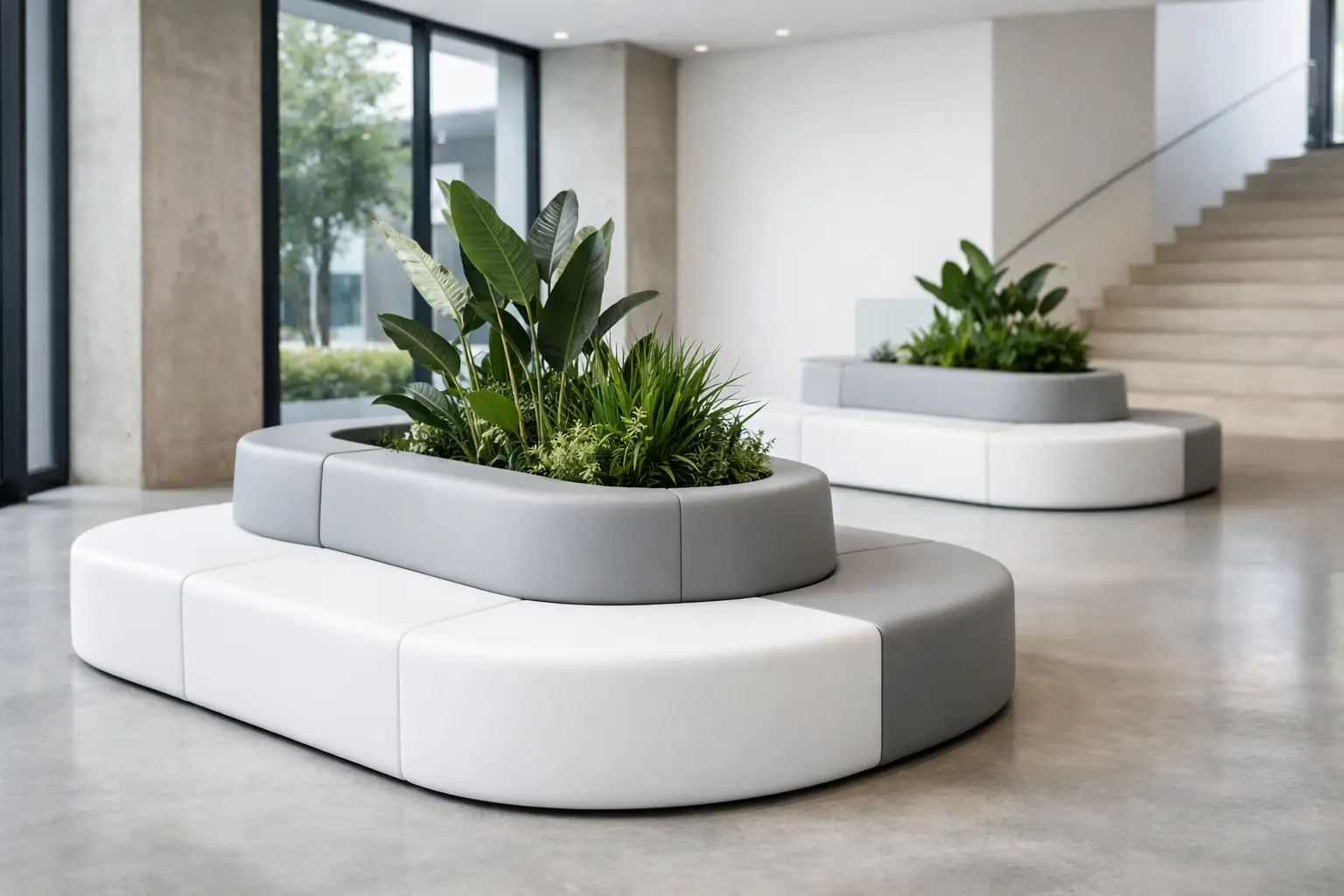
A bench that only offers a place to sit is a missed opportunity. In commercial interiors, hospitality settings, campuses, and public environments, every footprint works harder when it shapes circulation, softens scale, and introduces greenery at the same time. That is exactly why designers keep asking how to integrate seating planters without making them feel like an afterthought.
The strongest projects do not treat seating and planting as two separate layers forced together late in the process. They treat them as one spatial element from the start – part furniture, part landscape, part architecture. When that happens, seating planters can define zones, create privacy, guide movement, support brand expression, and bring a sculptural quality that loose furniture rarely achieves.
How to Integrate Seating Planters From the Start
The first decision is not form. It is function. Before sketching a curved bench wrapped around a planter or a modular island with integrated greenery, clarify what the piece needs to do in the space. In a hotel lobby, it may need to create semi-private waiting moments without closing off sightlines. In a retail environment, it may need to slow traffic and frame product storytelling. In an outdoor plaza, it may need to absorb heavy use while introducing softness into a hardscape.
That functional brief changes the geometry. If the priority is circulation, a long linear seating planter can act as a guide rail that subtly directs movement. If the goal is dwell time, broader seating edges and more generous planter mass tend to make the piece feel anchored and inviting. If privacy matters, planter height becomes a spatial tool, but that always comes with a trade-off. Taller planting creates screening, yet it can also reduce openness and visibility, especially in compact interiors.
Designers often get better results when they think in section as much as in plan. The relationship between seat height, planter depth, soil volume, drainage strategy, and planting height determines whether the object feels elegant or awkward. A clean silhouette may look effortless, but it depends on technical discipline.
Think of Seating Planters as Spatial Infrastructure
When integrated well, these elements do more than decorate. They organize experience. A seating planter can separate lounge and circulation zones without erecting walls. It can form a threshold in a hospitality project, mark collaborative pockets in a workplace, or create edges in a large atrium that otherwise feels too open.
This is where custom fabrication becomes especially valuable. Standard benches and standard planters placed side by side often read as temporary. A single integrated form has more authority. It can follow an architectural curve, respond to a branded geometry, or scale precisely to a difficult footprint. For specifiers working on expressive commercial projects, that difference matters. The object becomes part of the architecture rather than furniture filling a gap.
There is also a visual discipline to integrated solutions. Fewer disconnected parts means fewer competing lines, materials, and junctions. That simplification can make bold spaces feel more resolved, not less dynamic.
Placement Matters More Than Quantity
One well-positioned seating planter will outperform a cluster of scattered pieces. The question is where it can do the most work.
At entries, integrated planter seating can slow the threshold and create a moment of arrival. In large open interiors, it can break scale and create legible subzones. Along circulation routes, it can offer short-stay seating without interrupting flow, but only if the depth is carefully controlled. Oversized units in narrow passages become obstacles quickly.
In social environments, placing planter seating at the edge of activity usually works better than dropping it in the center. People tend to occupy a seat more comfortably when they have a sense of backing or enclosure, even if that enclosure comes from planting rather than a wall. That is especially useful in airports, education spaces, mixed-use lobbies, and cultural venues where people want both visibility and a modest sense of refuge.
Shape Should Follow Use, Not Trend
Organic forms are compelling, but they are not automatically functional. A sweeping sculptural planter bench may look dramatic in renderings, yet if the seat edge is too narrow, too sloped, or broken into unusable segments, it fails in use.
For high-traffic projects, clean geometries often support better occupancy. Straight runs, gentle arcs, and clear seat zones make behavior intuitive. More expressive silhouettes can absolutely work, but they need ergonomic discipline. Designers should test where people actually sit, where bags are likely to land, and where planting may interfere with comfort.
This is one of the most common mistakes in projects centered on visual impact. If every curve serves the image and none serve the body, the object becomes scenery. The best seating planters hold both.
Material Choices Affect More Than Appearance
If you are working out how to integrate seating planters in demanding environments, material specification cannot be an afterthought. Integrated pieces face a mixed performance brief. The seating surface must handle repeated contact, cleaning, and abrasion. The planter zone must support moisture management, planting requirements, and in some cases exterior exposure.
That means the formal ambition of the piece has to align with a realistic understanding of use. In hospitality and public projects, low-maintenance surfaces are usually more valuable than delicate finishes that require constant correction. If the design language calls for saturated color, monolithic form, or soft-edged geometry, the manufacturing method needs to support those choices without sacrificing durability.
This is where coated, sculptural fabrication can open more freedom than rigid, conventional assemblies. It allows designers to work with volume, rounded profiles, integrated transitions, and custom dimensions while still producing a finish appropriate for commercial use. Sixinch approaches this territory as a fabrication partner for projects that want furniture and architectural elements to behave as one designed object.
Still, material freedom does not remove the need for practical detailing. If the planter contains live planting, internal waterproofing, drainage, access for maintenance, and load considerations need to be solved early. A beautiful integrated form can fail quickly if irrigation leaks into the seating structure or if planting maintenance requires awkward disassembly.
Planting Strategy Is Part of the Design Language
Not every seating planter needs lush, overflowing greenery. Plant selection should match the concept, maintenance model, and light conditions.
In minimalist interiors, structured planting can reinforce architectural clarity. In hospitality settings, softer planting can make large spaces feel more relaxed and layered. Outdoors, resilient species with predictable growth habits often outperform visually ambitious planting schemes that become unruly or expensive to maintain.
There is an aesthetic trade-off here too. Dense planting creates immediacy and softness, but it can obscure the sculptural form of the furniture. Sparse planting reveals the object more clearly, though it may reduce the biophilic effect some clients want. The right balance depends on what the project is trying to say.
For branded environments, planting can also support color and identity without resorting to overt graphics. A bold monolithic seating planter in a signature hue paired with disciplined greenery can carry more presence than multiple decorative gestures competing for attention.
Design for Maintenance, Not Just Installation
The specification is only successful if the piece still looks intentional after months of use. That sounds obvious, but many integrated seating planters are designed for the handover photo, not for real operation.
Maintenance access should be simple. Can staff reach the planting easily? Is there a clean way to remove liners or manage irrigation? Will the seating surface show dirt immediately? Are the edges resilient enough for luggage, carts, or frequent impact in public settings?
For interior commercial environments, cleaning teams and facilities managers will quietly determine whether the piece remains an asset or becomes a problem. Designers who anticipate that reality tend to get more ambitious forms approved, because they can show that the object is not only striking but operationally sound.
It is also worth considering replacement cycles. In some projects, planting is seasonal or refreshed regularly. In others, long-term stability matters more than visual variation. That affects planter depth, access, and the level of horticultural complexity the design can realistically support.
Where Seating Planters Deliver the Most Impact
Some typologies benefit more than others. Hospitality projects gain from the way integrated planter seating can create intimate zones within large open plans. Retail environments use it to choreograph movement and offer pause points without cluttering the floor. Education, workplace, and civic interiors benefit from furniture that encourages informal gathering while reducing the hardness of built space.
Outdoor applications are equally compelling, especially where fixed elements need to balance durability with identity. In plazas, terraces, and mixed-use developments, integrated seating planters can make landscape infrastructure feel more intentional and less generic. They can also reduce the visual noise that comes from layering separate benches, barriers, and pots.
The strongest results come when the piece is scaled to the architecture. Too small, and it reads as accessory. Too large, and it overwhelms movement. The right proportion makes it feel inevitable, as though the space was always meant to have this element.
A well-designed seating planter does not simply add seats and plants. It gives form to how people arrive, pause, gather, and move. That is the real opportunity – not decorating a space with greenery, but shaping experience with an object that earns its footprint from every angle.