
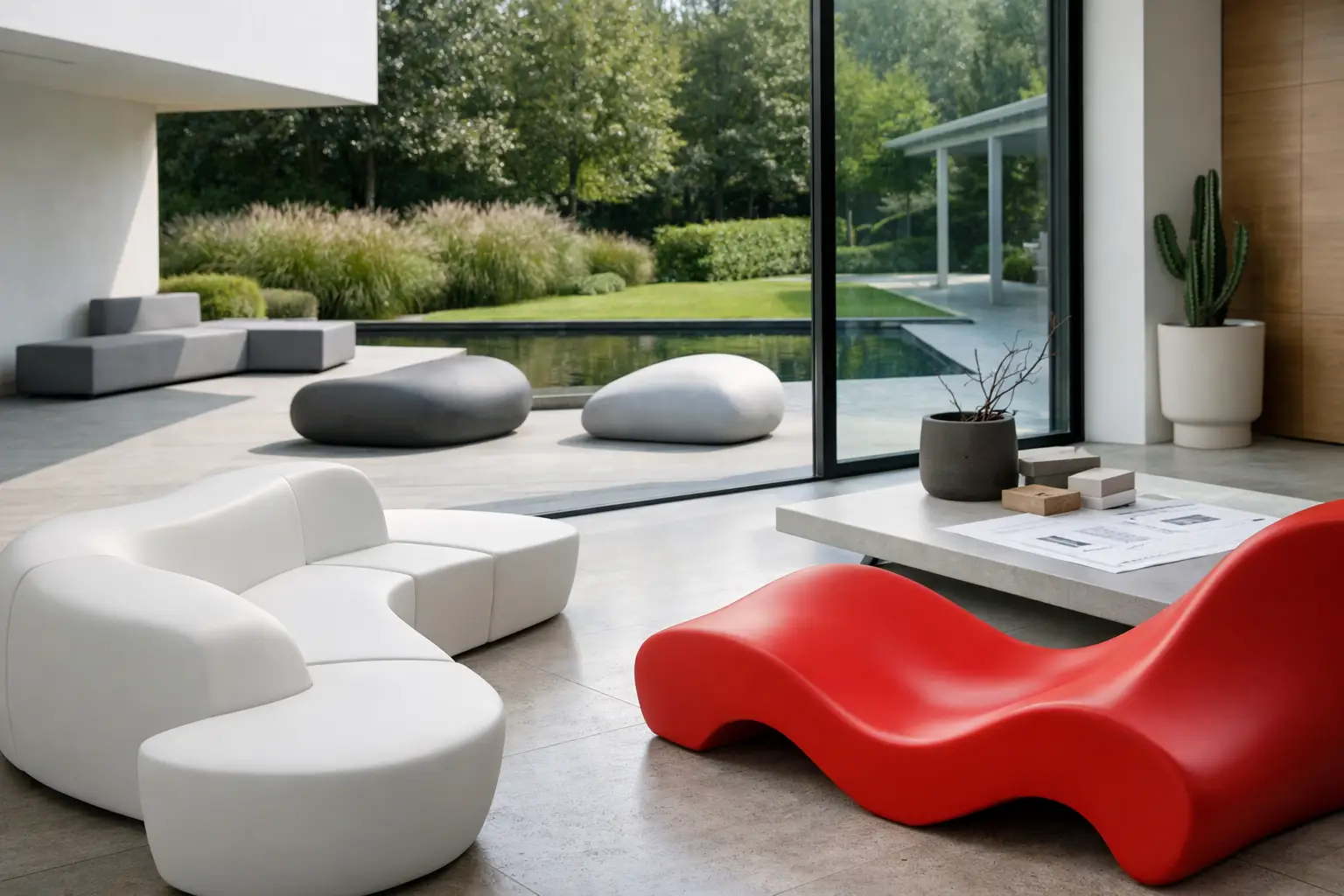
A custom outdoor bench can do far more than provide a place to sit. It can define circulation through a plaza, extend a hospitality brand into a terrace, turn a rooftop into a destination, or give a public realm project its visual signature. Knowing how to commission bespoke landscape furniture means translating that ambition into a brief a fabricator can engineer, test, and produce without flattening the original idea.
For architects, landscape designers, and specifiers, the commission is not simply a matter of selecting a shape and color. Outdoor furniture must perform under weather, frequent use, maintenance routines, accessibility requirements, and site-specific constraints. The strongest results come from treating the object as part of the landscape architecture from the first sketch.
Start With the Site, Not the Object
Bespoke furniture should answer a real condition in the landscape. Before discussing forms, establish what the piece must do and where it will live. A sculptural lounge element beside a pool faces a different set of demands than modular seating in a university courtyard or a curved planter-bench at the entrance to a retail destination.
Review the site in practical terms. Consider sun exposure through the day, prevailing wind, drainage patterns, salt air, freeze-thaw cycles, foot traffic, and the likelihood of food, drinks, or skateboards meeting the surface. A shaded garden may prioritize comfort and tactile warmth. An exposed public terrace may require ballast, anchoring, and a surface that can be cleaned quickly between events.
Also consider what is beneath and around the furniture. Is the paving capable of carrying the load? Are there waterproofing membranes below a roof deck? Will an irrigation line, electrical conduit, or mature tree root system limit fixing locations? A furniture concept can be visually compelling and still fail as a project solution if installation has not been considered early.
Write a Brief That Gives Design Freedom Direction
The best custom briefs are specific about performance and open about form. Rather than prescribing every radius before the maker has assessed the construction, define the spatial role, visual intent, dimensions, user group, and non-negotiable requirements.
A useful brief explains whether the furniture should invite solitary pauses, social gathering, informal work, play, or circulation. Include expected occupancy, desired seat heights, accessibility needs, and whether users may perch, recline, or gather around it. In a commercial setting, clarify peak use and operational realities. A hotel may need movable pieces for events, while an airport lounge may prioritize integrated power, fixed positioning, and a high level of resistance to wear.
Visual references are valuable, but they should communicate a design language rather than demand a direct copy of an unsuitable precedent. Share mood imagery, palette direction, site drawings, material samples, and the broader architectural concept. For a branded environment, provide the identity guidelines and explain how boldly the furniture should express them.
At this stage, identify your priorities. If a single continuous, highly sculptural form is central to the concept, say so. If budget, shipping access, or phased installation is more important, make that clear as well. Bespoke production works best when the design team and fabricator can make intelligent trade-offs instead of discovering constraints after the form is locked.
Include the information a fabricator needs
Provide plans, elevations, critical dimensions, photographs of access routes, and a target installation date. For larger pieces, the route from production to final position matters as much as the final footprint. Doorways, elevators, gates, crane access, loading restrictions, and site storage can determine whether a form must be sectional.
State the project location and expected environmental exposure. Ask for a proposed approach to drainage, ground contact, anchoring, and joints. These details are where bespoke furniture becomes genuinely project-ready rather than merely photogenic.
Choose Materials for Exposure and Experience
Outdoor material selection is never only aesthetic. It is a balance between color, tactility, maintenance, longevity, fabrication possibilities, and local climate. A hard mineral surface may feel appropriate for a civic plaza, while a coated foam construction can bring softness, organic volume, and unexpected sculptural freedom to a rooftop lounge or hospitality terrace.
For design-led landscape furniture, foam cores with specialized protective coatings offer particular advantages when the concept calls for rounded profiles, oversized geometry, integrated backrests, or monolithic forms that would be difficult to achieve with conventional joinery. The coating system, surface texture, and edge treatment should be selected according to the intended use. A smooth finish creates a crisp, graphic appearance but may reveal abrasion differently from a textured surface. A more tactile finish can better support a relaxed outdoor setting and disguise minor marks.
Ask direct questions about ultraviolet stability, water management, thermal movement, scratch resistance, stain removal, and repairability. No outdoor material is maintenance-free. The issue is whether the maintenance expectation is realistic for the operator. A private garden can accommodate a more delicate finish than a heavily used public environment with a limited facilities team.
Color deserves the same rigor. Dark colors can become uncomfortably hot in direct sun, while pale shades may show urban grime more quickly. Saturated colors can create an unforgettable spatial marker, but should be specified with awareness of fading, cleaning products, and the way the surrounding planting changes across seasons. Request samples and assess them outdoors, not only under studio lighting.
Design for Human Use, Not Just the Rendering
Landscape furniture is experienced physically and repeatedly. A beautifully modeled curve must still support a comfortable posture. Test seat height, depth, back angle, and the transition from seat to planter or paving. In social spaces, think about how groups naturally gather. A long linear bench supports flexible occupancy; a circular composition encourages conversation; split-level forms can create informal zones without adding visual clutter.
Accessibility should be designed into the composition rather than added afterward. Include portions with suitable transfer heights, arm or back support where appropriate, clear routes around the furniture, and spaces for wheelchair users within the social arrangement. The exact requirements depend on the project type and jurisdiction, but the design intent should be inclusive from the outset.
Scale is equally important. A small sculptural element may disappear against a large facade, while an oversized piece can overwhelm a planted courtyard. Use a plan view and human-scale elevations to examine the object from typical approach routes. For complex forms, a physical mockup or a taped floor layout can reveal issues that a rendering will not.
Develop the Concept With the Fabricator
A bespoke manufacturer should be involved while there is still room to improve the concept. Early technical dialogue can clarify minimum radii, feasible overhangs, hidden structural support, division lines, anchoring points, and how a color or texture will behave across a large form.
This is not a retreat from creative intent. It is the stage where the concept gains the intelligence to survive fabrication, transport, installation, and daily use. Sixinch approaches custom work through this intersection of sculptural design and specialized coated-foam fabrication, helping teams preserve the expressive qualities that made the idea worth pursuing.
Expect a progression from concept drawings to technical proposals, finish samples, and shop drawings. Review dimensions against the architectural set, not in isolation. Confirm clearances for doors, planting beds, handrails, drainage grates, and nearby furniture. If the design incorporates planters, lighting, signage, or power, coordinate every interface before production begins.
For ambitious pieces, prototyping is often worth the time. A sample can establish the desired surface texture and color. A full-scale section can test ergonomics, joint alignment, and visual mass. The expense is modest compared with correcting a finished installation that is uncomfortable, difficult to place, or inconsistent with the approved design language.
Plan for Fabrication, Delivery, and Installation
Many custom commissions lose momentum because delivery is treated as an administrative detail. Build a realistic program that includes design development, sample approval, production, quality review, shipping, site readiness, and installation. Lead times vary according to complexity, quantity, finish, and production scheduling, so do not set an opening date before discussing it with the manufacturer.
Decide who is responsible for unloading, positioning, anchoring, and final protection. Confirm whether components arrive fully assembled or in sections, and establish the sequence of installation relative to paving, planting, glazing, and other trades. A finished surface can be damaged quickly if it is installed before heavy work has cleared the site.
Prepare an operations plan before handover. It should identify approved cleaning methods, stain response, inspection intervals, and the contact process for repairs. Outdoor furniture earns its value over years of use, not on installation day.
A Better Starting Point for a Memorable Outdoor Space
The most successful commissions give a space a purpose people can feel: a place to meet, wait, rest, gather, or simply notice. Bring a clear understanding of the site and a bold point of view, then allow material expertise and fabrication logic to sharpen the idea. That is how a bespoke piece becomes more than outdoor furniture – it becomes part of the identity of the landscape.