
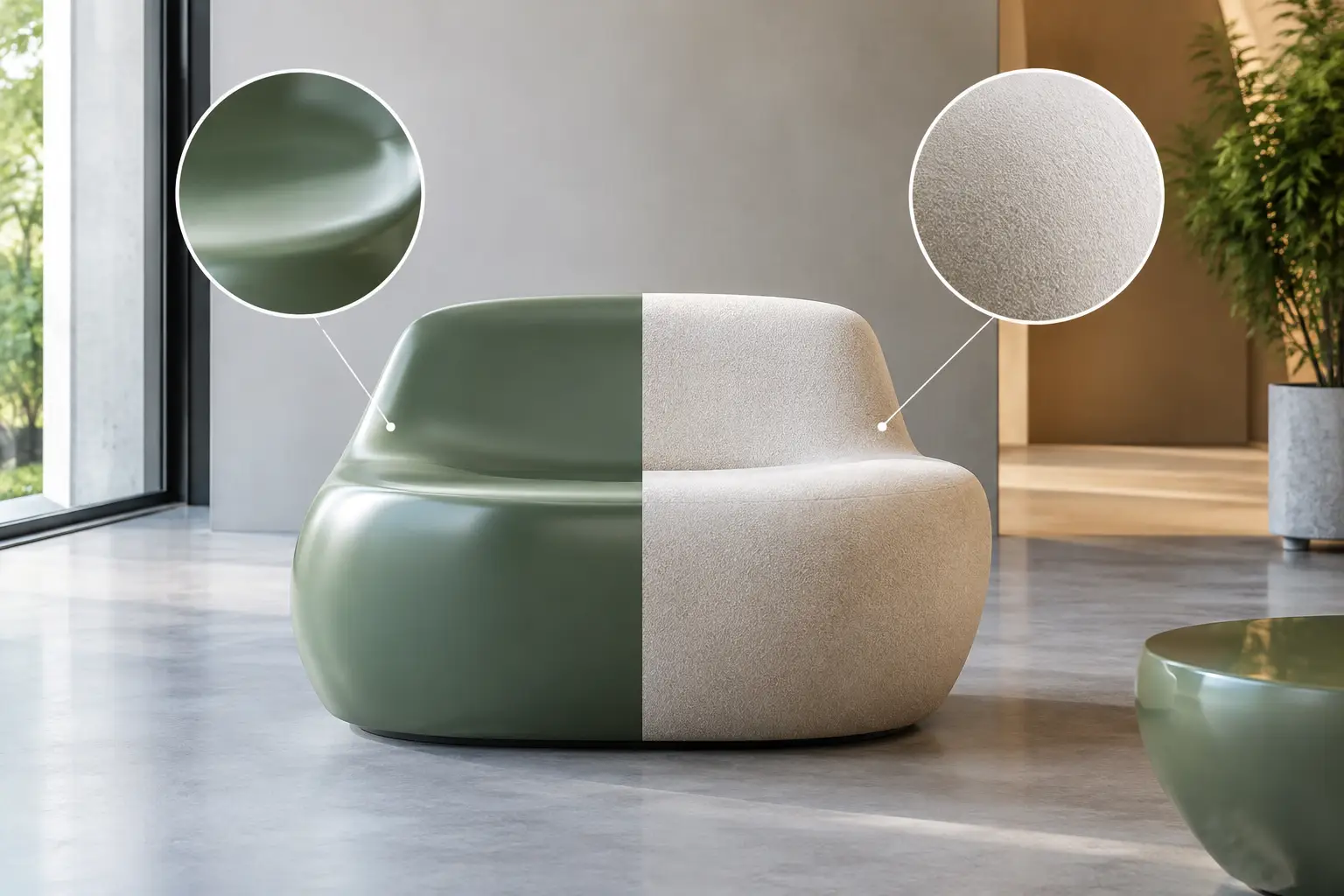
A lobby banquette can look exceptional on opening day and become a maintenance problem six months later. That is why polyurethane versus fabric upholstery is not a simple question of appearance. For hospitality, workplace, retail, education, and public-space projects, the right finish must support the intended visual language while standing up to the way people actually use the space.
Fabric brings softness, texture, and a familiar residential quality. Polyurethane can create a more graphic, continuous surface with strong cleaning performance and a distinctly contemporary character. Neither is universally better. The strongest specification starts with the form, traffic level, cleaning protocol, and sensory experience the project needs to deliver.
Polyurethane Versus Fabric Upholstery: The Core Difference
Fabric upholstery is a textile applied over foam, padding, and a furniture frame or substrate. It may be woven, knit, velvet, bouclé, performance textile, or a technical indoor-outdoor material. Its character comes from fiber, weave, pile, color, and pattern. Fabric can make even a large-scale seating installation feel warm, layered, and acoustically soft.
Polyurethane upholstery usually refers to a synthetic surface designed to resemble leather or provide a smooth, wipeable finish. Its performance depends on the specific construction, backing, thickness, protective topcoat, and manufacturing quality. It should not be treated as one uniform material category. A polyurethane-coated foam object is a different proposition again: the coating becomes an integral finish over a sculpted foam form, allowing soft geometry and continuous surfaces that conventional upholstered construction may not achieve as cleanly.
For design teams, that distinction matters. A conventional textile is often chosen to add tactile variation to a seating composition. A polyurethane finish is often chosen to sharpen the silhouette, simplify maintenance, or support a more monolithic design statement.
Start With the Space, Not the Swatch
The most expensive mistake is selecting a material from a sample board before defining the conditions around it. A quiet executive lounge, a hotel breakfast area, a children’s discovery zone, and a transit-adjacent waiting space can all require seating, but they place radically different demands on it.
Consider how frequently the piece will be touched, sat on, moved, cleaned, and exposed to food, beverages, bags, and outerwear. Also consider where it sits. Direct sunlight, humid pool environments, outdoor exposure, and heavy use near entrances all change the specification conversation. The material that feels perfect in a controlled showroom may not be the right one for a high-turnover venue.
Design intent matters just as much. If the concept depends on rich layering, a subtle pattern, or an intimate domestic mood, fabric may be essential. If the concept calls for a bold color field, sculptural seating island, or a branded object with uninterrupted visual impact, polyurethane can provide greater clarity.
Where Polyurethane Performs Best
Polyurethane is compelling when operational realities are as important as the visual concept. Smooth, nonporous or low-porosity finishes are generally easier to wipe down than textured textiles, making them practical for spaces with routine cleaning requirements. For cafés, family-oriented venues, clinical-adjacent waiting areas, and active public interiors, that advantage can be decisive.
It also supports a precise visual expression. A smooth finish allows color to read with intensity, especially across curved forms, integrated backs, and generous volumes. Instead of breaking a design into cushions, seams, and tailored panels, a coated foam approach can preserve the original gesture of the object. Curves remain curves. Oversized forms remain legible from every angle.
This makes polyurethane especially suitable for statement seating, playful public furniture, branded activations, and unconventional architectural elements. It can turn an ordinary waiting zone into an identifiable destination rather than a collection of standard products.
However, wipeability does not mean indestructibility. Sharp objects, aggressive cleaners, prolonged UV exposure, and misuse can damage a polyurethane surface. Specify cleaning agents approved for the exact finish, request performance documentation, and plan placement carefully. In a demanding project, material selection must be matched by realistic maintenance guidance.
Comfort Is More Than Surface Feel
Some teams assume fabric is automatically more comfortable. Fabric often feels warmer and more breathable to the touch, particularly during extended sitting. That can be an advantage in lounges, guest rooms, libraries, and residential-inspired settings.
Yet comfort is primarily shaped by ergonomics, foam density, suspension, seat depth, back angle, and the relationship between the body and the form. A well-designed polyurethane-coated seat can be highly inviting, particularly for shorter dwell times or informal social seating. The surface feel is one component of comfort, not the entire experience.
When Fabric Upholstery Is the Better Choice
Fabric excels when atmosphere is the priority. It can absorb light rather than reflect it, creating visual depth across expansive seating. A woven textile may soften the scale of a large sofa, while velvet can bring a theatrical quality to a hospitality lounge. The range of textures and patterns gives designers substantial control over mood.
Textiles also offer useful acoustic benefits. While furniture alone will not solve a difficult acoustic environment, upholstered fabric surfaces can contribute to a less hard, less reverberant room than smooth coated surfaces. In restaurants, workplace lounges, libraries, and collaborative areas, that softer sensory profile can support the wider interior strategy.
The trade-off is maintenance. Fabric can trap dust, hold spills, pill, snag, or show wear depending on its construction and color. Performance textiles improve stain resistance and cleanability, but they still require care procedures that differ from a simple wipe-down surface. For projects with high traffic, ask for abrasion data, cleaning instructions, colorfastness information, and realistic samples tested against anticipated use.
A deep, textured fabric may hide minor wear beautifully. A pale, tightly woven textile may reveal every mark. Material choice is never just fabric versus polyurethane. It is the specific finish, in the specific color, used in the specific environment.
Form, Seams, and Design Freedom
The construction method behind a piece often determines what is possible visually. Conventional fabric upholstery relies on panels, seams, tailored corners, and carefully managed tension. Those details can be beautiful and intentional, but they also influence the final geometry. Extremely organic or exaggerated forms may need visual compromises to remain upholsterable.
Polyurethane-coated foam opens a different design path. It can support rounded, inflated, faceted, or highly sculptural volumes with fewer visual interruptions. This is valuable when furniture must also act as an architectural gesture, a wayfinding device, or a branded centerpiece. Rather than placing furniture within an environment, the object can help define the environment itself.
That freedom should be used with discipline. Complex form still needs stable engineering, appropriate internal support, safe edges, and suitable scale. The best custom pieces are not simply unusual. They are designed to perform, manufactured with precision, and detailed for the people who will encounter them every day.
Specify by Performance Criteria
For professional projects, a material decision should be documented through criteria rather than aesthetic preference alone. Ask how the finish responds to cleaning chemicals, abrasion, UV exposure, staining, flexing, and the relevant fire requirements for the application. Request finish samples large enough to judge color, texture, seams, and reflectivity under the project’s lighting.
Prototype review is especially valuable for custom work. A small swatch cannot reveal how a material will behave across a large radius, a sharp curve, or an integrated seating landscape. It also cannot show where bodies will create wear patterns over time. Reviewing the intended form early allows designers, fabricators, and clients to make smart adjustments before production.
Sixinch approaches this question as both a design and fabrication challenge. The material is not an afterthought applied to a finished idea. It is part of the process that determines how a concept can be shaped, colored, detailed, and built for its intended setting.
The Better Choice Is the One That Supports the Experience
Choose polyurethane when the project needs sculptural continuity, bold color, straightforward surface cleaning, and a strong visual identity. Choose fabric when tactile warmth, texture, acoustic softness, and an inviting layered atmosphere are central to the brief. In many interiors, using both is the most intelligent answer: polyurethane for high-contact feature elements and fabric for longer-stay comfort zones.
The material should never dilute the original design idea. Specify the finish that lets the object look intentional after thousands of interactions, not only under perfect lighting on installation day.