
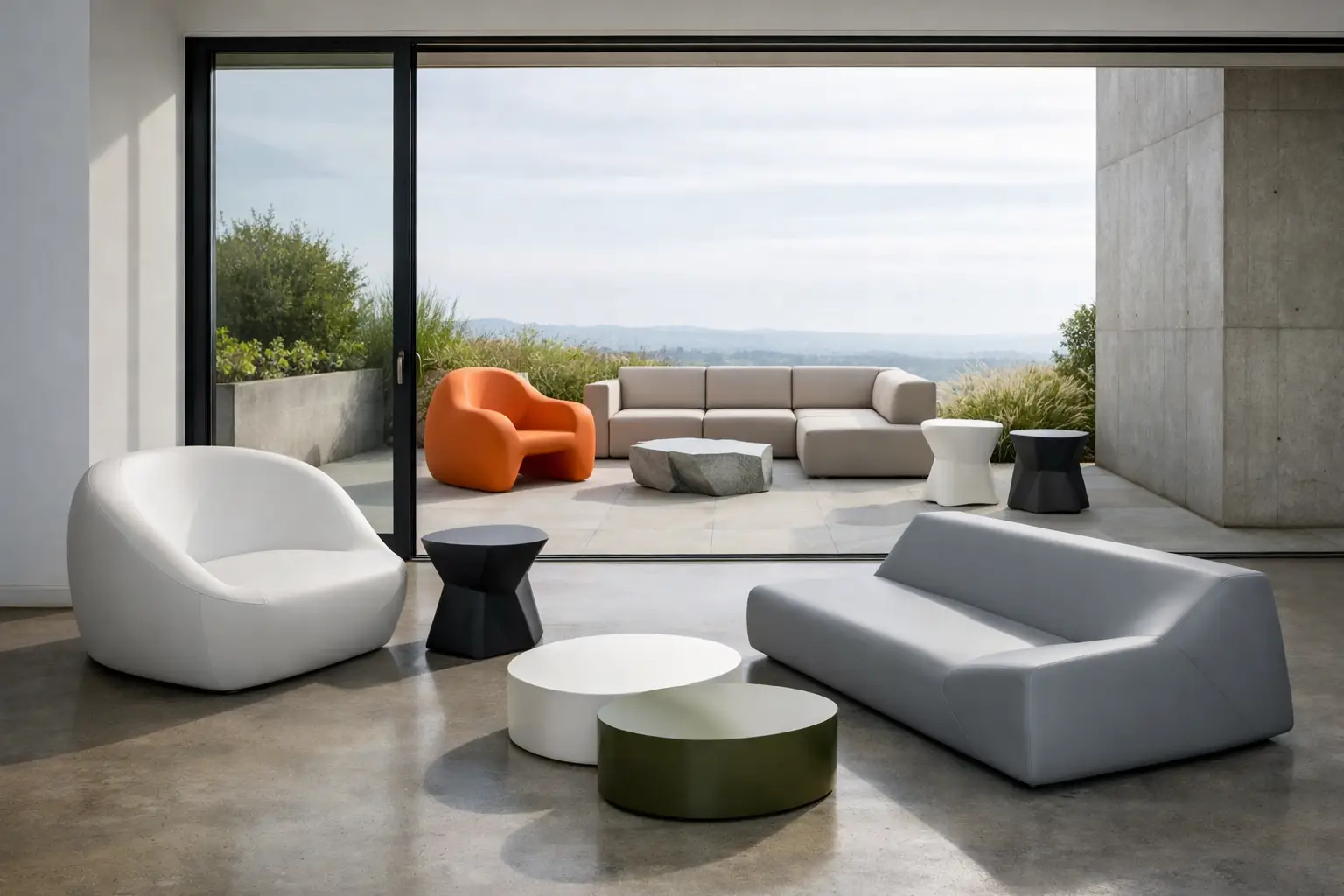
A lounge that looks perfect on a concept board can fail fast once it faces UV, rain, sanitizer, heavy traffic, and constant rearranging. That is why an indoor outdoor furniture materials comparison matters early in the design process, not after forms are approved and finishes are sampled. For architects, interior designers, and specifiers, the real question is not which material is best in the abstract. It is which material can carry the design intent, meet the performance brief, and still feel visually sharp after years of use.
The strongest specifications start by treating material as part of the design language. Surface feel, edge definition, weight, maintenance, weathering, and fabrication freedom all shape the final result. A sculptural hospitality bench, a rooftop lounge cluster, and a public-space planter-seat hybrid may all sit in the same project family, but they do not ask the same things from their materials.
Indoor outdoor furniture materials comparison by design intent
Most material roundups stop at general pros and cons. That is useful, but it is not enough for commercial and design-led environments. A more relevant indoor outdoor furniture materials comparison looks at how materials behave when the concept is ambitious – curved forms, integrated branding, unusual dimensions, or mixed-use placement from interior lounges to exterior terraces.
Wood, metal, plastic, stone, and coated foam each solve different design problems. Some bring structural clarity. Some deliver warmth. Some are easy to clean but visually generic. Others open up forms that would be difficult or expensive in conventional fabrication. The best choice depends on whether your priority is visual softness, custom geometry, weather resistance, vandal resistance, low weight, or a highly controlled finish.
Coated foam
For projects that need bold form without visual heaviness, coated foam occupies a distinct category. It allows rounded volumes, monolithic shapes, integrated seating elements, and custom pieces that feel more architectural than assembled. That matters in branded interiors, public lounges, retail concepts, and hospitality spaces where furniture needs to contribute to the spatial identity rather than simply fill it.
Its strength is design freedom. Complex curves, soft silhouettes, seamless volumes, and custom dimensions are far more achievable than with many rigid materials. A specialized coating creates a skin that is durable, easy to maintain, and suitable for indoor and outdoor applications when properly specified. This gives designers an unusual combination: comfort, shape flexibility, and a clean finished surface.
The trade-off is that coated foam should be specified with a clear understanding of use conditions. It is excellent for design-led commercial settings, but the performance target should match the application. A quiet hotel terrace, a museum lounge, and a high-abuse transit environment do not place the same demands on a piece. When the manufacturer controls both shaping and coating expertise, the result is far more reliable than treating form and finish as separate decisions.
Metal
Metal remains a default choice for outdoor and mixed-use furniture because it is structurally efficient and visually precise. Powder-coated aluminum works well where corrosion resistance and lower weight matter. Steel offers strength and a sharper industrial presence, though it usually requires more attention to coatings and environmental exposure.
For minimalist schemes, metal can be the right answer. It reads clean, performs well, and suits repeated production. But it also has limitations. It tends to produce harder visual and physical ergonomics unless combined with cushions or secondary materials. In sun-heavy climates, exposed metal surfaces can become uncomfortable to touch. Custom organic forms are possible, but often at a fabrication cost that pushes the project toward standard geometries.
Wood
Wood brings warmth that few materials can match. In hospitality, wellness, and landscape projects, that natural character can soften large architectural settings and make outdoor spaces feel more inviting. Teak and other durable species have a strong track record outdoors, while thermally modified woods can offer better stability than untreated options.
The challenge is weathering and maintenance. Some clients love the silvered patina that develops over time. Others want the original tone preserved, which requires a maintenance commitment many commercial operators underestimate. Wood also introduces movement, variation, and aging that can be beautiful in the right concept but problematic when a very controlled aesthetic is required.
Plastic and polymer-based materials
Molded plastics and polymer composites score well on practicality. They are often lightweight, easy to clean, and available in many colors. For large rollouts, casual settings, and budget-sensitive outdoor areas, they can be efficient.
Their limitation is often design presence. Even when performance is acceptable, many plastic furniture pieces read as standardized rather than site-specific. That is not always a flaw, but it matters in premium environments. If the space depends on material richness, sculptural identity, or custom integration, standard plastic products may feel visually flat.
Stone and concrete
Stone and concrete communicate permanence. They work well in civic, landscape, and public-space settings where weight, durability, and a strong architectural feel are advantages. They also resist wind movement and can hold up under serious use.
But they are heavy in every sense. Transport, installation, structural loading, and repositioning all become more complex. Ergonomics are another consideration. Without added softness or careful shaping, these materials can feel severe. They excel when monumentality is the point, but not every project benefits from that visual mass.
What matters most in an indoor outdoor furniture materials comparison
The right comparison framework goes beyond appearance. Designers need to evaluate how a material behaves across the whole lifecycle of a project.
Durability is the obvious starting point, but durability means different things in different settings. Outdoor exposure brings UV, moisture, freeze-thaw cycles, and temperature shifts. Interior public spaces may be protected from weather but face constant abrasion, spills, impact, and cleaning chemicals. A material that performs beautifully in a private terrace may not survive a busy airport lounge or poolside hospitality zone.
Maintenance should be treated as part of the specification, not an afterthought. Some materials age attractively with minimal intervention. Others only stay visually consistent with regular upkeep. For operators, this distinction affects staffing, budget, and guest perception. A material that looks premium on day one but deteriorates unevenly under routine cleaning can undermine the whole environment.
Weight and mobility also matter more than they first appear. Rooftops, terraces, event spaces, and flexible commercial interiors often need furniture that can be moved without special equipment. Stone and concrete offer stability but resist change. Aluminum is easy to handle but can feel less substantial. Coated foam can strike a useful balance where lower weight and strong visual volume are both desirable.
There is also the issue of formal freedom. If the concept calls for simple chairs and tables, many materials can work. If the brief includes integrated planters, oversized seating islands, branded sculptural pieces, or custom modules that move between indoors and outdoors, the field narrows quickly. This is where fabrication method matters as much as raw material.
Matching material to project type
Hospitality projects usually require a careful balance of impact and upkeep. Guests notice shape, comfort, and finish immediately, while operators notice cleanability and lifespan. Materials that can deliver a signature look without introducing fragile detailing often perform best.
Public and civic spaces place more pressure on resilience, anchoring, and ease of maintenance. Here, heavier or more abuse-tolerant materials may be appropriate, though there is still room for expressive form when the fabrication approach is right.
Retail and branded environments often prioritize identity first. Furniture becomes part of the storytelling. In these settings, the ability to produce custom shapes, exact colors, and memorable forms can outweigh the appeal of off-the-shelf material choices.
Landscape projects introduce another layer: sun exposure, drainage, surrounding hardscape, and seasonal use. Materials need to sit convincingly within the architecture and planting design, not compete with them.
The smartest material choice is rarely the safest one
Standard materials feel low-risk because everyone knows them. But safe choices can flatten a strong concept. The better question is whether the material can support both performance and distinction. If a piece needs to be iconic, tactile, weather-ready, and genuinely custom, conventional categories may not be enough.
That is where specialized manufacturing becomes part of the design strategy. Sixinch, for example, approaches furniture as a fabrication opportunity rather than a fixed catalog limitation, which is exactly what many architects and designers need when standard materials cannot carry the vision. The value is not novelty for its own sake. It is the ability to produce forms and finishes that stay faithful to the original concept while still meeting real-world demands.
A material should never be chosen simply because it is familiar, nor rejected simply because it is unconventional. The best specifications come from understanding exposure, maintenance realities, user behavior, and the visual ambition of the space. Get that balance right, and the furniture does more than survive the environment. It defines it.
When you are reviewing material options, look past the sample and picture the piece after three summers, thousands of users, and countless photographs. That is usually where the right answer becomes clear.