
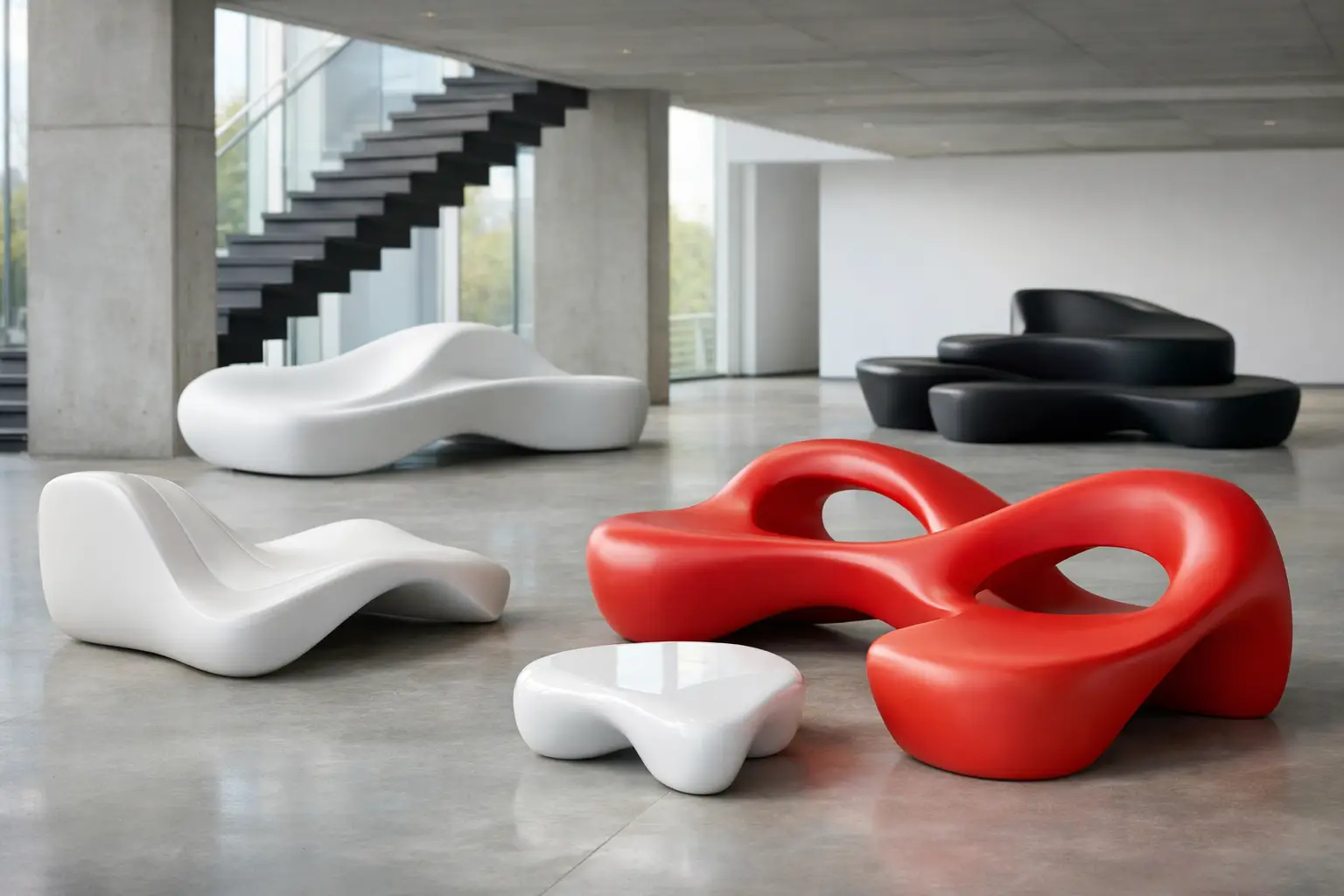
A hospitality lounge with generic seating disappears the moment a guest walks away. A sculptural installation that people sit on, gather around, photograph, and remember does the opposite. That is why the future of sculptural commercial furniture is not a niche design conversation. It is becoming a practical one for architects, interior designers, and brands building spaces that need identity as much as function.
Commercial furniture is moving past the old split between statement piece and usable product. In high-traffic interiors, public settings, retail environments, and outdoor applications, the strongest work now has to do both. It has to perform under daily use while carrying spatial character. It has to support circulation, brand expression, comfort, and durability without flattening into commodity seating. Sculptural furniture is increasingly where those demands meet.
Why the future of sculptural commercial furniture looks different
For years, sculptural furniture in commercial settings was often treated as a visual exception – striking, memorable, but sometimes difficult to specify at scale. That is changing because clients no longer see memorable form as optional. In experiential retail, workplace hospitality zones, campus commons, transit spaces, and mixed-use developments, furniture is part of the architecture of attention.
This shift is not only aesthetic. It comes from how commercial spaces are used. More environments now ask one object to solve several problems at once. A bench may need to guide movement, soften acoustics, define a waiting zone, reinforce a brand language, and withstand constant contact. Conventional furniture systems can do part of that work, but sculptural forms can do it with much more spatial intelligence.
The result is a new expectation. Designers are not just looking for furniture that fits a floor plan. They are looking for pieces that shape behavior and hold their own within a concept-driven environment.
Form is becoming part of the floor plan
In many commercial projects, furniture used to arrive late in the process as a layer added after architecture. The more ambitious model is different. Sculptural seating, planters, loungers, and soft architectural elements now influence zoning from the start.
This matters because the line between furniture and built element is getting thinner. In an airport lounge, a curved seating island can organize traffic while creating moments of pause. In a retail flagship, a monolithic bench can operate as display, social anchor, and branded gesture. In a workplace commons, soft volumetric forms can create informal boundaries without adding walls.
That is one of the clearest signals in the future of sculptural commercial furniture. The pieces that stand out will not simply decorate a layout. They will actively structure it.
Customization is no longer a luxury add-on
Commercial clients increasingly want spaces that feel authored, not assembled from familiar parts. That does not always mean every project needs a fully bespoke collection. It does mean specifiers want more freedom over scale, geometry, finish, and color than standard furniture manufacturing typically allows.
This is where fabrication capability becomes decisive. Bold forms are easy to sketch and harder to produce well. Radius transitions, integrated volumes, unusual footprints, and oversized gestures all introduce technical demands. If the manufacturing process cannot preserve the integrity of the original idea, the furniture loses what made it valuable in the first place.
Customization also needs to be practical. Designers are under pressure to deliver originality without creating impossible lead times, fragile details, or installation headaches. The future belongs to manufacturers that can translate expressive concepts into production-ready objects with repeatable quality. That means understanding not only form, but tolerances, surface performance, maintenance, and how the piece will behave in real traffic conditions.
Materials will decide what forms are possible
A great deal of the next wave of sculptural furniture will be driven by material technology rather than trend alone. Designers want fuller volumes, softer silhouettes, and more architectural presence, but those ambitions only work if the material system can support them.
Rigid construction methods often impose visible limits on shape. They can force segmentation, overbuilt frameworks, or geometric simplification. Advanced coated foam fabrication opens a different path. It allows complex forms, continuous surfaces, and substantial visual mass without the same constraints as conventional upholstery or hard-shell manufacturing.
That has direct implications for commercial projects. A coated surface can bring durability, easy maintenance, and indoor-outdoor versatility to forms that would otherwise be difficult to protect. It can also help preserve the visual clarity of a piece over time. For sculptural furniture, that matters. The appeal often lies in the purity of the silhouette. When seams, sagging, or material breakdown interrupt that silhouette, the concept weakens quickly.
Material choice will also shape where sculptural furniture can go. Outdoor hospitality, rooftop amenities, campus environments, wellness spaces, and public landscapes all demand resilience. The pieces that define the next few years will be the ones that maintain strong form while meeting the realities of weather, cleaning, and heavy use.
Expect softer geometry and harder performance standards
There is a noticeable shift in commercial interiors toward rounded forms, generous profiles, and more tactile spatial experiences. That does not mean softness in the domestic sense. It means geometry that feels approachable, fluid, and social.
In public and commercial settings, these forms do important work. Curves can improve circulation. Continuous benches can encourage group use. Sculptural seating can remove the visual stiffness that makes some large spaces feel impersonal. This is especially useful in hospitality, healthcare-adjacent environments, education, and workplace lounges where emotional tone matters.
But softer geometry cannot come at the expense of performance. Commercial buyers are asking harder questions about cleanability, color consistency, abrasion, UV stability, and long-term appearance. A dramatic object that looks tired after one season is not a good investment, no matter how strong the concept.
That tension is healthy. It pushes the category forward. The future is not about choosing between expressive form and contract-grade reliability. It is about expecting both.
Branded environments will keep raising the bar
As more businesses compete through experience, commercial furniture has become part of brand communication. This is obvious in retail and hospitality, but it is just as relevant in corporate, education, and cultural spaces. Furniture now helps tell visitors where they are and what kind of experience they are meant to have.
Sculptural pieces are especially effective here because they communicate without signage. Shape, scale, and color can carry identity in a way that feels embedded rather than applied. A custom seating landscape can echo a brand’s softness, energy, playfulness, precision, or boldness before anyone reads a word.
That said, there is a trade-off. Highly branded forms can age faster if they chase novelty for its own sake. The best commercial sculptural furniture avoids becoming a one-season gesture. It feels specific to the project, but still grounded in strong proportion, usability, and material logic. That balance is what keeps a branded environment from slipping into set design.
What specifiers should ask next
The most useful question is not whether sculptural commercial furniture is becoming more popular. It is whether the piece can carry design intent all the way through fabrication, installation, and daily use.
That requires early conversations about more than appearance. How will the form support movement? Can it be scaled or adapted for the footprint? What does maintenance look like in this setting? Will the finish hold up in sun, rain, or constant contact? Can the geometry be produced with enough precision to keep the concept intact?
For architects and designers, this is where the right manufacturing partner changes the outcome. The future of sculptural commercial furniture will belong to teams that treat bold form as a technical discipline, not a styling exercise. Companies like Sixinch have shown how specialized coating expertise and fabrication flexibility can turn ambitious concepts into durable, high-impact pieces built for real commercial use.
The next generation of commercial furniture will be more expressive, more integrated with architecture, and more demanding in performance. That is good news for designers who want more than standard answers. When form, material, and fabrication are aligned, sculptural furniture stops being an accent and starts becoming part of the space’s core identity. The projects people remember are rarely the safest ones.