
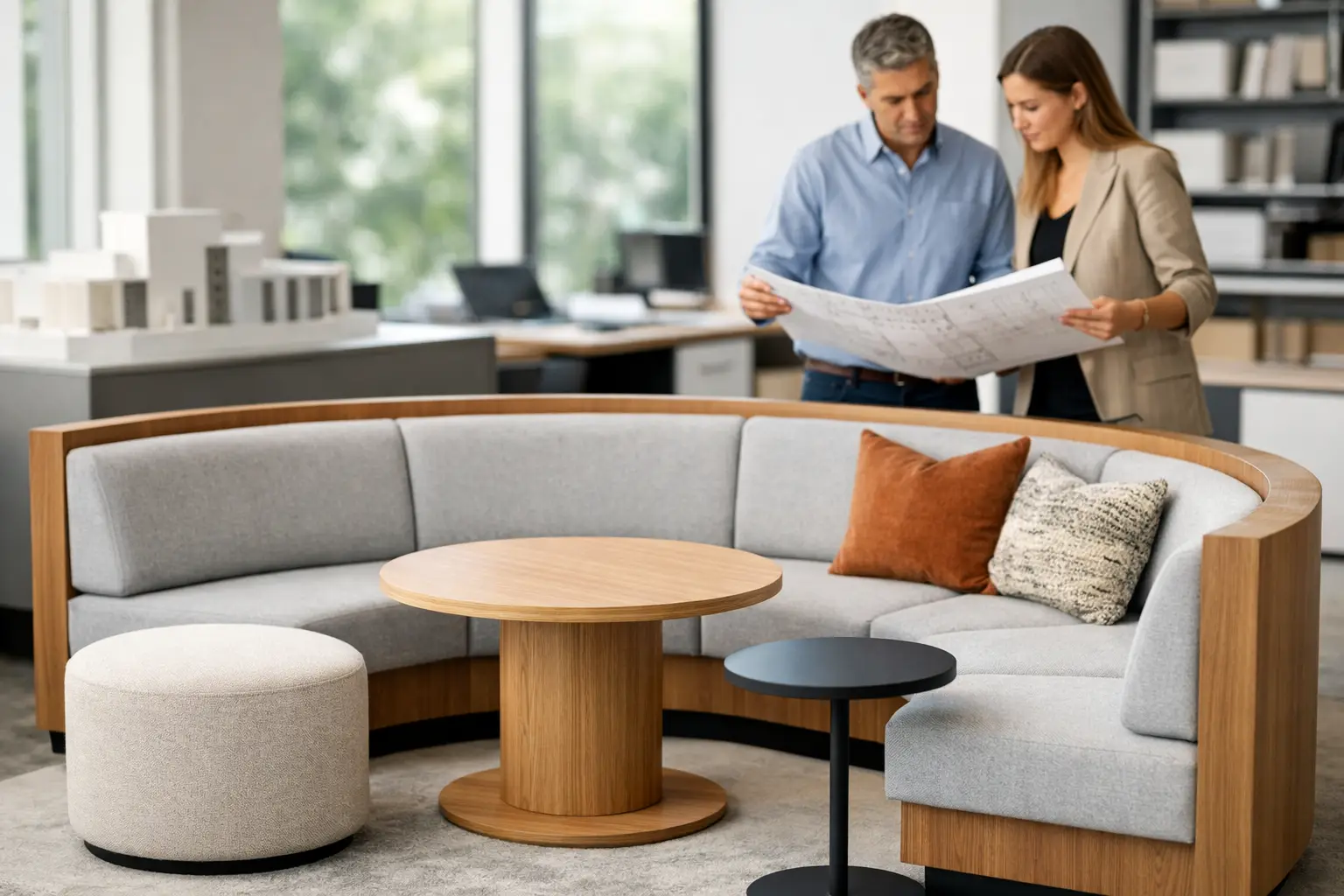
A lobby bench that is 3 inches too deep, a banquette that breaks the sightline, a lounge piece that looks right but fails circulation – these are small misses that reshape an entire space. That is one reason why architects choose bespoke seating. In commercial and public environments, seating is rarely just seating. It is part of the architecture, part of the user journey, and often part of the brand story.
Standard furniture works well when the brief is simple and the room can adapt to the product. But many projects move in the opposite direction. The space has a clear concept, strict dimensions, demanding performance requirements, and a need for visual distinction. In those cases, bespoke seating is not a luxury add-on. It is a practical design decision.
Why architects choose bespoke seating in real projects
Architects specify custom seating when off-the-shelf options force too many compromises. A standard piece may be close in size, close in color, or close in character, but close is often not enough when every line in the room has been considered.
This becomes obvious in hospitality, retail, workplace, and public space projects. A reception area may need a sculptural seating element that also guides movement. A rooftop terrace may require integrated forms that handle weather exposure without looking utilitarian. A branded interior may need custom geometry and exact color matching so the furniture feels native to the concept rather than added after the fact.
Bespoke seating allows the design intent to stay intact from concept sketch to final installation. Instead of editing the space around available products, architects can specify pieces that respond to scale, circulation, material language, and use patterns from the start.
Fit matters more than most furniture catalogs allow
One of the strongest reasons architects choose bespoke seating is spatial precision. Commercial interiors are full of awkward dimensions, curved walls, narrow thresholds, stepped levels, and multifunction zones. Standard furniture collections are built for broad market compatibility. Architecture is not.
Custom pieces can resolve dead corners, activate underused areas, and turn transitional zones into functional destinations. A made-to-measure bench can wrap a column, align with glazing, or create a waiting area without cluttering the plan. In landscape and public projects, seating can follow topography, define edges, or integrate with planters and architectural features in a way that modular catalog products rarely achieve.
That precision also affects how a space feels. When seating is scaled properly, the room reads as intentional. Circulation stays clear. Sightlines remain open. The furniture supports the architecture instead of competing with it.
Bespoke seating can solve visual and technical constraints at once
The most successful custom pieces do more than fit a footprint. They combine formal clarity with technical discipline. That might mean softening a hard architectural shell with generous rounded forms, or creating a sharp monolithic volume that still performs as comfortable seating.
This is where fabrication expertise matters. Bold shapes are easy to sketch and much harder to manufacture well. Architects need partners who understand how form, coating, structure, tolerance, and finish work together in a real project environment.
Design freedom has brand value
For design-led commercial spaces, custom seating often carries more than a functional brief. It carries identity. Architects working on hospitality, retail, cultural, and workplace projects are frequently asked to translate a brand into a physical experience. Seating becomes part of that language.
A bespoke piece can echo a logo curve, reinforce a spatial rhythm, or introduce a signature silhouette that makes the environment memorable. It can also help create a stronger emotional read. People may not consciously analyze a custom bench or lounge element, but they register whether the room feels generic or authored.
This matters because branded spaces are judged quickly. A hotel lounge, a flagship store, or a corporate reception area has seconds to establish tone. Distinctive seating can do that without relying on decorative excess. It gives the room a focal point, a sense of confidence, and often a more shareable visual identity.
Material capability changes what is possible
Architects do not choose bespoke seating only for aesthetics. They choose it when a project demands forms or performance levels that standard construction cannot easily deliver.
Coated foam fabrication opens up a very different design vocabulary from conventional upholstery or rigid manufactured shells. It allows continuous volumes, softened edges, integrated geometries, and sculptural forms that read as clean, bold objects. At the same time, the right coated finish can support durability, easy maintenance, and use across demanding commercial settings.
That combination is powerful. A seating element can look highly expressive while still meeting practical expectations for contract use. It can feel custom without becoming fragile. For architects, that is the difference between a concept piece and a specification-ready piece.
Why unusual forms still need disciplined production
There is always a trade-off in custom work between visual ambition and manufacturability. Some shapes look dramatic in a rendering but create weak points, awkward seams, or maintenance issues in reality. Good bespoke seating is not simply unusual. It is resolved.
That is why technical collaboration early in the process matters. Details such as radii, wall contact, floor conditions, drainage, cleaning protocols, weight, transport access, and installation sequence all affect whether a custom concept succeeds. When those factors are built into development, architects can push form further with fewer surprises later.
Bespoke seating supports the way people actually use space
Architects are designing for behavior as much as appearance. People wait, gather, lean, pause, work, socialize, and move through spaces in ways that standard seating categories do not always support. A row of identical chairs may satisfy a schedule of furniture, but it may not improve the space.
Custom seating makes it easier to respond to actual patterns of use. In a workplace lounge, that could mean creating informal clusters rather than formal rows. In a university common area, it might mean large communal forms that support short stays and spontaneous group use. In public and outdoor settings, it can mean durable seating integrated into the landscape so it feels permanent and intuitive.
This is also where hybrid functions become valuable. Seating can define zones, add acoustic softening, reinforce circulation paths, or combine with planters and architectural elements. The result is often cleaner than filling a room with separate objects trying to do separate jobs.
The trade-offs are real, but so is the payoff
Bespoke seating is not the right answer for every project. It typically requires more coordination, clearer decision-making, and realistic lead times. Approval cycles can be longer because prototypes, samples, and production drawings need review. Budget discipline matters too. Custom work should solve a real design problem or deliver meaningful project value, not exist only for novelty.
Still, the payoff can be substantial. A single custom piece may eliminate the need for multiple standard items. It can improve spatial efficiency, strengthen identity, and reduce the visual noise that comes from mixing compromises. In the right setting, bespoke seating works harder because it is doing more than one job.
That is especially true in projects where the furniture is highly visible. If seating anchors the first impression, shapes circulation, or becomes part of the architecture itself, custom specification often makes more sense than trying to force-fit a standard product.
Why architects choose bespoke seating over modifying standard pieces
There is a common middle ground that seems efficient at first: take a standard piece and tweak it. Sometimes that works. A finish adjustment or dimensional variation may be enough. But many projects reveal the limit of that approach quickly.
Modified standard furniture still carries the assumptions of its original design. The proportions, construction logic, and visual language were created for another context. Bespoke seating starts from the project itself. That difference is subtle on paper and obvious in built space.
For architects pursuing a strong concept, that starting point matters. It creates coherence. It lets furniture and architecture speak the same language. And when the manufacturer has deep experience translating ambitious forms into production-ready objects, the process becomes less about compromise and more about execution.
At Sixinch, that is where bespoke work becomes most valuable – when a design team wants freedom, but also needs a fabrication partner who can make bold forms perform in the real world.
The best custom seating does not ask for attention just because it is different. It earns its place by fitting the space so precisely that, once installed, it feels like it could never have been anything else.