
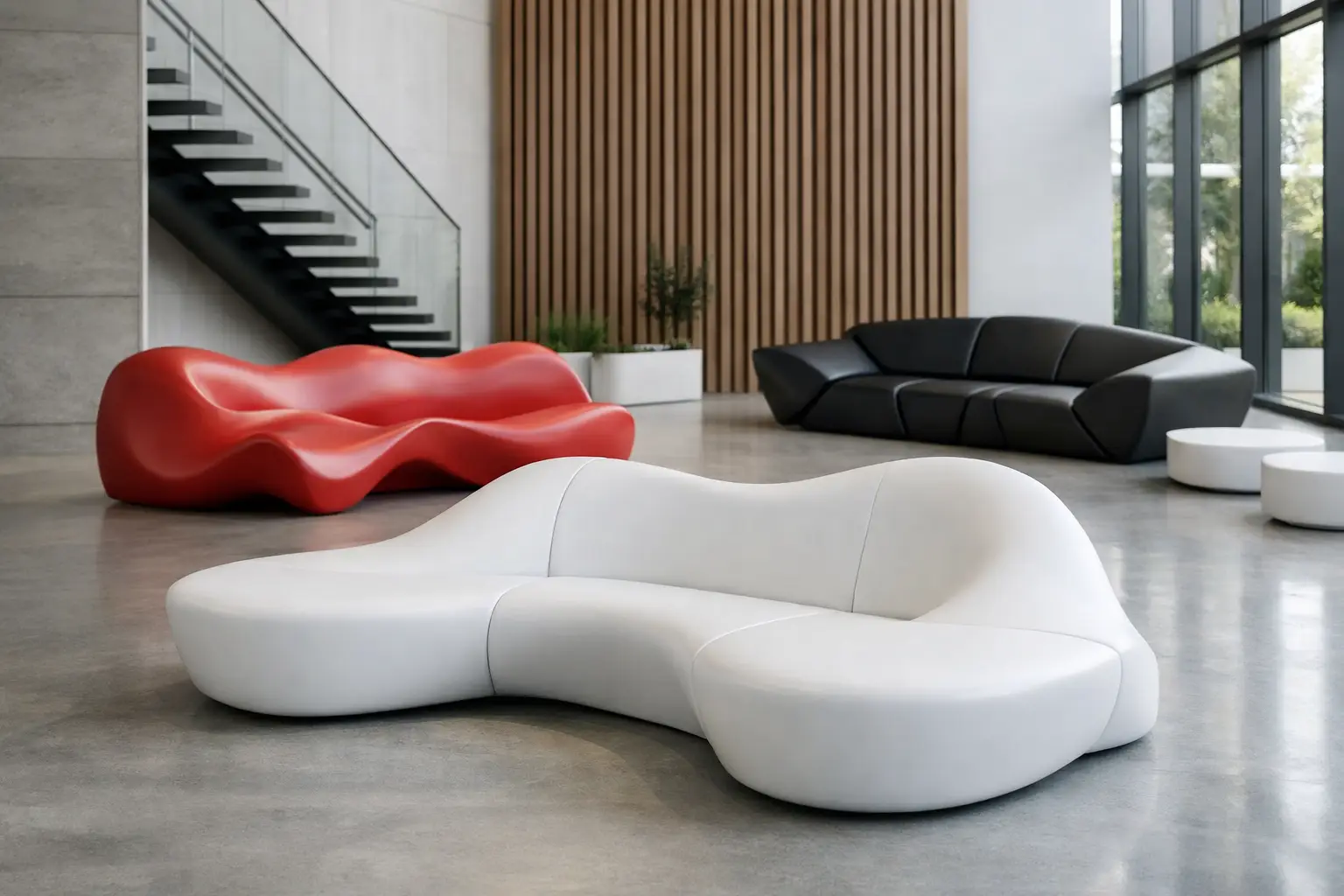
A lobby gets judged in seconds. Before reception speaks, before signage directs, before lighting settles in, the sofa has already done part of the branding work. That is why choosing the best statement sofas for lobbies is rarely about filling square footage. It is about setting tone, controlling movement, and placing a memorable form exactly where people first encounter the space.
In high-traffic hospitality, workplace, retail, and public interiors, a statement sofa has to do more than look impressive in a rendering. It has to hold visual tension in a large room, support repeated use, and stay true to the concept once materials, maintenance, and circulation realities enter the conversation. The strongest choices balance sculptural presence with specification discipline.
What makes the best statement sofas for lobbies
A statement sofa is not simply oversized or brightly colored. In a lobby, it becomes an architectural object. It helps define arrival, break up open floor plates, and create intentional zones without relying on walls or partitions.
Shape is usually the first differentiator. Sofas with curved, asymmetrical, monolithic, or unusually low profiles tend to perform well because they read from a distance. They create identity in a way standard contract seating rarely can. A straight, conventional sofa can still work, but only when the surrounding architecture is doing most of the expressive work. If the furniture needs to carry the visual narrative, stronger geometry matters.
Scale is just as critical. Many pieces that look dramatic in a showroom disappear in a double-height hotel lobby or a broad corporate atrium. The best lobby sofas hold volume confidently. That does not always mean making them larger. Sometimes the answer is a clustered composition, a linked modular system, or a custom footprint that gives the seating enough mass to belong in the room.
Materiality decides whether the idea survives daily use. Designers often want soft, inviting forms in lobbies, but upholstery alone can create vulnerability in busy public settings. This is where coated foam and similarly performance-driven solutions become compelling. They allow bold silhouettes, continuous surfaces, integrated curves, and a finish that is easy to maintain without flattening the visual impact.
Statement looks are easy. Lobby performance is harder.
Some sofas photograph beautifully and fail the moment people start using them. Seat depth may be too casual for a commercial setting. Back support may be too low for longer waiting periods. The silhouette may interrupt circulation or create awkward dead zones around reception and entry sequences.
That is why the best statement sofas for lobbies are specified with movement in mind. People do not use lobby seating like residential seating. They perch, pause, check phones, wait for colleagues, hold bags, and leave quickly. In a hospitality setting they may lounge longer, but even then the furniture has to support turnover, cleaning access, and visual order.
There is always a trade-off between pure sculptural expression and ergonomic familiarity. A highly experimental shape may win attention yet limit how many users feel comfortable occupying it. A more conventional seat profile may broaden usability but reduce impact. The right answer depends on the project. A gallery-like brand environment can push further. A healthcare, workplace, or mixed-use lobby usually needs stronger ergonomic clarity.
Shapes that work best in lobby environments
Curved sofas tend to outperform rigid linear forms in open lobbies because they soften circulation and make large spaces feel intentional. They can wrap around a feature point, create semi-private waiting zones, or serve as an anchor in the center of the room. They also read as more custom, which matters when differentiation is part of the brief.
Modular statement sofas are especially effective when the lobby has to serve multiple scenarios. A composition can be adjusted to support solo waiting, informal meetings, or event-based use. The visual strength comes from the overall geometry rather than one fixed object. For designers, this creates freedom. For operators, it allows adaptation over time.
Monoblock or one-piece forms bring a different kind of authority. They feel less like furniture and more like installation. In branded interiors, luxury hospitality, or high-concept public spaces, that can be exactly the point. A single sculpted volume can simplify the room while delivering maximum presence. The limitation is flexibility. If the layout needs to evolve often, monoblock pieces can become restrictive.
Island sofas also deserve attention. In larger lobbies, a sofa viewed from all sides performs better than one that depends on a wall. It activates the center of the room and lets designers organize traffic around it. This is often where statement seating has the most power – not pushed to the perimeter, but placed deliberately as a spatial event.
Color, finish, and why restraint can be bold
When teams talk about statement furniture, the discussion often jumps straight to vivid color. Bright finishes can work exceptionally well in lobbies, especially in retail, cultural, education, and hospitality projects where identity needs to be immediate. But color is only one route.
A neutral statement sofa with a powerful silhouette can have greater staying power. Soft whites, mineral grays, deep charcoals, and muted earth tones let form take the lead. In projects with expressive architecture, artwork, or lighting, this can be the sharper move. The object remains memorable without competing with every other focal point.
Finish also changes how the sofa is perceived. Matte surfaces often read more architectural and contemporary. Gloss can heighten drama but may feel too reflective or precious depending on the environment. Texture should be considered carefully. Heavily textured upholstery may introduce warmth, yet it can also complicate maintenance in public settings. Cleaner, coated surfaces tend to support both durability and clarity of form.
Customization is often the difference between good and right
Off-the-shelf seating can solve a budget line, but it rarely solves a lobby concept completely. Entrance dimensions, elevator access, fire code, traffic paths, branding requirements, and finish coordination all affect what the final piece should be. That is why custom or semi-custom development is often the better route when the sofa is expected to function as a signature element.
Customization does not need to mean starting from zero. It may involve resizing a proven shape, adjusting seat height for commercial use, integrating power access nearby, refining curvature to improve circulation, or matching a project palette exactly. Those changes are not cosmetic. They are what turn a dramatic object into a usable design solution.
This is where a fabrication partner matters. The ability to translate sketches and intent into production-ready forms is what gives statement seating real value. For ambitious lobby concepts, brands like Sixinch stand out because they combine sculptural freedom with manufacturing control, allowing designers to specify forms that are visually unconventional without stepping away from practical performance.
How to specify with fewer compromises
The safest way to choose a statement sofa is not to ask what looks boldest. Ask what the lobby needs the sofa to do in plan, in elevation, and over time.
Start with placement. If the sofa is meant to anchor the room, make sure it has enough negative space around it to be read clearly. If it is supporting reception, check sightlines and queuing patterns. If it is defining a waiting zone, confirm that access feels natural from multiple directions.
Then assess use intensity. A boutique hotel lobby and a transportation hub may both want visual impact, but they place very different demands on surfaces, cleaning cycles, and edge durability. The more public the environment, the more important it becomes to specify a finish that resists wear without diluting the concept.
Finally, think beyond the object itself. Statement sofas perform best when they are part of a wider design composition that includes lighting, planters, rugs, acoustic elements, and circulation logic. The sofa should not be the only idea in the room. It should be the clearest one.
A great lobby does not need furniture that shouts. It needs a piece with enough confidence to hold space, shape experience, and stay relevant after the opening photography is done. The best statement choice is the one that still feels intentional after thousands of arrivals, meetings, check-ins, and first impressions.