
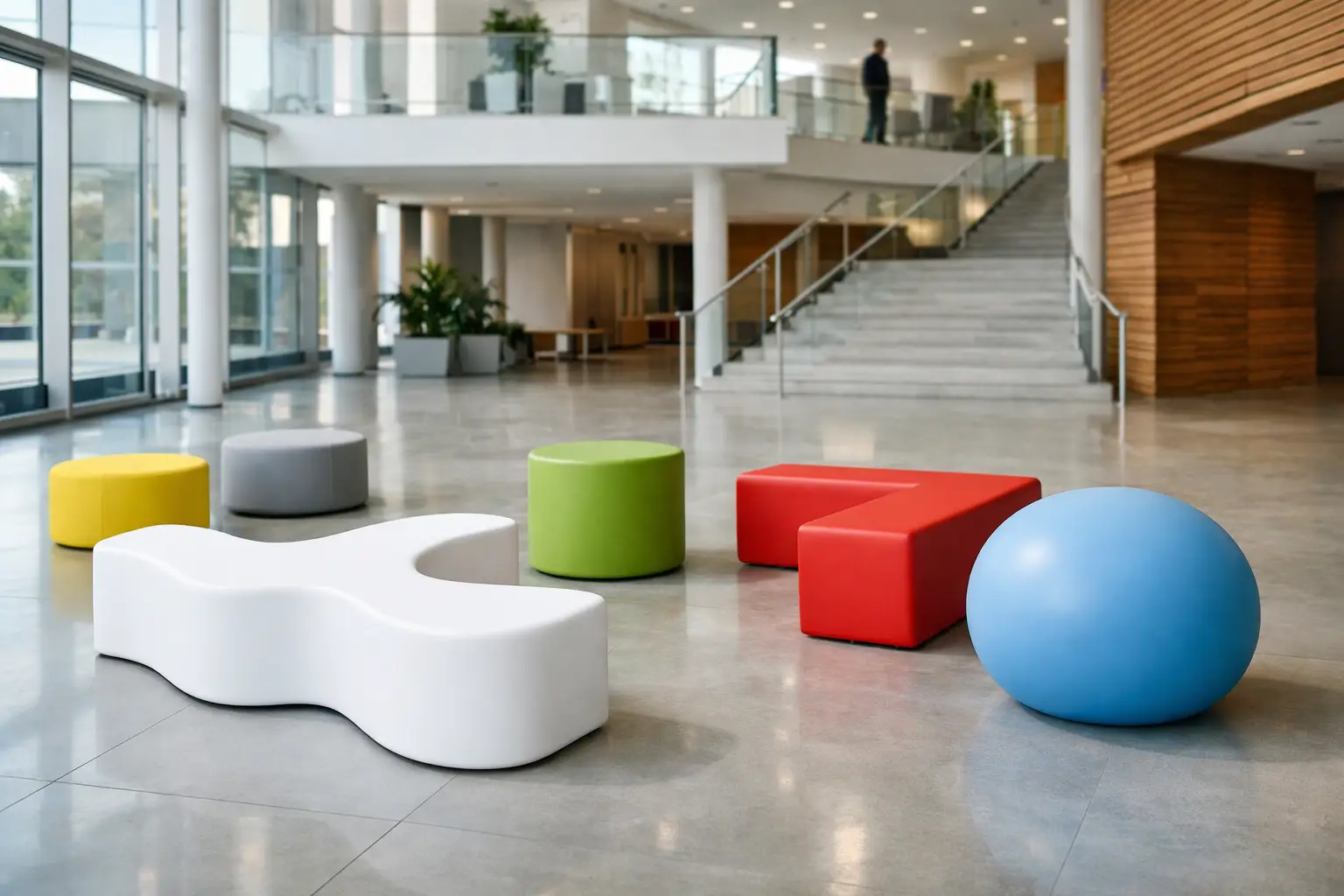
A campus quad tells the truth about a place in seconds. If students cut across it without stopping, if no one lingers between classes, if outdoor areas empty out the moment a lecture ends, the issue is rarely just programming. More often, the landscape has not been furnished with enough intention. Modern landscape furniture for campuses is not decoration at the edge of a hardscape plan. It is infrastructure for social life, informal learning, identity, and daily use at scale.
For architects, landscape designers, and institutional specifiers, that changes the brief. Outdoor seating, planters, and sculptural site elements have to do more than survive weather and traffic. They need to shape behavior, support circulation, create usable zones, and express a campus culture that feels current rather than generic. The strongest projects treat furniture as part of the spatial language from the start, not as a last package of benches dropped in before handover.
What modern landscape furniture for campuses needs to do
Campus environments are unusually demanding because they are both civic and intimate. A single site may serve first-year students eating lunch, faculty holding quick meetings, visitors on tours, and event crowds moving through the same zone in one afternoon. Furniture has to perform across all of those conditions without feeling overbuilt or institutional.
That is why contemporary campus furniture is moving away from the standard bench-at-intervals model. Designers are specifying pieces that invite multiple postures, support groups of different sizes, and create more fluid forms of occupancy. Curved seating, integrated planters, modular islands, and sculptural lounge forms can encourage people to gather naturally rather than line up along an edge. In practice, that means the furniture is helping define the outdoor room.
There is also a visual expectation that did not exist in older campus planning. Universities and colleges compete for attention, talent, and donor confidence. Prospective students read a campus through images before they ever visit in person. Outdoor spaces need to feel designed, not merely equipped. Strong form, bold color, and custom geometry can make a site memorable, but only if the execution is precise and the materials are suited to public use.
The shift from utility to experience
Traditional site furniture often solved only one problem at a time. A bench provided seating. A planter added greenery. A barrier managed flow. Modern campus design asks more from every element because space is under pressure and expectations are higher.
A seating object might need to anchor a plaza, soften a circulation spine, provide back support in one zone, offer perch seating in another, and still read as a coherent part of the campus design vocabulary. That is where form flexibility becomes a serious specification advantage. When furniture can be shaped to fit a site instead of forcing a site to fit a catalog, the result is more intentional and often more efficient.
This does not mean every campus needs dramatic one-off forms everywhere. Some projects call for a restrained kit of parts with repeatable modules. Others benefit from a singular statement piece that gives a student center terrace or courtyard a clear identity. The right answer depends on how visible the space is, how intensively it will be used, and whether the institution wants the furniture to blend in or lead visually.
Material performance matters as much as form
Design freedom is only useful when it survives contact with reality. Campuses deal with UV exposure, rain, freeze-thaw cycles in many regions, constant touching, spills, abrasion, and occasional misuse. Furniture that looks striking on installation day but degrades quickly becomes a liability for both operations teams and design teams.
That is why material selection deserves as much attention as silhouette. A coated finish can offer a distinctly smooth, monolithic appearance that suits contemporary landscapes and enables forms that would be difficult with more conventional construction. It can also simplify visual continuity across custom shapes, integrated seating, and planter elements. But performance depends on the quality of fabrication, the consistency of the coating process, and the suitability of the product for the exact installation conditions.
Specifiers should be asking practical questions early. How does the surface behave under heavy public use? How easy is it to clean after food service or events? Can the piece maintain color stability outdoors? What happens at joints, corners, and curved transitions over time? These are not secondary concerns. They are central to whether a design vision remains credible after years of occupancy.
Customization is not a luxury on campus projects
In campus work, standard products can be useful, but they often stop short of what the site actually needs. Grades shift. Traffic patterns are irregular. Branding goals vary by institution and by department. A business school courtyard does not have the same social rhythm as a residence hall lawn or an innovation hub terrace.
That is why custom and semi-custom landscape furniture is increasingly relevant. The ability to adapt dimensions, radii, color, and configuration allows designers to respond to architecture and circulation with much greater precision. A long serpentine seat can turn an awkward leftover area into a social zone. A cluster of low sculptural forms can create informal seating without introducing visual clutter. Integrated planters can soften hardscape while also organizing how people occupy the space.
For creative teams, customization is also about authorship. Campuses are trying to avoid the anonymous public-space look that makes one institution feel interchangeable with another. Bespoke furniture can echo building geometry, reinforce a landscape concept, or translate a brand palette into the outdoor environment without becoming literal or gimmicky.
How to specify modern landscape furniture for campuses
The best specifications begin with behavior, not products. Start by mapping how people will use the space across a full academic cycle. Morning traffic between buildings is different from lunchtime use, evening events, orientation weeks, and quiet exam periods. Furniture should support both movement and pause.
Next, think in zones rather than individual objects. A campus landscape usually needs a mix of social gathering, individual retreat, transitional seating, and edge activation. When every piece solves the same problem, the space feels flat. Variation in scale and posture creates a more legible and usable environment.
Then evaluate durability with the facilities team in mind. Beautiful forms lose value if maintenance protocols are complicated or replacement cycles are too short. This is where experienced fabrication matters. A design-led manufacturer should be able to talk clearly about coating systems, substrate behavior, cleaning, repair considerations, and outdoor suitability without reducing the conversation to generic claims.
Finally, consider how much visual boldness the site can carry. High-impact forms can transform a plaza, but they need enough space and architectural support to read properly. In tighter or more formal settings, quieter geometry may perform better. The goal is not to make every campus look louder. It is to make each outdoor space feel more intentional.
Where bold furniture delivers the most value
Not every corner of a campus needs a signature object, but some zones clearly benefit from one. Arrival plazas, student union terraces, residence life courtyards, interdisciplinary hubs, and outdoor commons are high-value locations because they appear in photography, tours, and day-to-day student life. These are spaces where furniture can become part of the campus identity.
In those settings, a sculptural approach can do real work. It can create landmarks without additional architecture. It can help a new building feel inhabited quickly. It can also make outdoor space feel less like leftover circulation and more like a destination.
This is especially effective when furniture is conceived as part of a broader site composition with planters, topography, and circulation. The strongest projects do not separate object from landscape. They use both to create a coherent experience.
For design teams pursuing that level of integration, a fabrication partner with genuine form flexibility matters. Sixinch has built its reputation on turning unconventional concepts into production-ready pieces with a distinctive coated finish and a high degree of customization. That kind of capability is useful when the design intent is ambitious and standard public furniture simply will not carry it.
The trade-offs are real
There is no single best solution for every campus. Modular systems can offer easier phasing and repeatability, while fully bespoke pieces can deliver stronger identity and better site fit. Bold color can energize a student zone, while neutral tones may age more gracefully in formal academic settings. Soft-edged sculptural seating can feel more inviting, but sharper architectural lines may better align with some building languages.
Budget also changes the answer. If the project needs broad coverage across a large campus, a mix of standard and custom elements may be smarter than concentrating the budget on a few statement pieces. If the goal is to transform one flagship exterior, investing in more expressive furniture can have an outsized impact.
The key is to make those trade-offs deliberately. Campus furniture should not end up generic because the team ran out of time to think through the site. Nor should it become expressive for its own sake. The best work balances visual force with day-to-day usability.
Outdoor campus space has become one of the most visible tests of whether a design team understands how people actually gather, wait, talk, study, and move. Furniture plays a bigger role in that experience than many institutions realize. When it is shaped with purpose, engineered for public life, and integrated into the landscape concept from the beginning, it can turn open space into a place students choose to return to.