
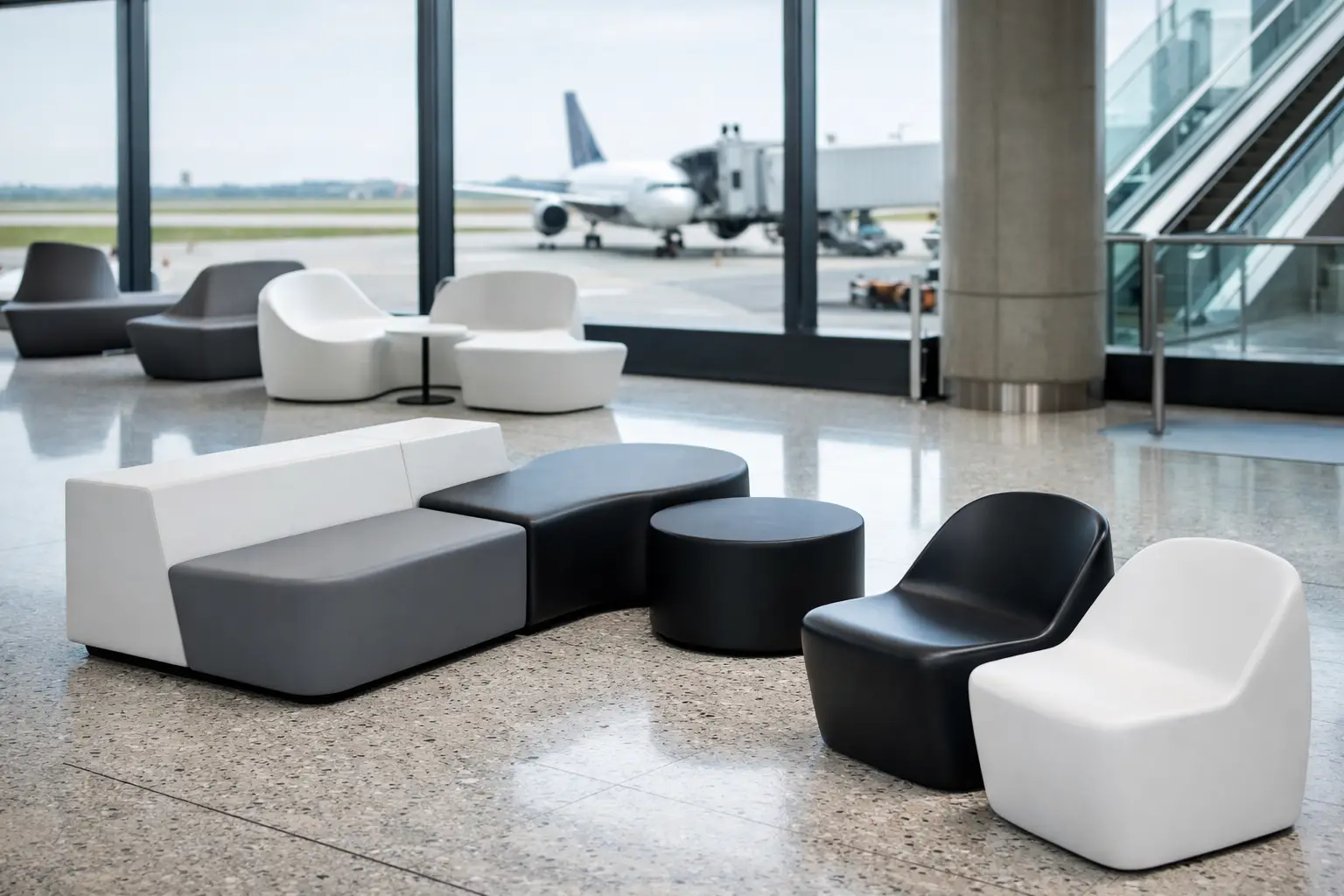
An airport lounge chair is rarely just a chair. It is a waiting place, a work surface, a waypoint, and sometimes the first physical expression of a city or airline brand. Knowing how to source furniture for airports means specifying for this intense reality: high passenger turnover, heavy baggage, continuous cleaning, changing dwell times, and public expectations that are far higher than the utilitarian terminals of the past.
The strongest airport furniture projects begin before product selection. They start by defining how people move, wait, recharge, gather, and recover within each zone. From there, furniture becomes a tool for operational clarity and a major part of the passenger experience.
Start With Passenger Flow, Not a Product List
An airport is not one environment. The curbside hall, security queue, gate hold room, premium lounge, arrivals area, retail concourse, and outdoor terrace each place different demands on furniture. A bench that works at a crowded gate may feel institutional in a hospitality-led lounge. A sculptural seat that creates a memorable central moment may be inappropriate where fast circulation and clear sightlines are essential.
Map the journey before issuing a furniture schedule. Identify where passengers arrive with luggage, where they need a short pause, where groups congregate, and where people may spend several hours during delays. Consider visibility to flight information displays, access to power, accessibility routes, cleaning paths, and the way staff need to move through the space.
This approach also prevents a common mistake: filling every open area with seating. Some zones need generous circulation, flexible queuing capacity, or visual breathing room. Furniture should support movement rather than become an obstacle course of isolated chairs and tables.
Specify for the Demands of an Airport
Airport furniture must tolerate conditions that many commercial interiors never face. Thousands of people may use the same seat each day. Wheels, hard-shell luggage, food spills, cleaning chemicals, and changing temperatures all affect material performance. A compelling concept only succeeds if its details can withstand this level of use.
Start with a performance brief that addresses anticipated traffic, indoor or outdoor exposure, cleaning routines, and replacement strategy. Request information on abrasion resistance, stain resistance, impact behavior, color stability, edge durability, and repairability. For upholstered pieces, evaluate seam placement, foam recovery, textile suitability, and how easily damaged components can be serviced.
Fire performance is equally critical, but requirements vary by jurisdiction, airport authority, location within the terminal, and the material itself. Do not assume a rating used on a previous hospitality project will apply. Confirm the applicable code requirements early and ask manufacturers for project-specific documentation rather than broad assurances.
Think Beyond the Surface Finish
A material may look durable in a sample box yet fail at its transitions. Sharp corners chip. Exposed feet collect damage from baggage. Loose cushions migrate. Deep seams become dirt traps. Decorative details can make daily maintenance unnecessarily difficult.
Look closely at the construction logic. Are edges rounded where they will receive impact? Can individual modules be replaced without removing an entire installation? Are bases stable enough for people leaning, shifting, and placing bags beside them? Is the underside designed for cleaning access? These questions are especially important for custom furniture, where a prototype can reveal problems long before they reach the terminal.
Use Furniture to Create Legible Zones
Passengers read an airport through spatial cues. Furniture can quietly signal where to wait, work, rest, dine, or meet without adding more signage. High-back lounge elements can create privacy within large halls. Curved benches can soften a hard architectural grid and establish gathering points. Low, open seating can preserve views across a gate area, while more enclosed forms suit premium or quiet zones.
Scale matters. Small clusters can make a large terminal feel fragmented if they are scattered without purpose. Oversized forms can create a powerful identity, but they must still maintain accessible routes and accommodate operational equipment. The right answer depends on ceiling height, sightlines, passenger density, and the visual character of the architecture.
Color is another powerful zoning device. A restrained terminal palette may call for one concentrated burst of color in a lounge or family zone. A branded gate environment may need a custom hue that supports recognition without overwhelming the wider space. Choose color with maintenance in mind: pale tones reveal soil sooner, while very dark surfaces can show dust, scratches, and residue.
Balance Comfort With Turnover
Comfort is not a single measurement. At a gate, passengers may need supportive seating for 20 to 60 minutes, with enough personal space to manage carry-ons and charging devices. In an airline lounge, the expectation shifts toward longer dwell times, softer forms, and a wider choice of postures. Arrivals seating may prioritize quick use, intuitive orientation, and room for companions.
Avoid treating every passenger as if they have the same needs. Provide a mix of individual seats, shared benches, accessible places, perch-height options, and lounge settings where the program allows it. Families, older travelers, business travelers, and passengers with reduced mobility all use the terminal differently.
Power integration deserves the same level of planning. It should be accessible without forcing passengers to crawl beneath seating or stretch cords across circulation routes. Yet power units add maintenance and coordination requirements. Decide early whether power belongs in furniture, floor boxes, adjacent tables, or architectural elements. The most elegant answer is not always the easiest to service.
Source Custom Pieces With Production Discipline
Custom airport furniture can create the identity that standard products cannot. It can echo an airport’s architecture, carry a regional design language, integrate planters or charging, or turn an otherwise generic hold room into a place passengers remember. But custom work needs a disciplined path from concept to installation.
Share drawings, renders, material intent, expected traffic, dimensions, access constraints, and desired finish early. A capable fabrication partner should help translate expressive forms into manufacturable components, advising where geometry, joints, coating systems, or modules need adjustment for durability and transport.
For sculptural seating and architectural furniture, coated foam fabrication offers particular design freedom. It enables soft, continuous volumes and custom geometries that are difficult to achieve with conventional upholstered construction, while creating a highly durable, easy-to-clean surface when specified for the application. Sixinch works at this intersection of bold form and production-ready execution, making it possible to develop furniture that feels integral to the space rather than selected from a catalog.
Do not skip samples and prototypes. A full-size mockup can test seat comfort, visual scale, cleaning behavior, stability, and the way a form relates to luggage and passenger movement. For a large project, approve a control sample that establishes the accepted color, texture, workmanship, and tolerance before full production begins.
Plan Logistics, Installation, and Lifecycle Support
Even exceptional furniture can become a problem if it cannot reach its final location. Airport projects often involve restricted delivery windows, security procedures, limited loading access, phased construction, and long distances from dock to installation point. Confirm product dimensions, packaging, module breakdown, elevator access, and on-site assembly needs before placing the order.
Ask how the manufacturer manages spare parts, replacement modules, finish matching, and future additions. Airport interiors are rarely static. Gates are reconfigured, lounges expand, and damaged items need to be addressed without disrupting operations. Modular systems can offer an advantage here, but only if the modules remain visually coherent and replacement lead times are understood.
Procurement should also account for the total cost of ownership, not only the purchase price. A less expensive item that stains quickly, requires whole-unit replacement, or looks tired after a short period can be costly in a public terminal. Durable, repairable furniture with a clear maintenance protocol can protect both the design vision and the operating budget.
Build a Specification That Protects the Design
A clear specification aligns the architect, operator, contractor, manufacturer, and maintenance team. It should describe the intended use, required testing or certifications, dimensions, finishes, color references, fixing requirements, cleaning guidance, warranty expectations, and approved substitutions policy. When custom work is involved, include drawings and samples as part of the approval record.
The specification should leave room for expert manufacturing input without allowing the concept to drift. If a proposed substitution changes the silhouette, surface quality, comfort, or maintenance profile, it is not a like-for-like replacement. Protect the elements that define the passenger experience.
The most successful airport furniture is never an afterthought added to a terminal plan. It is designed as part of the passenger journey: durable enough for the operational reality, distinctive enough to shape memory, and flexible enough to keep performing as the airport evolves.