
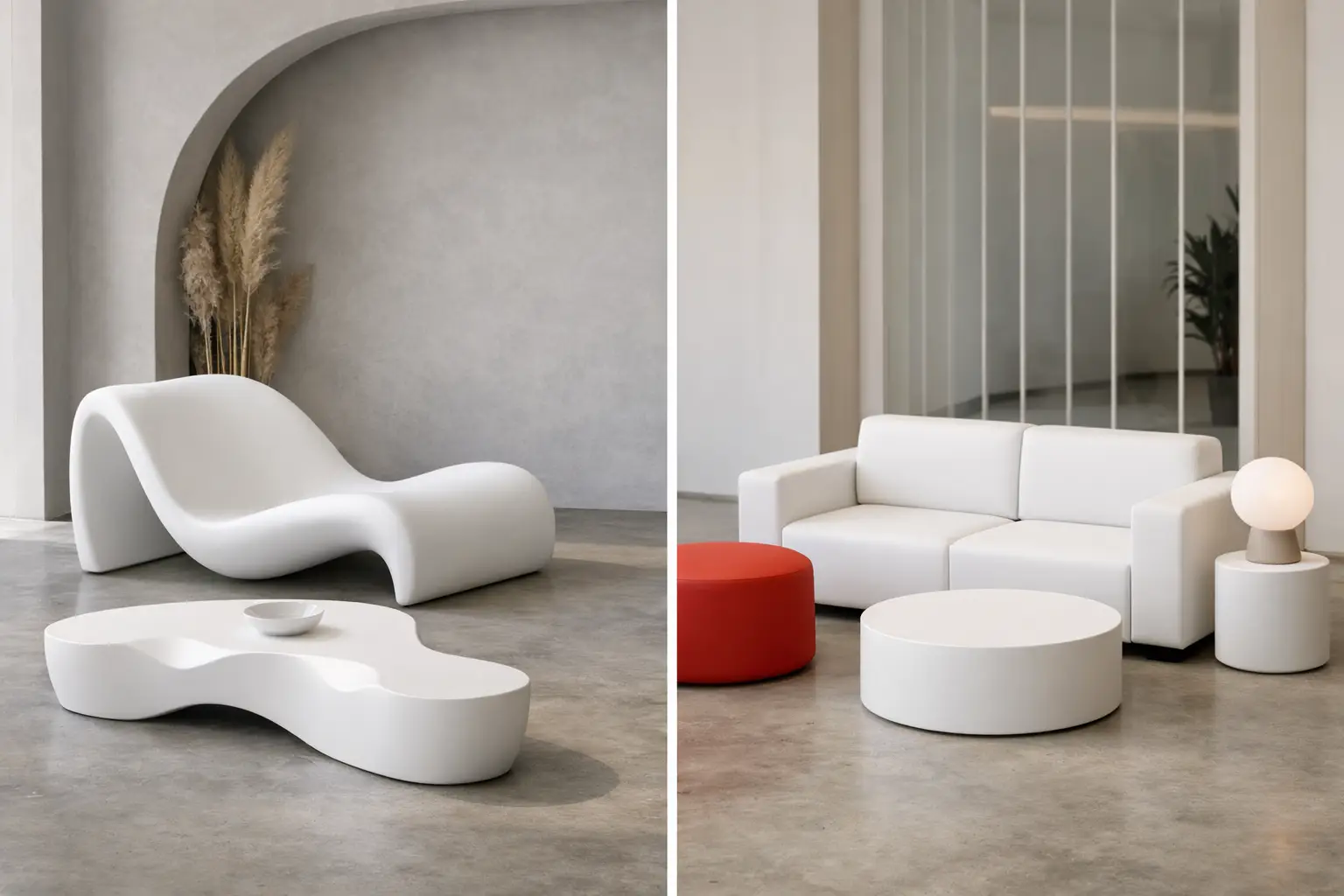
A lobby bench can do far more than provide a place to sit. It can direct movement, frame an arrival sequence, carry a brand’s color language, or turn an otherwise neutral room into a memorable destination. That is why the choice between bespoke furniture or standard collection pieces should begin with the spatial idea, not with a catalog page or a preliminary price request.
For architects, interior designers, and hospitality teams, the question is rarely whether customization is better. The real question is where custom fabrication creates meaningful value and where a proven collection delivers the stronger result. Both have a place in ambitious environments. The right balance protects the design concept while keeping procurement, performance, and installation under control.
Bespoke furniture or standard collection: start with intent
A standard collection is a resolved design system. Its proportions, materials, finishes, and construction have already been developed into a repeatable product. This makes it a strong choice when the project needs visual confidence, known specifications, and a clear route from selection to delivery.
Bespoke furniture begins with a different premise: the object must answer a condition that no existing product fully addresses. That condition may be architectural, such as a curved wall or a narrow circulation zone. It may be experiential, such as a sculptural seat that becomes the focal point of a lounge. Or it may be commercial, such as a branded form, color, or seating arrangement designed specifically for a retail concept, workplace, or hospitality destination.
The distinction matters because furniture is not simply an isolated object. In high-traffic interiors and public-facing spaces, it influences circulation, dwell time, visual hierarchy, maintenance planning, and the identity of the environment. A collection piece can support those goals. A bespoke piece can be designed around them.
When a standard collection is the smartest move
A collection is not a compromise by default. In many projects, it is the most disciplined choice.
You need repeatability across locations
For multi-site hospitality, retail, workplace, or public-space programs, consistent furniture creates a recognizable visual language. A permanent collection provides repeatable proportions and finishes, making it easier to maintain continuity between locations while allowing for controlled variation in color or placement.
This is particularly valuable when several teams are specifying the same program. Rather than re-engineering seating for each site, designers can work from a known family of products and focus their attention on the architecture, lighting, graphics, and site-specific details that need it most.
The dimensions already work
Not every space needs a new form. If a sofa, pouf, bench, or planter from a collection fits the footprint, seating capacity, comfort expectation, and aesthetic direction, there is little benefit in forcing a custom solution. The best specification is often the one that meets the brief without adding unnecessary development time.
Collection pieces also help establish a reliable design baseline. They give clients something tangible to review early, with an understood silhouette and performance profile, rather than asking stakeholders to imagine every decision from a drawing.
The project needs a known production path
A standardized product generally brings more certainty around construction, finish options, maintenance guidance, and production planning. That certainty is useful when a project has a compressed opening date or when furniture must be coordinated with multiple trades.
The key is to assess the collection as a design tool, not as a default purchase. Does it reinforce the concept? Does it have enough presence in the room? Can its color, scale, and grouping create the intended impact? If the answer is yes, a collection can be highly expressive without being custom.
Where bespoke furniture earns its place
Custom work becomes valuable when the furniture must do something a standard piece cannot. It may need to bridge a difficult architectural geometry, establish an unmistakable identity, or perform as both seating and spatial infrastructure.
The architecture demands a precise response
Curves, columns, stepped floors, unusually shallow depths, and irregular perimeter conditions often create dead zones when furnished with standard dimensions. Bespoke benches and lounge elements can turn these constraints into intentional moments. A curved seating run can follow a facade. A low sculptural form can soften a transition between zones. A modular landscape of seats can define a waiting area without enclosing it.
This is not customization for novelty. It is customization that makes the plan work harder.
The furniture is part of the brand experience
In a flagship retail interior, a hotel lobby, an experiential venue, or a client-facing workplace, the furniture may be one of the first things people photograph, touch, and remember. If the environment is built around a distinct brand world, generic seating can weaken the impression even when it is well made.
Bespoke forms create a more direct relationship between brand and space. A signature color can become a volumetric object. A graphic gesture can become a bench, a pouf, or a family of soft architectural elements. The result should not feel like branded merchandise placed in a room. It should feel inherent to the room itself.
The concept needs one defining gesture
A project does not need every item to be custom in order to feel original. Often, one large-scale feature is enough: a sculptural central island, a curved communal seat, a series of oversized outdoor forms, or a reception element with a distinct silhouette. That gesture can establish the project’s identity while standard pieces handle secondary zones.
This approach is especially effective when budget needs to be directed toward the areas with the greatest visual and operational influence.
Material and construction shape what is possible
The choice is also about fabrication. A compelling sketch may look simple, yet its success depends on whether the selected material can achieve the intended radius, surface quality, comfort, durability, and finish.
Coated foam fabrication opens possibilities that are difficult to achieve with conventional upholstered or hard-shell furniture. It supports soft, continuous volumes, rounded transitions, bold monolithic silhouettes, and forms that can feel both playful and architectural. The coated surface also creates a distinctive visual character, allowing furniture to read as a sculptural object rather than a framework hidden beneath upholstery.
However, custom geometry must still be engineered for real use. Consider anticipated traffic, user behavior, indoor or outdoor exposure, cleaning procedures, drainage where relevant, stability, and the relationship between soft visual language and structural requirements. A public-facing bench needs more than an arresting profile. It needs a construction strategy suited to repeated use.
For custom projects, early material dialogue prevents expensive revisions. A designer’s intent is strongest when the manufacturer is involved while forms, dimensions, and finish expectations are still open to refinement. At Sixinch, that collaboration is central to translating ambitious concepts into production-ready furniture with a controlled coated-foam finish.
Budget and lead time are design questions too
Bespoke furniture includes development work: drawings, technical review, prototyping or sampling, tooling considerations where applicable, and production planning. These steps add time and cost, but they also reduce the risk of discovering that a signature piece cannot be built, shipped, installed, or maintained as intended.
Standard collection pieces usually offer a clearer starting point for budgeting and scheduling. Yet the lower initial cost of a standard item does not automatically make it the better project value. If it fails to fit the space, lacks visual impact, or requires surrounding architectural work to compensate for its limitations, the apparent saving may disappear.
Evaluate cost in relation to the object’s role. A high-visibility centerpiece, a branded reception zone, or a complex site-specific seating feature may justify bespoke investment because it carries a disproportionate share of the project’s identity. Back-of-house spaces, repetitive meeting zones, or secondary lounges may be better served by collection products.
Build a hybrid specification strategy
The strongest projects often combine both approaches. Use collection furniture where repeatability, speed, and proven proportions create value. Reserve bespoke development for moments that shape the experience of the space.
Begin by identifying the areas visitors will notice first, occupy longest, or use most intensely. Then ask whether an existing product answers each requirement without diluting the design concept. If it does, specify the collection. If it does not, define exactly what the custom piece must achieve before beginning form development.
A useful brief for bespoke furniture should address more than aesthetics. Include the desired footprint, seat height, capacity, intended users, surrounding circulation, color direction, indoor or outdoor conditions, cleaning expectations, and installation constraints. Reference images are useful, but clear functional priorities are what allow a fabrication partner to make informed technical decisions.
Choose the object that gives the space a reason to exist
The goal is not to make every project more complicated. It is to make every major furniture decision intentional. A standard collection can bring clarity, consistency, and speed. Bespoke furniture can create the one form that people remember long after they leave.
When the furniture reinforces the architecture, expresses the brand, and performs under real conditions, it stops being a finishing layer. It becomes part of the reason the space feels worth entering.