
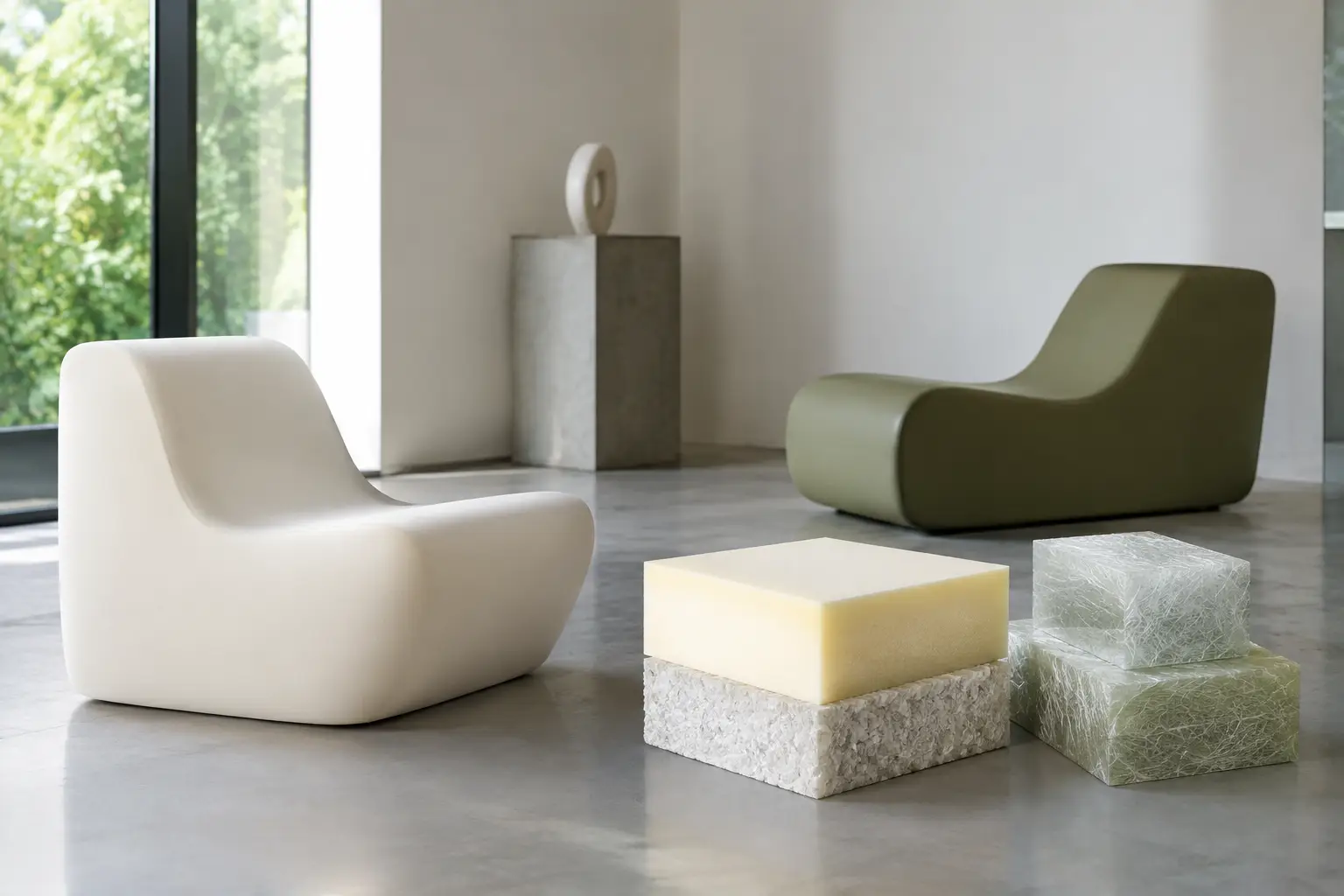
A curved reception desk, sculptural planter, or oversized lounge seat should not be forced into a material simply because that material is familiar. The architectural foam versus fiberglass decision begins with the object’s intended experience: how it should look, feel, perform, and be installed. Both materials can create dramatic forms, but they achieve them through very different fabrication logic.
For architects and designers, the question is rarely which material is universally better. It is which one supports the design intent without creating unnecessary compromises in comfort, finish quality, maintenance, lead time, or site complexity.
Architectural Foam Versus Fiberglass: The Core Difference
Architectural foam is a broad term, so specification language matters. In design-led furniture and architectural applications, it often refers to shaped foam cores that are finished with a durable coating system. The foam creates volume and geometry, while the coating provides the visible surface, tactile character, and protective layer.
Fiberglass typically refers to a fiber-reinforced plastic composite. Glass fibers are combined with resin to form a rigid shell or structural component, often using molds, hand layup, or other composite manufacturing processes. It is a familiar choice for hard shells, exterior elements, and repeatable molded components.
The practical distinction is immediate. Coated foam can combine sculptural freedom with a softer, more forgiving presence. Fiberglass produces a hard, rigid surface with a fundamentally shell-like character. That difference influences everything from the way people interact with the object to the way a designer resolves details at edges, joints, and transitions.
Design Freedom Is Not the Same as Mold Freedom
Fiberglass is highly capable when a project calls for rigid, repeated forms. Once a mold is created, it can support production consistency across many units. For a large run of identical shells, this can be a sensible manufacturing route.
But molds introduce a threshold. They require investment, development time, and design decisions to be finalized early. Complex undercuts, major dimensional changes, or late-stage revisions can become expensive quickly. A form that looks effortless in a rendering may demand multipart tooling, complex demolding, and extensive finishing in production.
Architectural foam approaches customization differently. CNC shaping, hand finishing, and specialized coating techniques can make it possible to develop seating, planters, wall features, and architectural objects without treating every design adjustment as a tooling event. This is especially valuable for hospitality interiors, branded environments, and public spaces where a concept may include varied dimensions, integrated functions, or site-specific geometries.
That does not mean foam is the automatic choice for every one-off. The scale of the piece, required structural support, and intended use still matter. It does mean designers can preserve more of the original gesture when a project calls for soft radii, continuous surfaces, unexpected profiles, or a family of related but non-identical forms.
What Happens at the Edge
Material character becomes most visible at the edges. Fiberglass can achieve crisp lines and strong corners, but its surface remains hard and may reveal the realities of composite fabrication if details are not carefully resolved. Seams, part lines, and finishing work deserve attention in both the design and quality-control process.
Coated foam favors a different expression. It can create smooth, uninterrupted volumes with softened edges and a monolithic appearance. That is particularly compelling for objects meant to be touched, leaned against, or used as informal seating. The visual language is less about a rigid shell and more about an object that appears formed as a single gesture.
Comfort, Acoustics, and Human Contact
A material selection should respond to the way people occupy a space, not only to how the object photographs. Fiberglass is hard. Even when it is beautifully finished, it generally requires separate cushions or upholstery when comfort is central to the brief.
Coated foam can provide controlled give under contact, depending on foam density, geometry, and the coating specification. This makes it particularly relevant for benches, loungers, poufs, seating landscapes, and playful public-space furniture. A coated foam object can read as architectural while still delivering a more inviting body feel than a hard composite shell.
There is also an acoustic consideration. Hard fiberglass surfaces reflect sound. In a lively restaurant, lobby, retail environment, or workplace, a room filled exclusively with hard materials can become visually polished but acoustically tiring. Foam-based furniture will not solve an acoustic strategy on its own, yet it can contribute a softer material counterpoint within a broader interior palette.
Durability Depends on the Whole Specification
It is tempting to describe fiberglass as durable and foam as delicate. That is too simplistic. Durability is determined by the complete assembly: substrate, coating or gel coat, thickness, reinforcement, joints, installation method, exposure conditions, cleaning regimen, and expected abuse.
Fiberglass can be an effective choice for rigid objects that need to resist deformation. It is often selected for shells, enclosures, and elements exposed to demanding conditions. However, composite surfaces can scratch, chip, or crack under sharp impacts, and repairs may require color matching and skilled refinishing. UV exposure, temperature movement, and moisture must also be considered in exterior applications.
A professionally engineered coated foam product can offer a resilient surface designed for daily commercial use while retaining the visual continuity of a sculptural form. The coating system is central to performance. Its flexibility, thickness, adhesion, texture, and resistance to cleaning products should be evaluated against the project’s actual conditions.
For exterior use, neither category should be specified with assumptions. Ask how the assembly responds to UV exposure, standing water, freeze-thaw conditions, heat gain, drainage, anchoring, and seasonal maintenance. A rooftop lounge in Phoenix, a coastal hotel terrace, and a covered courtyard in Chicago are not the same application.
Weight, Installation, and Site Reality
Large fiberglass objects can be lighter than many traditional construction materials, but they still behave as rigid shells. Their size may affect crating, freight access, elevator clearances, and the ability to maneuver through a completed interior. A one-piece feature may look ideal on drawings yet become difficult to bring into a finished site.
Architectural foam can offer meaningful advantages where low weight and easier handling matter. This is useful for large-format seating, temporary installations, upper-floor projects, and environments that are regularly reconfigured. The reduced mass can also support safer handling during installation, though every large object still requires a clear logistics plan.
Structural demands may shift the decision. If an element must bridge a span, support concentrated loads, resist vandalism, or serve as a code-sensitive architectural barrier, a foam core alone may not be appropriate. Internal frames, reinforcements, anchoring systems, or a different material altogether may be necessary. Good fabrication begins with an honest understanding of forces, not a preference for a visual effect.
Finish and Color: Specify the Experience
Fiberglass is commonly associated with glossy, automotive-like surfaces, although matte and textured finishes are possible. Its finish can feel precise and polished, making it suitable when the concept calls for a clean, hard-edged, high-gloss statement.
Coated foam offers a broader tactile conversation. Depending on the coating and texture, it can appear smooth, matte, lightly textured, soft-touch, or more architectural. Color can become part of the object rather than a separate upholstery decision, allowing a bench, planter, or lounge form to function as a strong chromatic element within the space.
Finish samples are essential. Designers should review them under the project’s real lighting conditions and discuss how the surface will age, how often it will be cleaned, and what kinds of contact it will receive. A pale matte finish in a busy airport lounge has different maintenance implications than a saturated color in a controlled gallery setting.
Questions That Lead to a Better Material Choice
Before selecting either material, define the object beyond its silhouette. Is it seating, a decorative feature, a planter, a spatial divider, or a load-bearing element? Will people sit on it, move it, climb on it, or simply see it from a distance? Does the project require ten identical units or a series of related custom forms?
Then consider the conditions that renderings do not show: access routes, cleaning protocols, attachment points, fire and local code requirements, exposure to weather, replacement strategy, and the tolerance for visible wear. These are not constraints that diminish creativity. They are the information that lets a fabrication partner turn a bold concept into an object that remains convincing after opening day.
For expressive furniture and architectural forms, Sixinch works from that intersection of design ambition and material discipline. The strongest result is not a generic answer to foam or fiberglass. It is a deliberately engineered object whose material, finish, and construction reinforce the experience the designer intended people to remember.