
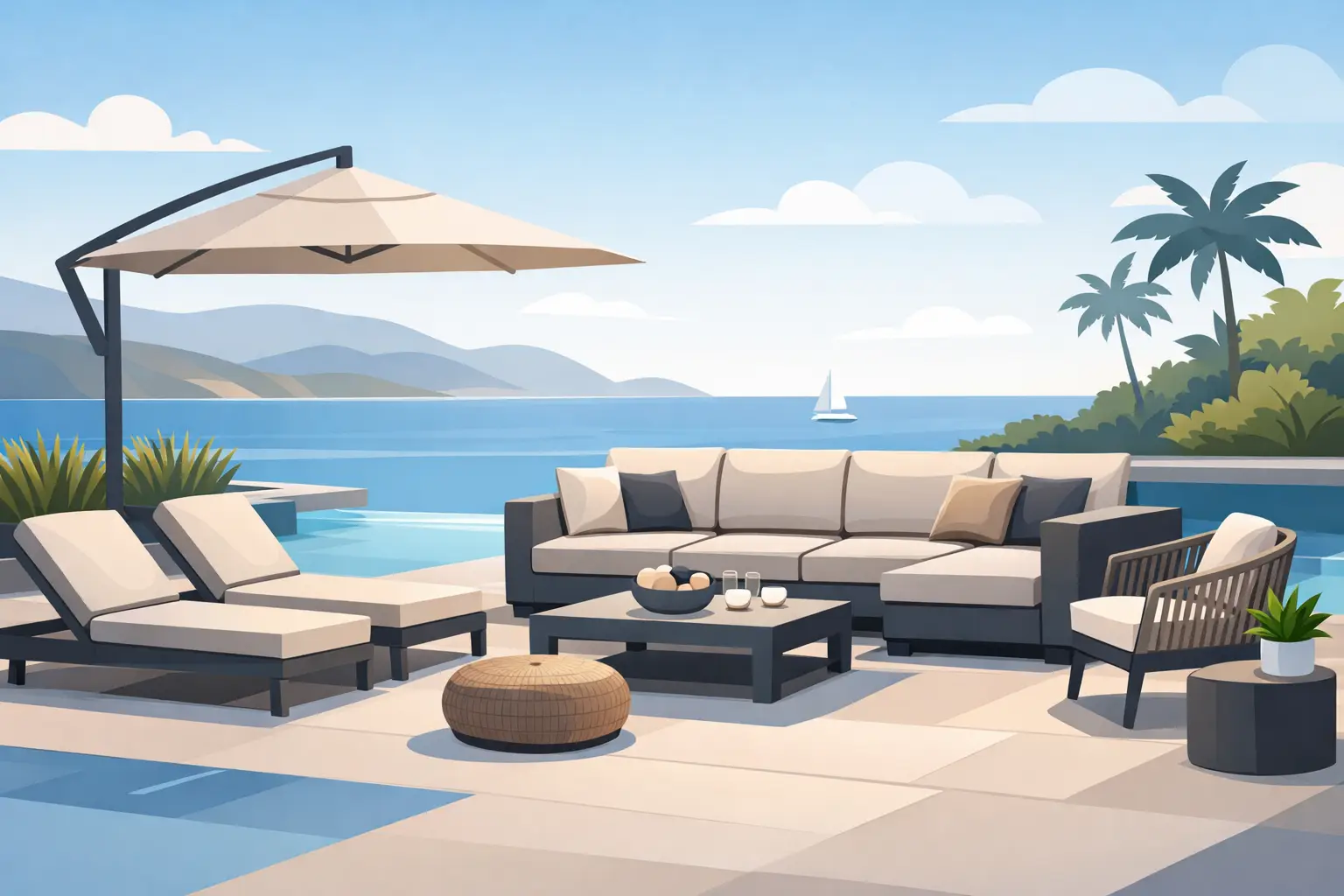
A pool deck can look finished on paper and still fall flat the moment standard seating lands on it. The scale is wrong. The silhouette is forgettable. The furniture survives outdoors, but it does nothing for the architecture. That gap is exactly where custom outdoor lounge furniture earns its place – not as decoration, but as a design tool.
For architects, landscape designers, and hospitality teams, outdoor seating is rarely just about giving people somewhere to sit. It has to support circulation, reinforce brand identity, handle weather exposure, and hold its visual presence in open space. Off-the-shelf pieces can work when the brief is simple. When the project calls for something sculptural, site-specific, or unmistakably original, customization stops being a luxury and becomes the most practical route.
Why custom outdoor lounge furniture changes the project
Outdoor environments are unforgiving. They expose every weak decision. A lounge piece that feels generous indoors can appear undersized on a terrace. A material that looks refined in a showroom can lose credibility after a season of sun, moisture, and heavy public use. Customization allows the furniture to be designed in response to the real conditions of the site rather than forced into them.
That matters most in projects where furniture is expected to do more than fill square footage. A rooftop hospitality lounge may need integrated shapes that guide social clusters without blocking views. A public plaza may require pieces that soften circulation zones while resisting impact and frequent cleaning. A retail exterior may need seating that extends the brand language beyond the facade. In each case, the geometry, finish, and scale of the furniture influence how the space is read and used.
Custom work also gives specifiers control over visual coherence. Instead of assembling a setting from unrelated products, designers can create seating that aligns with paving lines, planter forms, architectural curves, or a branded color strategy. The result is sharper and more intentional. People may not always identify why a space feels resolved, but they notice when it does.
What designers should specify from the start
The strongest custom outdoor lounge furniture projects begin with a clear understanding of performance, not just form. Shape comes first in the visual conversation, but specification determines whether the piece keeps its impact over time.
Form has to suit the site
Custom gives freedom, but freedom works best with boundaries. The right form depends on how the piece will be used, what kind of movement surrounds it, and how exposed the location is. A low, expansive lounge island can create drama in a resort setting, but the same footprint may be inefficient in a compact commercial courtyard. Similarly, a highly sculptural piece can become the focal point of a space, though that only works if circulation and access are resolved around it.
Designers should also think carefully about edge conditions and seating posture. Formal hospitality settings may call for more structured comfort and defined seat geometry. Casual public environments often benefit from looser forms that invite different sitting positions. There is no universal right answer. It depends on whether the project needs precision, softness, playfulness, or control.
Surface finish is not a secondary detail
For outdoor furniture, the finish is doing aesthetic and technical work at the same time. It defines the tactile experience, influences how light interacts with the object, and affects how the furniture handles wear, cleaning, and exposure. In coated furniture, that surface becomes especially important because it allows soft underlying forms to take on a durable architectural skin.
This is where specialized fabrication changes the possibilities. Foam-coated construction allows designers to develop volumes and contours that are difficult to achieve with harder, more conventional materials alone. Rounded monolithic seating, seamless curves, oversized organic forms, and branded sculptural elements become viable without losing durability. For design-led outdoor spaces, that combination of visual freedom and practical performance is a serious advantage.
Color should be specified with context
Outdoor color behaves differently than indoor color. Daylight intensifies some tones and flattens others. A vivid hue can activate a neutral terrace, while the same hue might overwhelm a compact courtyard. The surrounding materials matter just as much as the chosen finish. Stone, timber, metal, planting, water, and signage all shift the perception of color.
Custom production allows color to be treated as part of the architecture rather than an afterthought. That can mean matching a brand palette, developing contrast against the landscape, or selecting a tone that lets the form speak more quietly. Bold color can be a strength, but restraint can be equally powerful when the geometry is doing the work.
The real value of bespoke outdoor fabrication
There is a tendency to frame customization as a purely creative choice. In practice, it often solves practical problems faster than trying to modify standard products around a difficult brief.
A custom piece can be scaled to fit an irregular footprint without creating dead zones. It can be developed as a modular system for easier installation and future reconfiguration. It can incorporate planters, backrests, dividers, or branded forms into one continuous design language. It can also reduce visual clutter by replacing multiple separate objects with one cohesive solution.
That efficiency is particularly valuable in commercial and public settings where every element has to earn its place. A well-designed custom lounge piece can act as seating, spatial definition, and visual identity all at once. Instead of adding more products to achieve those functions, the project gets one stronger object.
For specifiers, the fabrication partner matters as much as the concept. Bold forms are easy to sketch and much harder to manufacture well. Translating intent into a production-ready object requires technical knowledge around tolerances, surface behavior, structural logic, and use conditions. The best outcomes happen when design ambition and manufacturing expertise are part of the same conversation from the beginning.
Custom outdoor lounge furniture for hospitality, public space, and retail
Different sectors ask different things of outdoor furniture, even when the visual expectations are equally high.
Hospitality needs atmosphere and endurance
Hotels, resorts, restaurants, and rooftop venues need seating that photographs well, wears well, and supports guest experience from morning to night. Custom lounge furniture can shape zones for conversation, waiting, dining-adjacent relaxation, or poolside use without relying on generic hospitality language. It also gives operators a way to create a memorable exterior identity rather than treating the outdoor area as an extension furnished by default.
The trade-off is that hospitality projects usually involve heavy use and frequent maintenance. Beautiful forms only succeed when the material system is easy to clean and built for repeated contact. That is why durability should never be separated from concept development.
Public space demands resilience without looking defensive
Public seating often swings between two extremes – anonymous utility or overworked anti-vandal solutions that flatten design quality. Custom fabrication offers another route. It allows public furniture to feel generous, contemporary, and integrated into the landscape while still being engineered for demanding use.
Here, the right answer depends on context. A civic plaza may need large anchored elements with clear visibility and minimal maintenance complexity. A campus or cultural site may support more expressive forms that encourage interaction. The challenge is creating furniture that feels inviting without becoming fragile.
Retail and branded environments need recognition
For retail terraces, mixed-use developments, and experiential commercial spaces, outdoor furniture can become part of the brand architecture. A custom silhouette, signature color, or sculptural seating gesture can reinforce identity before a visitor enters the building. When done well, it feels effortless. When done poorly, it feels promotional.
The difference is integration. Branded outdoor furniture should extend the visual logic of the space, not interrupt it. That requires discipline in form, proportion, and finish selection.
When to go custom and when not to
Not every project needs a bespoke solution. If the layout is straightforward, the budget is tight, and there is no need for distinctive geometry or brand alignment, a standard product may be the smarter choice. Custom should not be specified for its own sake.
It becomes the better decision when the project has a unique footprint, a strong visual identity, or a need for forms that standard manufacturing does not offer. It also makes sense when furniture has to solve multiple design problems at once, especially in high-visibility spaces where generic seating would weaken the overall concept.
The key is being honest about priorities. If the furniture is expected to disappear quietly into the background, customization may be unnecessary. If it is expected to carry the space, support the architecture, and leave a lasting impression, custom is often the clearest path.
Sixinch approaches that challenge with the mindset of a fabrication partner, not just a furniture supplier – translating ambitious concepts into durable coated forms that are made to perform in real-world environments.
The best outdoor spaces do not rely on furniture as a final layer. They build it into the idea from the start. When custom outdoor lounge furniture is treated that way, it stops being an accessory and starts shaping how the project is experienced.