
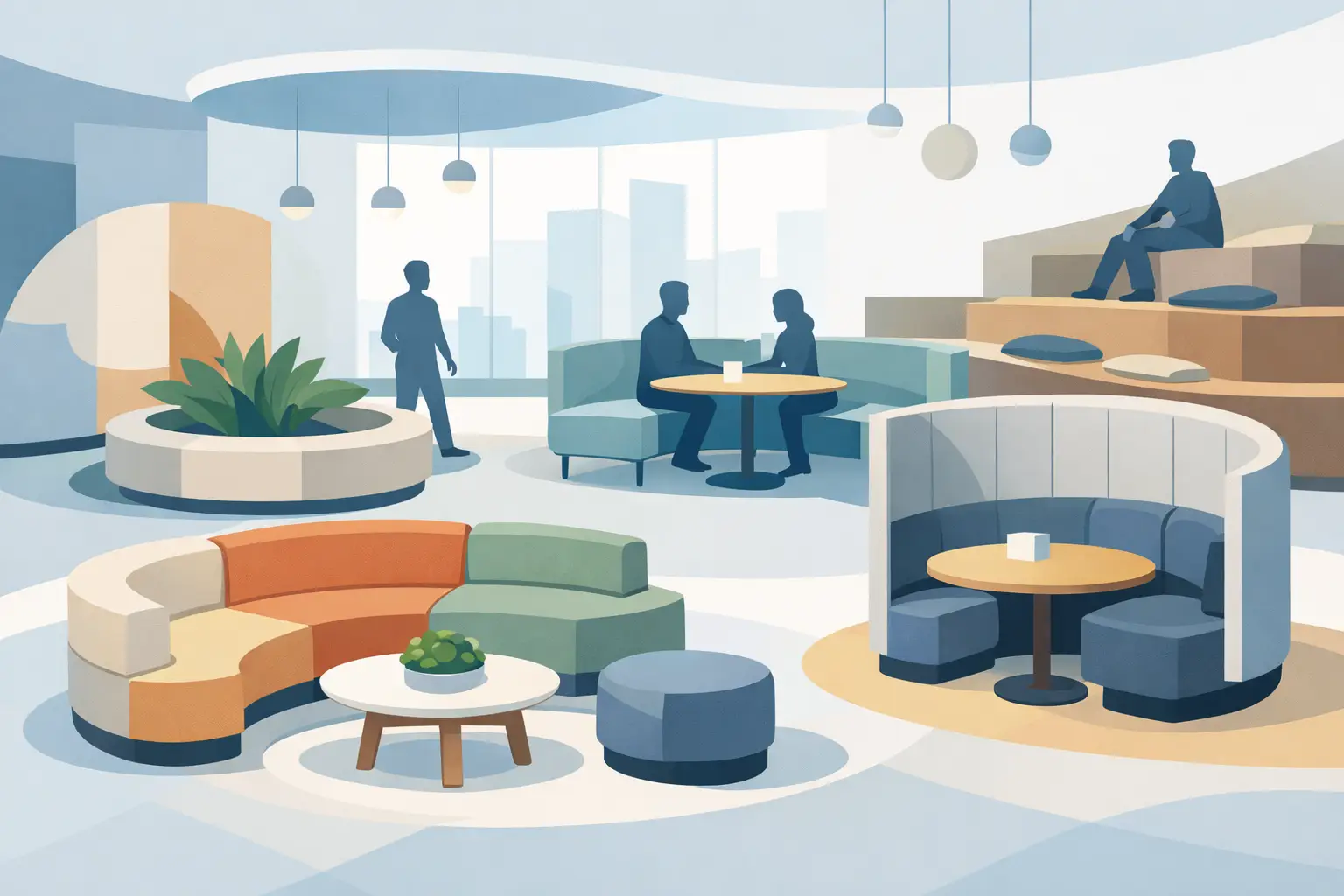
A hospitality lobby with perfect lighting and expensive finishes can still fall flat if the seating feels generic. The same is true in retail, workplace, education, and public projects where people don’t just pass through – they pause, gather, wait, recharge, and remember. Custom commercial seating changes that equation by turning seating into part of the architecture, part of the brand story, and part of the user experience.
For designers and specifiers, that shift matters because seating occupies visual and functional territory at the same time. It can direct circulation, soften hard spaces, define zones without walls, and create a more memorable identity than off-the-shelf pieces ever could. When the form, scale, finish, and performance are developed for the project rather than borrowed from a catalog, the result is usually stronger, more coherent, and more useful.
Why custom commercial seating matters
Commercial seating is rarely just about offering a place to sit. In high-traffic interiors and public-facing environments, it also has to withstand use, support brand expression, and fit a space that often has unusual dimensions or competing demands. A standard bench or lounge chair can solve one problem, but it often introduces another. It may fit the budget but miss the visual brief. It may look right in isolation but waste valuable floor area. It may meet capacity needs but fail to create the atmosphere the project requires.
Custom commercial seating gives the design team more control over these trade-offs. A built form can be lengthened, curved, wrapped around a column, integrated into a waiting zone, or developed as a sculptural focal point. The upholstery or coated finish can align with brand colors. The geometry can encourage short-stay use, longer dwell time, or casual social interaction depending on the setting.
That flexibility is especially valuable in projects where the seating has to do more than furnish a room. In a flagship retail environment, it may need to support a branded experience. In a student commons, it may need to support both individual pause points and informal group use. In a hospitality lounge, it may need to feel distinctive enough to photograph well while still performing every day.
Designing custom commercial seating around behavior
The strongest seating concepts begin with behavior, not just form. What people do in a space should inform how they sit in it. That sounds obvious, but many commercial environments are still furnished with pieces chosen primarily for appearance or immediate availability.
A reception area calls for a different posture than a social lobby. Airport-adjacent hospitality asks for different seat depths than a fast-turn café. Public waiting areas need easy ingress and egress, while lounge settings can afford a more relaxed profile. If users carry bags, laptops, shopping, or drinks, those objects also need a place in the composition, whether through adjacent surfaces, integrated geometry, or spacing that accommodates movement.
This is where bespoke development earns its value. Instead of forcing human behavior into a pre-existing product, the seating can be shaped around actual use patterns. Curves can pull people into conversation. Linear runs can keep circulation clear. Islands can create moments of pause in open plans that would otherwise feel exposed.
There is always an it-depends factor here. Highly expressive forms can create drama, but they also need to remain intuitive. If a piece looks impressive and sits awkwardly, the project pays for visual impact with user discomfort. Good custom seating resolves both.
Form, brand, and architectural integration
When commercial interiors are expected to feel distinct, seating becomes a branding tool as much as a functional one. This does not necessarily mean applying logos or obvious graphics. More often, the strongest branded environments use shape, proportion, color, and material language to create recognition.
Custom seating can echo architectural curves, extend a facade concept indoors, or bring softness into a space dominated by hard surfaces. It can also become a signature object – the element people remember, photograph, and associate with the place. For hospitality, retail, cultural, and experiential environments, that kind of visual recall has real value.
Architectural integration is equally important. Standard products often leave awkward residual spaces: too much gap at the wall, too little flexibility around a column, too much visual noise in a clean interior. Custom pieces can resolve those conditions precisely. They can be freestanding or built-in, monolithic or modular, expressive or restrained. The point is not customization for its own sake. The point is achieving a cleaner fit between object and environment.
Material choices shape performance
The conversation around custom commercial seating usually starts with form, but performance depends heavily on fabrication and finish. Designers specifying for commercial use need materials that hold shape, resist wear, clean well, and maintain visual quality under repeated use.
Different projects will demand different solutions. Traditional upholstery can bring warmth and tactile softness, but it may introduce maintenance complexity in some public environments. Harder materials can offer durability, but they may lose comfort or visual softness. Coated foam occupies a compelling space between these categories because it allows fluid, sculptural forms while delivering a durable, easy-care surface appropriate for demanding settings.
That matters when the concept includes unusual geometries that would be difficult or visually compromised in conventional construction. Smooth radii, bold volumes, and soft-edged monolithic forms become more feasible when the manufacturing process supports them from the start. For design teams pursuing non-standard forms, material capability is not a secondary issue. It defines what can actually be built.
Maintenance should also be discussed early. A dramatic statement piece specified for a busy public environment needs to look intentional after months of use, not only on installation day. Surface cleanability, color consistency, and resistance to abrasion or impact all influence long-term success.
What to consider when specifying custom commercial seating
A custom piece can solve many design problems, but it also asks better questions upfront. Dimensions are only the beginning. Designers should consider occupancy patterns, expected dwell time, adjacency to circulation paths, accessibility, maintenance staff realities, and whether the seating will need to be moved, anchored, or installed in sections.
Tolerance and scale are especially important. A piece that reads beautifully in a rendering may overwhelm the room if the seat height, back angle, or overall mass is not carefully tested. Likewise, an elegant profile can become impractical if it leaves no margin for cleaning around it or access to nearby fixtures.
Mockups and fabrication dialogue often make the difference between a strong idea and a buildable one. Commercial projects involve constraints, and custom work succeeds when those constraints are engaged early rather than treated as an obstacle at the end. Budget, lead time, logistics, and installation sequencing all shape the final result.
This is where an experienced fabrication partner becomes critical. The best outcomes come from translating ambitious concepts into production-ready forms without flattening the original design intent. That requires technical authority as much as creative openness.
When custom is worth it
Not every project needs bespoke seating throughout. Sometimes a standard product is the right call for schedule, consistency, or cost control. But custom commercial seating tends to be worth the investment when the seating plays a defining role in the spatial concept, when the layout includes challenging dimensions, or when the project needs a level of originality that catalog products cannot deliver.
It is also worth it when one piece can do the work of several. A custom bench might organize circulation, provide seating, reinforce branding, and create a focal point all at once. In that case, the value is not just in having something unique. It is in solving multiple design objectives with one integrated move.
For architects and designers working on high-concept environments, that efficiency can be powerful. The object is no longer an afterthought. It becomes part of the architecture’s logic.
At Sixinch, that approach is central to how bold seating concepts move from sketch to finished object. The real opportunity in custom work is not simply choosing a different shape or color. It is using fabrication freedom to create seating that belongs to the space so completely that it could not have been specified any other way.
The best commercial interiors leave an impression because every element feels intentional. Seating should do the same – not just fill the plan, but shape how the space is seen, used, and remembered.
1 comment