
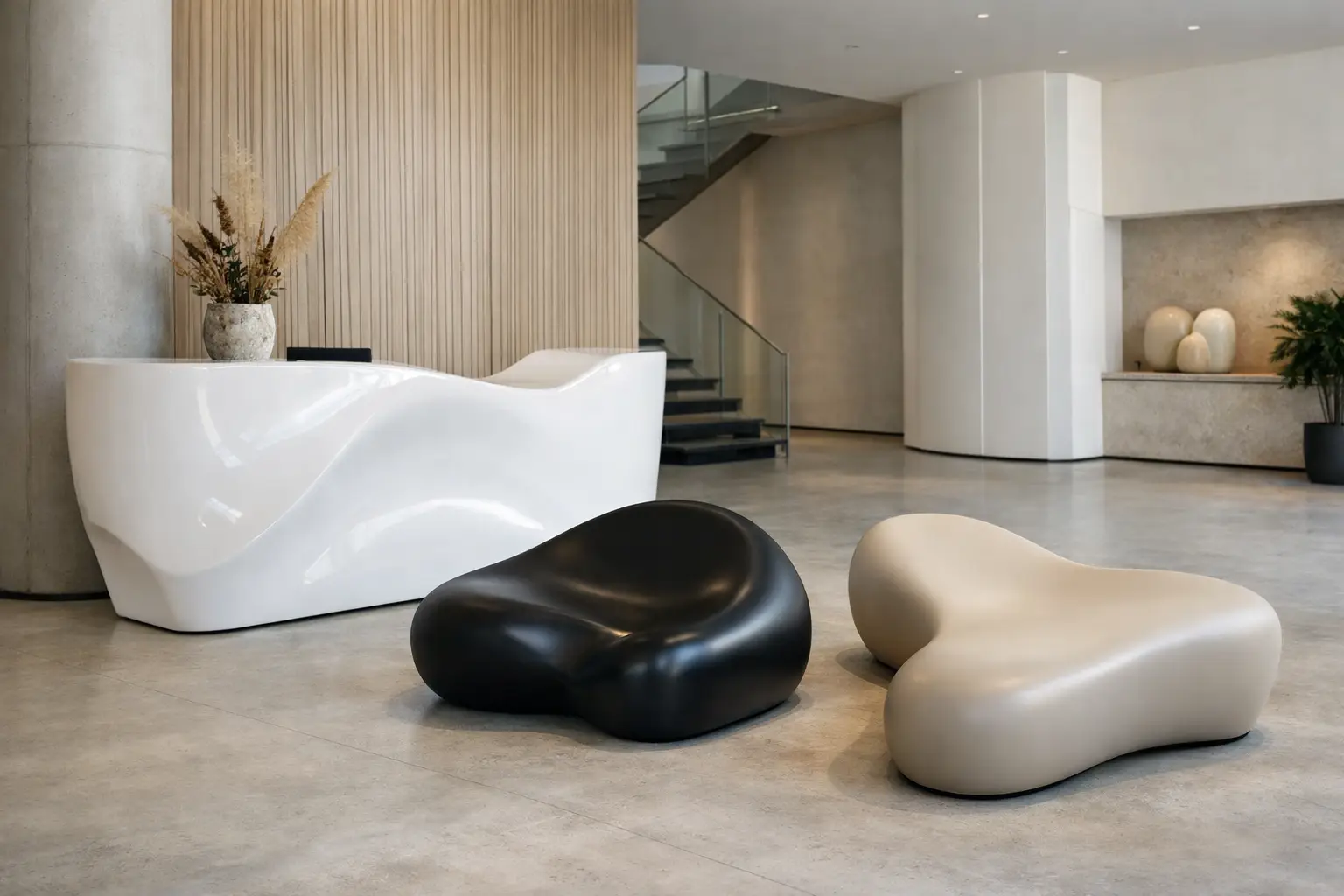
A reception piece has about three seconds to do its job. Before anyone notices the lighting detail, the signage, or the material palette, they register the object at the front of the room. If you are figuring out how to commission sculptural reception furniture, that reality should shape every early decision. The right piece is not just seating or a desk. It sets the spatial tone, signals brand intent, and has to survive constant public use without losing its edge.
That is exactly why sculptural reception furniture needs a different commissioning process than standard contract furniture. Off-the-shelf products are designed to fit broad categories. A sculptural piece is usually carrying more weight. It may need to anchor circulation, soften architecture, hide functional requirements, integrate branding, or create a memorable first impression in a hospitality, workplace, retail, or public setting.
Start with the role, not the shape
The most common mistake is starting with an image and trying to reverse-engineer the brief around it. Strong reception furniture can look effortless, but it only works when the visual idea is tied to use. Is the piece primarily a reception desk, a waiting zone, a sculptural bench, a brand statement, or all four at once? Those are very different design problems.
A reception island for a hotel lobby may need guest-facing elegance on one side and hidden operational efficiency on the other. A branded seating form for a corporate headquarters may need to function more like spatial sculpture, where comfort matters but visual impact matters more. In a healthcare or education setting, circulation, cleanability, and durability might drive the geometry more than expressive form.
Define the piece in terms of performance before aesthetics. You want to know how many people will use it, how long they will sit, whether bags or devices need to be accommodated, whether accessibility needs to be built into the form, and how it will interact with flooring, walls, and nearby architectural elements. The sculptural language can then grow from real constraints instead of fighting them.
How to commission sculptural reception furniture with a clear brief
A good custom brief does not have to be long, but it does need to be specific. Designers often bring references, sketches, renderings, finish directions, and a target mood. That is useful, but manufacturers also need information that makes the concept buildable.
At minimum, the brief should establish the intended dimensions, approximate capacity, installation environment, desired finish, color direction, and expected traffic level. It should also clarify whether the object needs to be freestanding, modular, fixed, or integrated with other architectural features. If lighting, power, signage, storage, or display functions are part of the idea, say so early. Those elements affect internal structure and fabrication sequencing.
The best commissioning conversations happen when ambition and realism meet early. A dramatic overhang may be possible, but only with reinforcement. A monolithic form may look simple, but transport and site access could complicate production. A very soft organic radius may be ideal visually, yet the exact edge profile will influence durability in high-contact zones.
That is where an experienced fabrication partner adds value. You are not only buying production capacity. You are buying technical interpretation.
Material logic matters as much as concept
Sculptural reception furniture succeeds when the material system supports the form instead of limiting it. This is especially relevant for pieces with continuous curves, oversized geometry, or monoblock silhouettes that conventional upholstery or casework methods handle poorly.
Coated foam fabrication offers unusual freedom here because it can produce smooth, highly controlled forms without the visual interruptions that come with panelized construction, stitched upholstery, or multi-part assemblies. That matters in reception spaces, where visual clarity is often the point. A piece can read as one precise volume instead of a collection of joined parts.
Still, material freedom is not the same as material neutrality. You need to ask how the surface will perform under bags, shoes, cleaning routines, and repeated touch. You should also consider whether the piece is likely to be moved, climbed on, or used in unintended ways. In a public-facing environment, people rarely interact with furniture exactly as specified.
If the project demands a bold, sculptural gesture, the finish has to hold that gesture over time. Crisp edges, smooth transitions, and consistent color application are not minor details. They are what make the object read as intentional rather than experimental.
Design for traffic, maintenance, and abuse
Reception zones are deceptively tough environments. Even in refined interiors, the furniture takes constant friction from luggage, denim, belts, shoes, carts, and cleaning equipment. If the piece includes a desk element, you may also be dealing with cable access, devices, concealed storage, and user ergonomics for staff.
This is why the answer to how to commission sculptural reception furniture is never just “make it look iconic.” The form has to anticipate wear. Rounded transitions often age better than overly sharp projections. Fully integrated shapes can reduce weak points and dirt traps. Surface finish selection should reflect the actual use profile, not only the rendering.
Maintenance teams should be part of the conversation sooner than many designers expect. What products will they use? How often will the surface be cleaned? Does the space experience wet weather at the entrance? Is the furniture close to food or beverage service? These factors shape finish recommendations and detailing decisions.
There is also a strategic trade-off between maximum visual drama and long-term tolerance. Sometimes the strongest move is not the most extreme one. A form can still be highly sculptural while being easier to maintain, safer in circulation paths, and more durable at contact points.
Collaborate around prototypes and samples
Renderings can sell a concept, but prototypes expose reality. For bespoke reception furniture, that reality usually includes scale, ergonomics, finish behavior, and construction logic. Even a partial mockup can reveal whether the radius feels elegant or oversized, whether the seat height is inviting, or whether the piece reads as architecture rather than furniture.
This stage is where confident designers sharpen the work. It is also where smart clients protect the budget. Adjusting geometry in development is far less painful than revising fabricated pieces after approval.
Color and surface samples matter just as much. Reception furniture is often photographed, heavily lit, and viewed from multiple angles throughout the day. A color that feels saturated in a sample chip may look flatter across a large curved volume. A matte effect may feel sophisticated in one project and too muted in another. Samples let the design team make decisions based on the actual object language, not assumptions.
Budget for complexity, not just size
Large does not always mean expensive, and small does not always mean simple. A compact reception piece with compound curves, integrated functionality, custom color matching, and tight tolerance requirements can be more demanding than a much bigger bench.
When budgeting custom work, it helps to separate the drivers of cost: geometry complexity, surface finish requirements, integrated features, prototyping needs, shipping constraints, and installation conditions. If the design has to break into sections for access, that join strategy must be resolved cleanly. If the object needs to align precisely with architectural finishes on site, that coordination needs time and technical rigor.
Lead times should also reflect the fact that bespoke furniture is a process, not a product pulled from inventory. Development, review, sampling, production, and logistics all need room. If the reception area is the focal point of the opening, leaving the signature piece to the end of the schedule is a gamble.
Choose a manufacturer that can translate, not just produce
A sculptural concept lives or dies in translation. The partner you choose should be able to discuss proportion, detailing, use case, tolerances, finish performance, and installation with the same fluency. That is especially true when the design is unconventional.
The strongest custom partnerships are collaborative without diluting the idea. They protect the concept while making it manufacturable. Sometimes that means refining radii, adjusting thicknesses, simplifying hidden structure, or recommending a different approach to surface treatment. Those are not compromises by default. Often, they are the steps that turn a strong sketch into a convincing built object.
For architects and designers working in branded or experiential environments, this matters even more. Reception furniture is often carrying identity. It has to feel precise, not approximate. A manufacturer with real expertise in sculptural form development can help preserve that precision from concept through production.
How to know the piece is ready
You are ready to approve when the piece answers three questions clearly. Does it belong to the brand and the space? Will it perform under real-world use? And does the final fabrication method support the visual ambition rather than imitate it?
If any of those answers are uncertain, the project needs another round of refinement. That is normal. Sculptural furniture is rarely about speed. It is about conviction backed by technical control.
Sixinch works in exactly that territory, where bold form has to meet real specification demands. And that is the useful standard to keep in mind for any custom reception project: if the piece cannot survive contact with people, operations, and time, it is not sculptural reception furniture yet. It is still just an idea waiting to be made real.
The best reception pieces do more than greet people. They make the room feel authored from the moment someone walks in.