
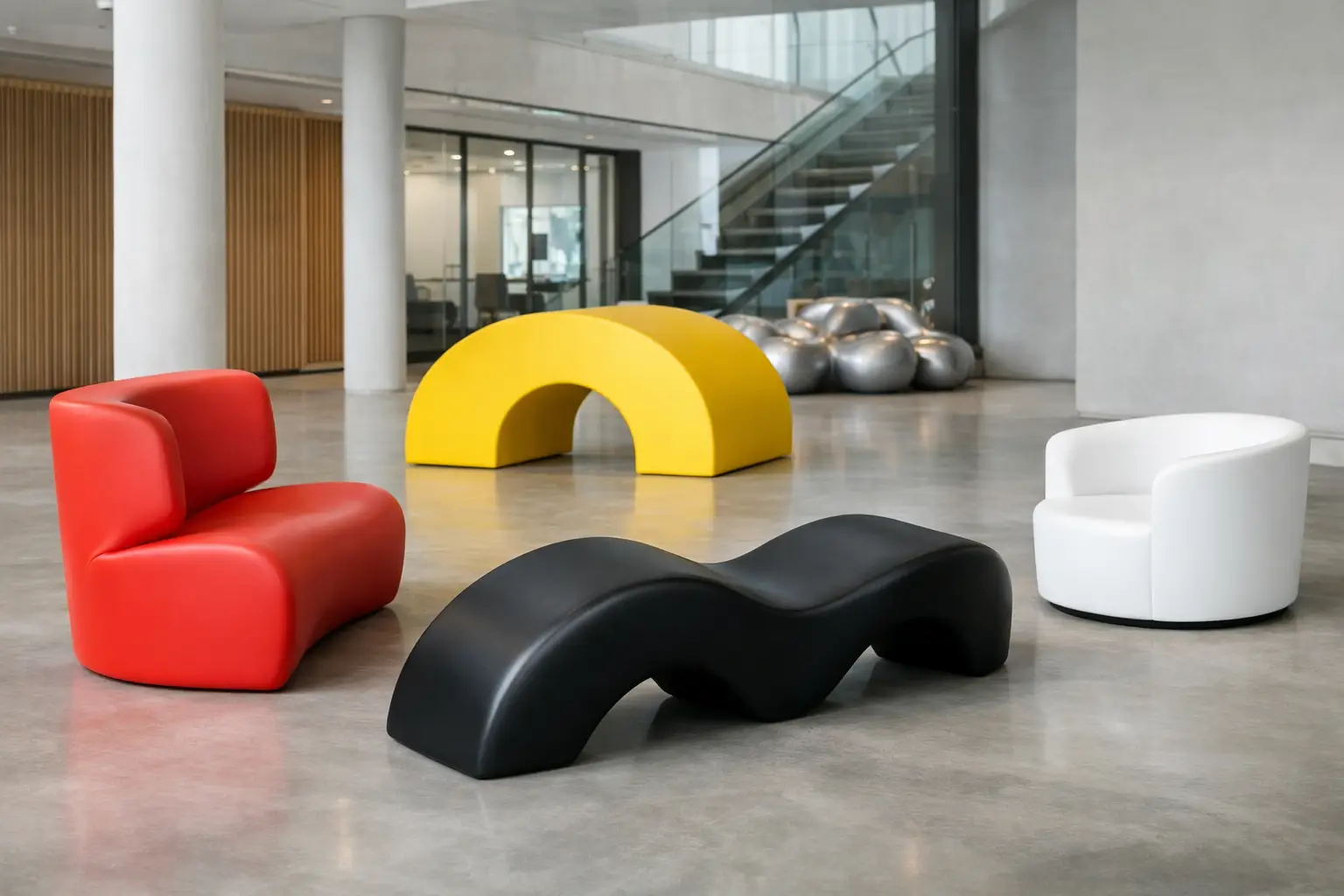
A branded interior rarely fails because the logo is wrong. It fails when the space says one thing and the furniture says another. A hospitality lounge can carry a bold identity system, a retail concept can have immaculate graphics, and a workplace can invest in every surface finish – but without statement furniture for branded spaces, the experience stays flat.
The pieces people sit on, gather around, photograph, and remember carry far more brand weight than many teams expect. Furniture is not just a functional layer. In the right hands, it becomes spatial messaging with volume, color, and presence.
Why statement furniture for branded spaces matters
In commercial environments, furniture is one of the few brand elements that operates at both visual and physical scale. Guests do not just see it. They move around it, touch it, wait on it, and build associations through repeated use. That makes it more powerful than decorative styling and more immediate than signage.
For architects and interior designers, this creates an opportunity and a constraint. The opportunity is obvious: furniture can become a signature feature that gives a project identity. The constraint is that generic products rarely hold up in concept-driven spaces. Standard seating lines tend to flatten the brand story because they were never designed to carry one.
Statement furniture changes that equation. It can reinforce a brand through silhouette, material expression, color, proportion, and customization. In a retail environment, that might mean sculptural seating that echoes packaging geometry or display language. In hospitality, it might mean soft, expressive forms that make the atmosphere feel designed rather than furnished. In public or workplace settings, it can create memorable zones without adding visual clutter.
This is especially true in projects where the brand is meant to feel immersive. If the environment is part showroom, part social space, and part experience, furniture needs to do more than fill a floor plan. It needs to hold attention and support the concept from every angle.
What makes furniture a statement piece in a branded interior
A statement piece is not simply oversized, bright, or unusual. Those moves can work, but they are not enough on their own. Real impact comes from alignment between concept and execution.
Form is usually the first driver. Unconventional curves, monolithic volumes, softened geometry, and custom profiles can create immediate recognition. In branded settings, form often does the work of differentiation before a visitor consciously registers the brand language.
Color is the second driver, and it is often underused. Many branded interiors rely on small accents while keeping furniture visually safe. That restraint can be appropriate in some settings, especially luxury environments where subtlety matters. But in experiential retail, hospitality, education, and public projects, custom color can turn furniture into an active part of the identity system rather than a neutral support layer.
Then there is finish. This is where many striking concepts become difficult to specify. A dramatic shape may look compelling in a rendering, but if it cannot withstand traffic, cleaning protocols, or repeated contact, the design loses value quickly. Statement furniture has to perform. Otherwise, it becomes an expensive visual gesture that ages badly.
The role of custom fabrication in brand expression
The strongest branded spaces usually require more than off-the-shelf selection. They need adaptation, custom development, or a fabrication partner capable of translating a concept into a buildable object without losing what made it compelling in the first place.
That is where custom coated-foam fabrication becomes especially relevant. It allows designers to move beyond conventional furniture typologies and work with freer, more sculptural forms while still meeting the practical demands of commercial use. Soft geometry, continuous surfaces, integrated seating, branded volumes, and architectural furniture elements become much more achievable when the manufacturing process supports shape complexity instead of fighting it.
For design teams, this opens a wider range of possibilities. A bench can become a sculptural marker in a lobby. A planter can become part furniture, part wayfinding. A lounge element can carry the softness and color identity of a brand without looking like a branded prop. These are subtle distinctions, but they matter. The best branded spaces avoid literalism. They express identity through spatial character, not just applied graphics.
Sixinch has built its reputation around exactly this kind of freedom: taking bold ideas and turning them into production-ready furniture and architectural elements with a distinctive coated finish and strong visual clarity.
Where statement furniture works hardest
Retail is the obvious category, but it is far from the only one. In stores and showrooms, statement furniture often becomes part of the customer journey. It creates pause points, social moments, and photo-worthy features while reinforcing a brand’s visual world.
Hospitality environments benefit just as much. In hotels, bars, rooftop venues, and lounges, furniture often defines mood faster than lighting or decorative accessories. A custom sofa landscape, a curved bench system, or a series of sculptural stools can anchor the identity of a venue in a way that feels immediate and experiential.
Workplace and campus environments are another strong fit, especially for brands trying to create less corporate, more expressive common areas. Reception zones, collaboration hubs, breakout areas, and terraces all benefit from furniture with personality. The key is balancing identity with comfort and circulation.
Public and mixed-use projects add another layer. Here, statement furniture has to work harder because it serves diverse users and sees heavier wear. That does not mean the design has to become conservative. It means the specification has to be more disciplined. Shape, finish, maintenance, and installation all need to be considered from the beginning.
The trade-offs designers should think through
Not every branded space needs its furniture to be the loudest element in the room. Some projects benefit from one focal piece and a quieter supporting palette. Others need a family of custom elements that create consistency across zones. The right answer depends on the architecture, the brand maturity, the traffic profile, and how often the concept will be refreshed.
There is also a difference between visual impact and visual overload. If every piece competes for attention, the result can feel themed rather than designed. Statement furniture works best when it has room to breathe and a clear role within the larger composition.
Budget matters too, but not always in the simplistic custom-versus-standard way clients assume. A well-designed signature piece can do the work of multiple decorative interventions. In some cases, investing in fewer, more intentional furniture elements creates a stronger branded environment than spreading budget across generic pieces and added styling.
Lead time and technical development should also be part of the conversation early. Bespoke work offers more freedom, but it requires clarity around dimensions, use case, finish expectations, and installation conditions. For specifiers, the best process is collaborative: ambitious on the design side, precise on the production side.
How to specify statement furniture for branded spaces well
The strongest specifications start with a simple question: what should this piece do for the brand besides provide a seat, surface, or boundary? When that answer is clear, design decisions become more focused.
Sometimes the goal is recognition. Sometimes it is softness in an otherwise angular environment. Sometimes it is to pull a brand color into three-dimensional form. Sometimes it is to create an object people remember long after they leave. Each goal leads to different choices in scale, geometry, placement, and finish.
It helps to think in zones instead of isolated products. A branded interior usually needs moments of intensity and moments of calm. Statement pieces can define entrances, social nodes, waiting areas, terraces, or circulation anchors, while quieter complementary elements support usability around them.
Material performance should stay close to the design conversation, not follow after it. High-touch commercial furniture needs to resist wear, clean easily, and maintain visual integrity. This is one reason coated furniture solutions are so attractive in demanding spaces: they combine expressive form with a surface designed for real use.
And finally, prototype thinking matters. Bold furniture often looks simple when it is resolved well, but that simplicity is usually the result of technical discipline. Radius, density, coating, edge behavior, and installation details all shape the final experience.
Branded spaces are remembered through atmosphere, and atmosphere is built from physical decisions. The right furniture does more than support the concept – it gives the concept mass, silhouette, and staying power.