
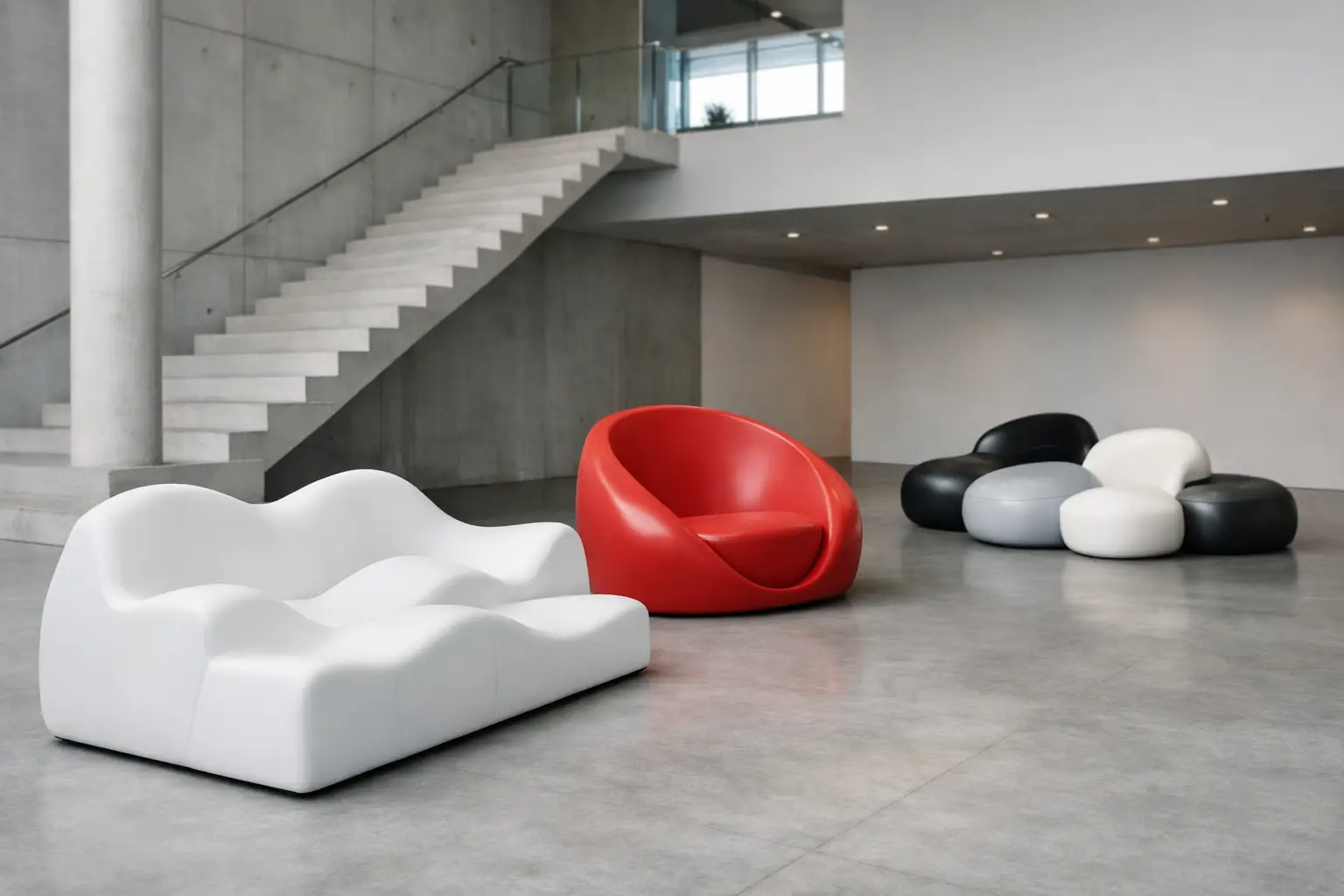
A lounge that gets photographed all day and ignored at night usually has the same problem: it was designed as an image first and a place second. The most relevant trends in experiential seating design are correcting that imbalance. Designers are pushing beyond statement furniture that simply looks unusual, toward seating that shapes movement, supports brand identity, invites interaction, and still performs under real commercial use.
For architects, interior designers, and specifiers, that shift matters. Seating is no longer a background layer added after the spatial concept is set. In hospitality, retail, workplace, education, and public environments, it is increasingly part of the architecture of experience. It defines zones, slows people down, encourages social behavior, and often becomes the object that carries the strongest visual memory of a space.
Why trends in experiential seating design are changing
What changed is not just taste. Clients now expect furniture to do more at once. A single seating element may need to support brand storytelling, withstand heavy traffic, soften acoustics, create flexible circulation, and photograph well from multiple angles. In many projects, it also needs to feel custom even when timelines and budgets remain commercially grounded.
That pressure is driving a more integrated design language. Seating is becoming less typological and more spatial. Instead of asking whether a project needs benches, sofas, or poufs, designers are asking what kind of interaction a zone should generate. The answer often leads to hybrid forms – pieces that operate as furniture, soft architecture, wayfinding devices, and sculptural anchors at the same time.
There is also a clear move away from generic modularity. Modular systems still matter, but the expectation has changed. Standard modules alone rarely create a memorable environment. Designers want modules that curve, stack visually, wrap columns, negotiate awkward footprints, or align with a brand’s geometry. Flexibility now means formal freedom, not just easy reconfiguration.
The key trends in experiential seating design
Sculptural forms are becoming functional tools
Expressive seating is not new, but its role is more sophisticated than before. Bold silhouettes are being used to direct sightlines, shape behavior, and create atmosphere. A soft monolithic bench in a large atrium can make an oversized space feel intentional. A rounded seating cluster can turn an open retail floor into a pause point without introducing hard partitions.
The best sculptural seating does not force a choice between drama and usability. It resolves both. That requires careful control of proportion, seat height, edge softness, and surface durability. The visual gesture may be dramatic, but the user experience still depends on fundamentals. If the piece is beautiful but awkward to occupy for more than a minute, it fails in a commercial setting.
Soft zoning is replacing rigid space planning
One of the strongest shifts in experiential environments is the use of seating to organize space without building it out. In open-plan hospitality, workplace, and mixed-use settings, furniture is now doing more of the zoning work once handled by walls, millwork, or fixed dividers.
This is where low-profile seating, curved benches, upholstered landscape forms, and island-like lounge compositions are especially effective. They create edges without closing off visibility. They also let designers preserve openness while still defining moods and functions within the same footprint.
There is a trade-off, of course. Soft zoning works best when circulation has been studied properly. A dramatic seating composition can improve flow, but it can also create bottlenecks if it is treated as a sculptural insert rather than part of the plan. The form has to read clearly from multiple approaches and support intuitive movement.
Customization is moving from luxury to expectation
In design-led commercial work, bespoke seating is no longer reserved for flagship budgets. More clients are asking for tailored dimensions, brand-specific colors, integrated logos, project-driven geometries, or forms developed around a spatial concept. The reason is simple: experience has become a competitive tool, and off-the-shelf furniture rarely delivers a distinct identity on its own.
That does not mean every project needs fully custom product development. Often the smartest approach is a calibrated one – adapting an existing typology through scale, finish, upholstery strategy, or configuration. But the broader trend is clear. Specifiers increasingly want manufacturing partners who can translate unusual ideas into production-ready seating without losing the design intent in the technical process.
Comfort is becoming more layered
Experiential seating used to be criticized, sometimes fairly, for prioritizing spectacle over comfort. That gap is narrowing. Designers and manufacturers are paying closer attention to how people actually occupy informal seating across different dwell times.
Short-stay seating in retail or public waiting zones can be more upright and active. Hospitality lounges, campus environments, and collaborative work areas often need a wider range of postures, from perch seating to reclined social arrangements. The trend is not simply softer furniture. It is more intentional ergonomics matched to the behavior the space is trying to produce.
This is especially relevant when forms become less conventional. Curves, asymmetry, and topographic seating can create a strong visual rhythm, but they need ergonomic logic beneath the shape. When that balance is right, a piece feels intuitive even when it looks unfamiliar.
Material performance is part of the design conversation
The visual ambition of experiential seating means very little if the material system cannot support it in use. High-traffic commercial spaces require resistance to impact, staining, abrasion, moisture, and cleaning chemicals. Outdoor or semi-outdoor applications add UV exposure, temperature fluctuation, and drainage concerns.
What is changing is that performance is now being considered earlier in the concept phase rather than later in specification. Designers are increasingly aware that the material technology determines how far a form can go, how cleanly it can be fabricated, and how well it will age in public use.
This is one reason coated foam and other advanced fabrication methods have gained relevance in experiential work. They allow for fluid geometry, controlled softness, and durable finished surfaces in ways that standard construction methods often cannot. For projects that demand custom shapes with a strong tactile and visual presence, that combination opens a much wider design field.
Social seating is getting more fluid
Many experiential environments are moving away from fixed one-to-one seating logic. Instead of arranging spaces around individual chairs or repetitive banquettes, designers are creating shared forms that support looser, more social occupation. Think conversational islands, wraparound lounges, stepped seating landscapes, and hybrid perch-and-lounge elements.
This trend works especially well in hospitality, cultural, education, and branded public spaces where people gather informally and use furniture in less predictable ways. It creates a more relaxed atmosphere and often increases the perceived openness of the environment.
Still, fluid social seating is not universally right. In some corporate, healthcare, or formal waiting contexts, too much ambiguity can reduce usability. The key is matching the social script of the furniture to the behavioral expectations of the setting.
What designers should watch when specifying experiential seating
Ambitious seating concepts succeed when the design narrative and the technical brief are developed together. Form should never be isolated from maintenance, cleaning access, fire requirements, installation conditions, or replacement strategy. A piece that looks effortless on the render may become complicated fast if these details are left unresolved.
Scale is another frequent pressure point. Experiential seating often needs to read strongly in photography and at distance, which can lead to overstatement. In a real plan, however, oversized forms can quickly dominate circulation or reduce seating efficiency. Full-scale mockups, taped floor layouts, or digital spatial testing are worth the effort when the geometry is unconventional.
Color deserves the same level of discipline. Bold palettes remain central to the category, but the most effective applications are strategic rather than loud for their own sake. A saturated seating form can anchor a neutral interior beautifully. In other settings, tonal sculptural seating creates a stronger effect because the silhouette carries the drama while the palette keeps the composition controlled.
For brands and developers, there is also a broader question to ask: is the seating meant to create a moment, or sustain a whole environment? Those are different goals. A single iconic object can carry a focal zone. A larger experiential scheme needs consistency across form, finish, comfort, and durability so the concept holds up beyond first impression.
That is where manufacturing expertise becomes decisive. Design freedom is only valuable if the production process can preserve the geometry, material integrity, and installation quality the concept demands. Sixinch has built its reputation around exactly that intersection of expressive form and technical execution, which is why this category continues to expand in commercial and public projects.
Experiential seating is moving toward something more rigorous than visual novelty. It is becoming a spatial instrument – one that can shape identity, behavior, and memory in the same move. The designers who will get the most from it are the ones willing to treat seating not as an accessory, but as part of the architecture people actually touch.