
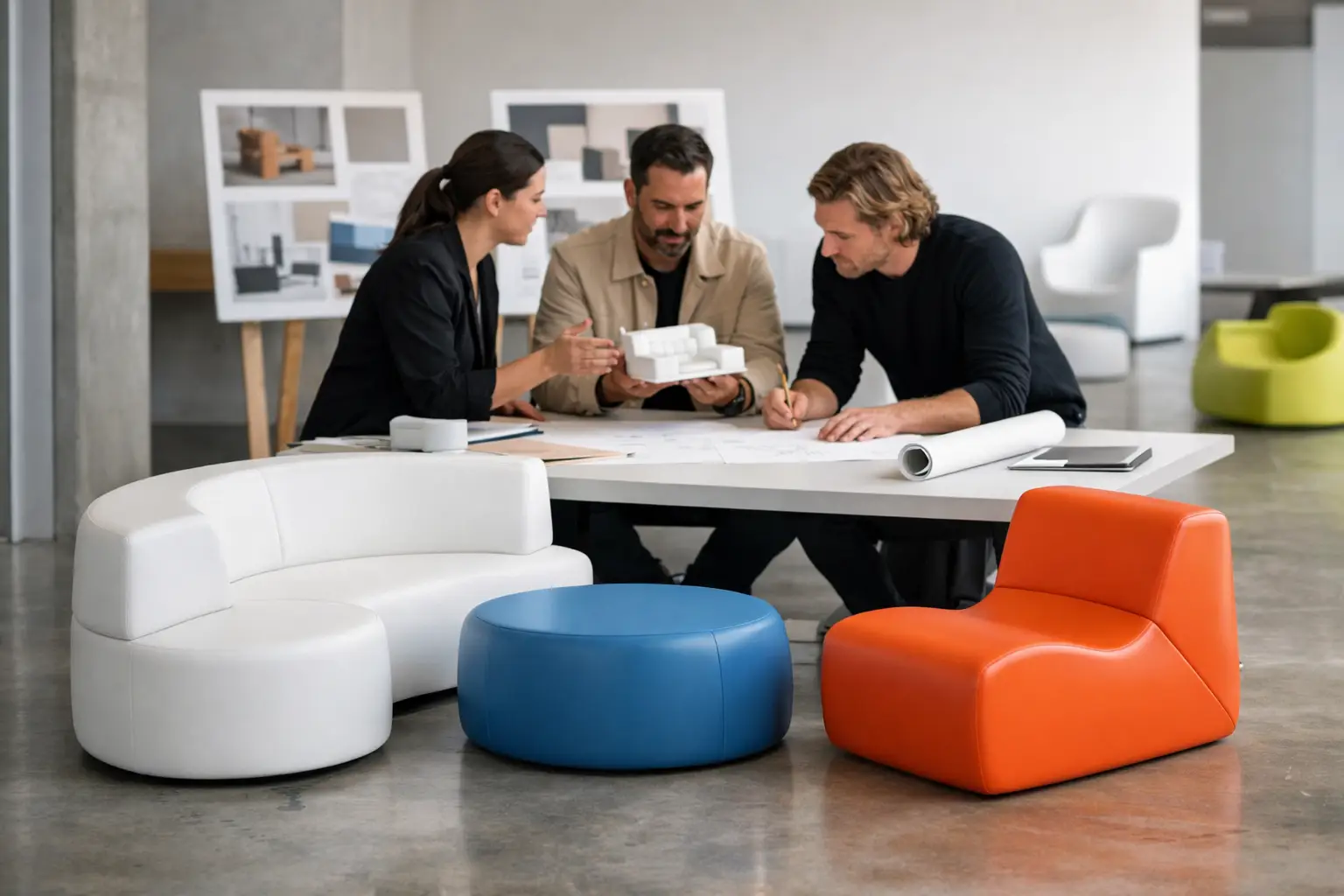
A strong concept can lose its edge the moment it hits manufacturing reality. The radius becomes too tight, the scale shifts, the finish changes, or the piece gets value-engineered into something safer than the original intent. That is exactly why the designer collaboration furniture process matters. For architects, interior designers, and specifiers working on high-visibility spaces, the process is not just about getting a piece made. It is about protecting the design idea while translating it into something buildable, durable, and fit for the project.
When the furniture is sculptural, highly customized, or tied to a branded environment, collaboration needs more than a standard shop-drawing exchange. It requires a fabrication partner that understands form, material behavior, and how to refine a concept without flattening its character. The best outcomes happen when design ambition and production expertise are brought together early.
What the designer collaboration furniture process really involves
At a glance, the process can look straightforward: concept, prototype, production. In practice, each stage carries decisions that affect appearance, comfort, maintenance, budget, and installation. A custom lounge element for hospitality has different pressures than a public-space bench or a retail feature piece, even if all three begin with a bold sketch.
The designer collaboration furniture process works best when it is treated as a shared development path rather than a handoff. Designers bring spatial intent, aesthetic language, and user experience. The manufacturer brings material logic, engineering judgment, and production methods. The tension between those two perspectives is useful. It is often where the best solutions appear.
That does not mean every idea needs to be compromised. It means every idea needs to be tested against the real conditions it will face, from traffic levels to cleaning protocols to visual consistency across multiple units.
From concept to object
1. Reading the design intent
The first job is not pricing. It is interpretation. Before dimensions and technical drawings are finalized, the manufacturer needs to understand what makes the concept non-negotiable. Sometimes that is the silhouette. Sometimes it is the monolithic appearance, the continuous skin, the exaggerated softness, or the way several elements connect to build a landscape.
This stage is where vague approval comments create expensive problems later. If a designer wants a form to feel carved rather than upholstered, or wants a seating element to read as one uninterrupted volume, those cues need to be discussed in direct, physical terms. The more unusual the piece, the more useful it is to define the design priorities clearly.
2. Matching the form to the material system
Not every furniture material is good at the same things. Standard construction methods often push projects toward visible seams, rigid geometries, or a limited range of compound curves. In coated foam fabrication, the material system opens different possibilities: rounded profiles, sculptural massing, integrated forms, and a visually clean surface treatment that feels closer to an object than a conventional upholstered piece.
That freedom is powerful, but it still has rules. Edges, thickness, support conditions, and intended use all affect what should be proposed. A dramatic, low-slung form may look perfect in a rendering, but if it is meant for a public waiting area, ergonomics and access matter. A highly expressive planter or landscape element may need to hold its form outdoors while dealing with weather and wear. Material selection is never separate from design development.
3. Refining for comfort, scale, and use
This is where many custom projects either become better or start drifting. A furniture piece can look exceptional and still fail if the sit angle is wrong, the seat height reads awkwardly in the room, or the scale overpowers adjacent architecture.
Refinement is not about softening the idea. It is about making sure the piece performs in context. Designers often arrive with strong visual intent, but physical mockups or technical reviews can reveal subtle adjustments that improve the result without changing the concept. A few inches in depth, a slightly revised back angle, or a smarter transition between volumes can make the difference between a statement piece and a successful one.
Where collaboration tends to break down
The biggest issue is usually timing. If manufacturing input arrives after the design has been sold internally, approved by the client, and embedded in the layout, the room for smart adjustment becomes narrow. At that point, every technical note feels like a threat to the concept.
Another common problem is treating custom furniture as if it behaves like standard casegoods or upholstery. It does not. Unconventional forms require earlier discussion about tolerances, transport, installation sequencing, and finish expectations. A piece that looks simple can be complex to produce if it needs to arrive in sections, align perfectly on site, or maintain a continuous visual surface across modules.
There is also the issue of under-specification. A beautiful rendering is not enough. Designers need to communicate intended use, traffic type, indoor or outdoor application, cleaning requirements, and whether the object must match an established branding language. These details are not administrative. They shape the fabrication path.
The role of prototyping in the designer collaboration furniture process
Why prototypes matter even for experienced teams
When a piece breaks away from standard typologies, prototyping becomes less of a luxury and more of a control tool. It tests proportion, tactile quality, edge definition, sit comfort, and how the finish reads under real light. That is especially important for furniture designed to make visual impact. Sculptural work succeeds through nuance, not just geometry.
In the designer collaboration furniture process, prototypes also help align expectations across stakeholders. Designers, brand teams, developers, and fabricators do not always read drawings in the same way. A prototype gives everyone a shared reference before full production begins.
Full prototype or targeted sample?
It depends on the project. A full-scale prototype makes sense when ergonomics, unusual dimensions, or complex interactions are central to the piece. A targeted sample may be enough when the key question is finish, coating behavior, color, or a particular construction detail.
The trade-off is time and cost versus risk reduction. For a one-off feature object, a full prototype can protect the result. For a repeatable modular system, detail sampling may be enough if the geometry is already proven. What matters is not following a ritual. It is testing the part of the design that carries the most uncertainty.
Production readiness is a design stage
One of the most overlooked truths in custom furniture is that production readiness is still part of design. It is the stage where geometry becomes manufacturable, specifications become accountable, and the object is prepared to perform beyond the photo shoot.
That includes confirming dimensions, reviewing how pieces connect, defining finish standards, and checking whether installation conditions affect the design. If furniture is going into hospitality, retail, education, or public settings, the conversation should also cover maintenance and long-term appearance. Bold forms need practical credibility.
This is where an experienced fabrication partner adds real value. Not by saying no to difficult ideas, but by identifying where the concept needs technical reinforcement to succeed at scale. For coated foam furniture, that can involve how a form is segmented, how modules align, how surface continuity is maintained, or how indoor and outdoor requirements change the recommendation.
Sixinch works in this space because the challenge is not simply making furniture. It is translating ambitious geometry into finished objects that still feel intentional after fabrication, delivery, and daily use.
What designers should bring into the process early
The strongest collaborations usually begin with more than a sketch. They include a clear sense of the project narrative, the desired emotional effect, the practical use case, and the visual constraints around the piece. Reference images help, but so do statements like these: the seating should feel carved from one mass, the modules should read as a continuous landscape, or the form should carry the brand color without looking decorative.
It is also useful to be honest about where flexibility exists. If the overall silhouette is sacred but dimensions can shift, say so. If budget matters more than preserving a hidden construction detail, say that too. Clarity speeds up development and reduces revision cycles.
For specifiers, this early definition has another benefit. It leads to cleaner documentation and fewer surprises later in approvals, pricing, and site coordination.
Why this process matters more for commercial and public environments
In a private residential project, custom furniture can sometimes survive minor imperfections if the setting is forgiving. In commercial and public environments, the standards are harsher. Pieces are used harder, seen by more people, and judged as part of the brand or architectural experience.
That raises the stakes for collaboration. The furniture has to carry a concept, support real use, and hold visual presence over time. If it is a centerpiece in a hotel lobby, a branded seating system in retail, or a sculptural installation in a public zone, the object cannot feel generic. But it also cannot be precious.
That balance is exactly what a disciplined designer collaboration furniture process is built to achieve. It protects originality while forcing the right technical questions at the right moment.
The most memorable furniture does not come from a designer working alone or a manufacturer merely executing instructions. It comes from a shared process where design intent is challenged, clarified, and strengthened until the final piece has both presence and purpose. If the concept is bold, the process needs to be just as deliberate.