
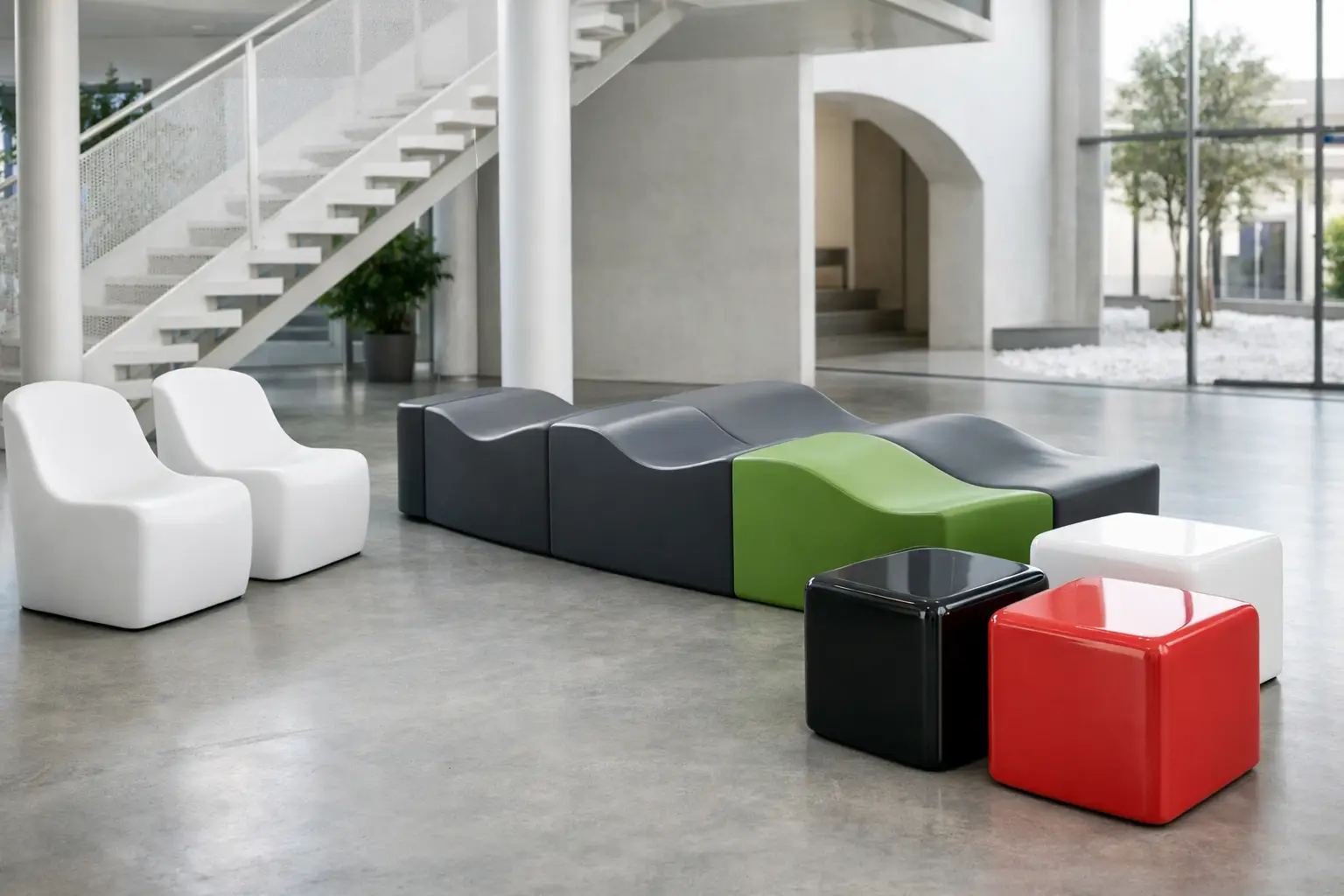
A bench in a transit hall and a sculptural seat in a hotel lobby may both serve the same basic function, but they do not ask the same thing of their material. That is why choosing the top materials for public seating is never just a matter of durability. It is a decision about wear, maintenance, user comfort, visual identity, and how far a design concept can push before fabrication pushes back.
For architects, designers, and specifiers, material choice shapes more than performance. It defines whether seating disappears into the background or becomes part of the spatial experience. In public settings, that distinction matters. A waiting area, campus courtyard, museum atrium, retail environment, or hospitality lounge all place different demands on touch, traffic, cleaning routines, weather exposure, and brand expression.
How to evaluate top materials for public seating
The strongest specifications start with context, not habit. A material that performs beautifully indoors may fail quickly in a plaza. A surface that looks refined in renderings may become unforgiving after heavy daily use. Public seating needs to be judged across five practical criteria: structural durability, comfort, maintenance, environmental resistance, and formal flexibility.
Durability sounds straightforward, but it has layers. You need to consider impact resistance, scratching, moisture exposure, UV stability, and how the material ages rather than simply whether it survives. Some materials develop character over time. Others just look worn.
Comfort is often underestimated in public projects. Hard surfaces can be appropriate for short-stay areas, but they tend to reduce dwell time. In hospitality, workplace commons, education, and experiential retail, the feel of the seat matters almost as much as its appearance. The right material can make a bold form feel inviting rather than severe.
Then there is maintenance. Public seating has to withstand repeated cleaning, inconsistent use, and occasional abuse. If upkeep requires too much labor, even a beautiful specification becomes a liability. For many projects, the real question is not whether a material is strong enough but whether it stays presentable with realistic maintenance cycles.
Metal for public seating
Metal remains one of the most common answers when discussing top materials for public seating, especially in transportation, civic, educational, and exterior projects. Powder-coated steel, stainless steel, and aluminum each offer different advantages.
Steel brings strength and a clear architectural presence. It works well for frames, legs, and monolithic seating concepts where load-bearing performance matters. Powder coating expands color possibilities and can align seating with a broader project palette. The trade-off is weight and, if detailing is poor, vulnerability at joints or damaged coatings.
Stainless steel performs well where hygiene, corrosion resistance, or a crisp contemporary look are priorities. It suits high-traffic interiors and exposed environments, though it can feel cold, both visually and physically. Fingerprints and glare can also become design issues in refined public interiors.
Aluminum is lighter and naturally corrosion resistant, which makes it attractive for outdoor applications. It is easier to handle and often better suited for modular systems. The compromise is that it can read less substantial if not carefully designed, and softer grades may dent more easily under hard use.
Metal is rarely the whole comfort story. It often needs to be paired with another material or shaped very deliberately to avoid a purely utilitarian result.
Wood brings warmth, but asks for care
Wood has enduring value in public seating because it softens architecture. In plazas, campuses, hospitality terraces, and cultural venues, it introduces warmth that metal and concrete cannot replicate. It also photographs well, ages with visual richness in the right applications, and helps large public environments feel more human.
Hardwoods and thermally modified woods are usually preferred where longevity matters. They can hold up well outdoors when correctly specified and maintained. Indoors, wood is often a strong choice for backs, slats, and seating surfaces in projects that want a natural counterpoint to harder architectural finishes.
The trade-off is maintenance discipline. Wood moves, fades, and responds to moisture. If a client wants the look of timber without committing to regular care, the result can deteriorate quickly. In some public settings, that weathering is part of the intended character. In branded or highly polished environments, it may not be acceptable.
Wood also limits formal freedom compared with more moldable materials. It excels in linear, crafted expressions, but it is less accommodating when the design intent calls for continuous curves, sculptural volume, or seamless integration with architectural geometry.
Concrete offers permanence and presence
Concrete is often specified when seating is expected to become part of the landscape itself. It communicates permanence, resists vandalism, and performs well in exposed public environments. For urban spaces, parks, transit zones, and large exterior circulation areas, that can be exactly the right move.
Its strength is also its limitation. Concrete is heavy, hard, and unforgiving. It discourages long dwell times unless paired with warmer materials or cushions, and its visual mass can overpower finer design gestures. Cast finishes, aggregate choices, and pigmentation create some aesthetic range, but concrete is still a relatively blunt instrument compared with materials that allow more nuanced shaping.
When the brief calls for integrated seating that feels almost infrastructural, concrete makes sense. When the goal is comfort, interaction, or a softer human experience, it usually needs support from another material strategy.
Plastic and composite options
High-performance plastics and composites have earned a place in public seating because they can balance durability, color consistency, and low maintenance. Rotomolded polyethylene, recycled plastic lumber, fiberglass-reinforced materials, and compact laminates all serve different purposes.
These materials can perform well in wet environments, withstand repeated cleaning, and support brighter color use than many traditional options. They are especially useful in schools, aquatic facilities, casual public spaces, and outdoor leisure settings.
Still, not all plastics deliver the same design value. Some read as playful and intentional. Others read as commodity solutions. For design-led commercial projects, the challenge is selecting finishes and forms that feel elevated rather than generic. Composite systems can also solve practical problems while limiting formal expression if they rely on standard profiles or repetitive modules.
Coated foam changes what public seating can be
For projects that want public seating to do more than simply endure traffic, coated foam opens a different design conversation. This material approach combines a soft core with a highly durable coated skin, making it possible to create seating that is comfortable, visually bold, and formally unconstrained.
That flexibility matters in public environments where furniture often carries brand identity, zoning, acoustical value, and user experience all at once. Coated foam allows continuous curves, integrated backs, sculptural silhouettes, and custom geometries that would be difficult or cost-prohibitive in wood, metal, or concrete. It can produce pieces that feel monolithic yet remain approachable.
From a performance standpoint, the right coating system creates a closed, resilient surface that is easy to clean and suitable for demanding interior and selected exterior applications, depending on the specification. Unlike many upholstered solutions, there are no seams, loose covers, or fabric failure points to complicate maintenance. That makes it particularly attractive for hospitality, retail, workplace commons, museums, and branded public zones where tactile comfort and visual originality need to coexist.
This is also where material choice becomes a design tool rather than just a compliance exercise. Sixinch has built a strong position in this space by translating ambitious forms into production-ready seating with coated finishes that support both expressive concepts and practical use. For specifiers working on spaces that need character, not just capacity, that is a meaningful distinction.
The trade-off is that coated foam is not a universal answer. In highly exposed urban infrastructure or settings with extreme abrasion and abuse, harder materials may still be the right call. But where comfort, shape freedom, and strong visual impact are central, it offers possibilities that traditional public seating materials simply do not.
Matching material to use case
The best public seating schemes rarely start by asking which material is best in the abstract. They start by asking how people will use the space. In a transit terminal, hard-wearing metal may outperform softer alternatives. In a luxury hospitality lounge, that same choice could feel cold and transactional. In a museum or retail flagship, custom coated foam may deliver both usability and a memorable spatial signature.
Outdoor conditions complicate the choice further. Sun, moisture, pollutants, temperature swings, and cleaning methods all affect longevity. So does user behavior. A campus courtyard sees different wear than a corporate atrium, even if both require communal seating.
That is why the smartest specifications often combine materials. A metal substructure with a softer seating surface. A concrete base with timber accents. A coated foam piece in an interior zone paired with more infrastructural solutions outdoors. Good material strategy is rarely ideological. It is responsive.
If there is one useful rule, it is this: public seating performs best when the material supports the intended behavior and the design ambition at the same time. When those two align, the furniture stops feeling like an obligation and starts shaping the experience of the space.