
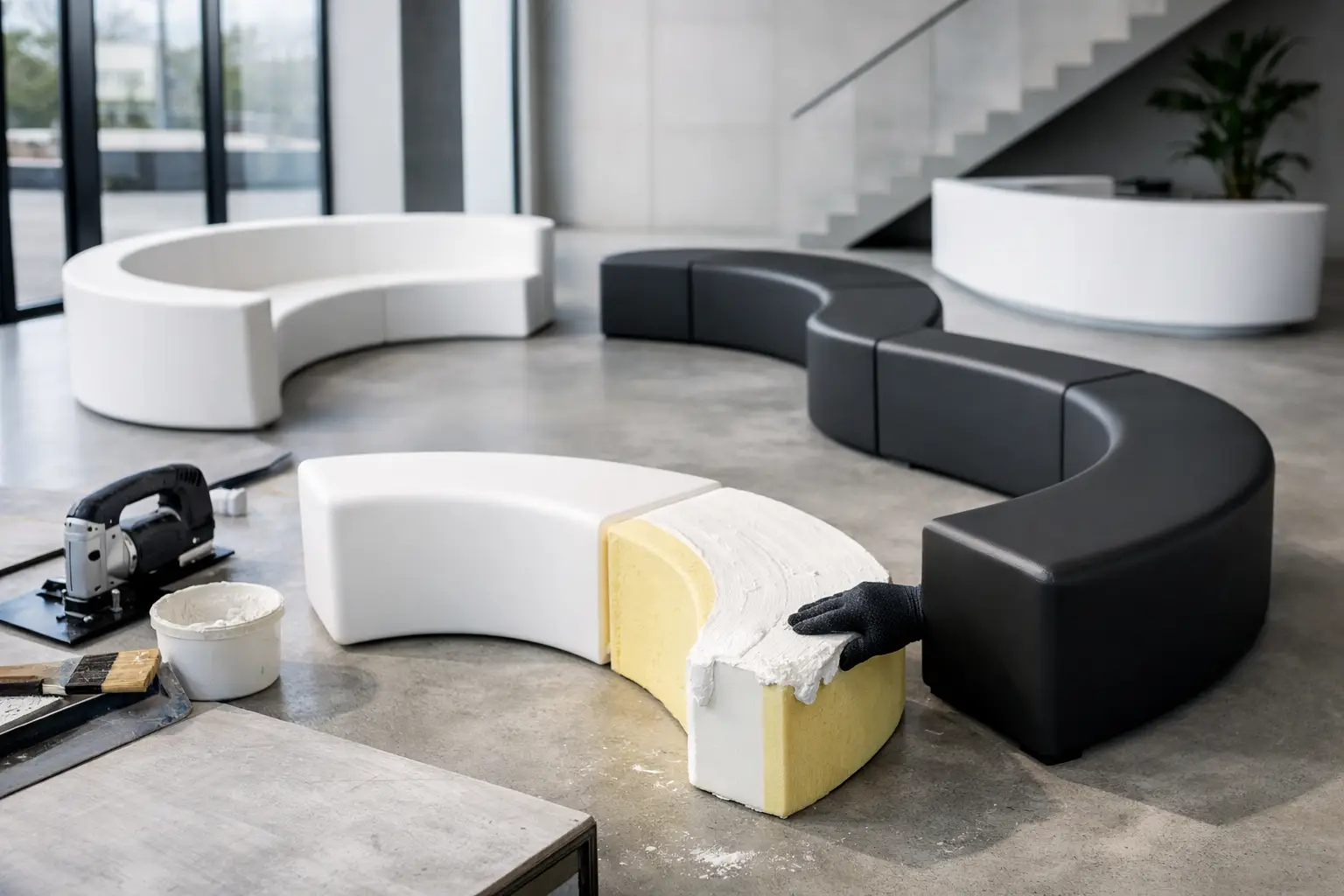
A curved bench is never just a straight seat bent into an arc. Its radius affects sightlines, body posture, circulation, structural loads, and the way a space is remembered. The right curved bench fabrication methods turn an ambitious sketch into seating that holds its geometry, performs in use, and delivers the sculptural impact the project demands.
For architects and designers, the decision is not simply about finding a way to make a curve. It is about choosing a fabrication route that supports the intended scale, finish, environment, and level of customization without compromising the original concept.
Why the Fabrication Method Changes the Design
A continuous curve can feel calm, inviting, and precise. It can guide guests through a lobby, frame a landscape feature, soften a retail environment, or create a social center in a hospitality setting. Yet each of those applications places different demands on the bench.
A small interior lounge bench may prioritize soft tactility and a deeply upholstered profile. A large public-space installation may need a durable, cleanable surface and concealed segmentation for access and transport. An exterior bench must account for drainage, ultraviolet exposure, temperature movement, and the realities of an uneven site.
Fabrication is therefore part of the design language. A laminated timber base creates one type of curve. Rolled steel creates another. Digitally cut foam with a hand-applied coating enables an entirely different family of forms – including thick, monolithic seating volumes that would be inefficient or visually heavy in traditional construction.
Curved Bench Fabrication Methods for Design-Led Spaces
There is no universal best method. The strongest choice comes from matching the material system to the project brief, rather than forcing the form through a familiar production process.
Laminated Wood and Plywood Construction
Laminating thin timber veneers or plywood layers around a form remains a reliable approach for controlled curves. Once cured, the assembly can create a stiff shell or a structural internal frame for an upholstered bench. It is especially effective for interior seating with moderate radii and a refined furniture-scale appearance.
The advantages are familiar: wood is workable, structurally efficient, and well suited to integrated joinery. It also allows for warm exposed edges when the design calls for a visible wood expression. However, tight radii require careful layer selection and tooling, while long continuous pieces can become difficult to transport. If the bench will receive upholstery, the underlying frame must be designed to avoid hard edges telegraphing through the finished surface.
This method is often best when the curve is disciplined, the seating is primarily indoors, and the project benefits from a conventional structural core beneath a tailored finish.
Rolled Metal Frames
Steel or aluminum tube, flat bar, and plate can be rolled into arcs, then welded into a structural frame. The frame may support timber slats, upholstery, cushions, panels, or a more sculptural outer skin. Rolled metal is particularly valuable for long spans, narrow profiles, and benches that need to resist high public use.
The engineering potential is significant, but metal fabrication asks for early coordination. Weld locations, attachment points, drainage paths, and tolerances all need to be resolved before finishing begins. A metal frame can also be unnecessarily complex if the desired object is a generous, soft, solid-looking form rather than a lightweight linear bench.
For exterior work, material selection matters. Aluminum offers corrosion resistance and reduced weight, while steel can provide exceptional strength when correctly protected. In either case, the finish system must match the site conditions rather than relying on appearance alone.
Segmented Joinery for Large Curves
Large curved benches are often fabricated as a series of manageable modules. Each segment may be built from wood, metal, foam, or a hybrid construction, with connection details hidden at the joints. This approach makes shipping, site access, replacement, and installation far more practical.
Segmentation should not look like a compromise. When the modules follow the geometry precisely and the seams are positioned intelligently, the finished bench reads as one continuous gesture. The key is to define segment lengths around the project realities: elevator dimensions, door openings, freight access, floor loading, and the ability of installers to maneuver each piece safely.
There is a trade-off. More segments improve handling but introduce more joints and connection points. Fewer segments create a cleaner visual read but can increase cost and logistical risk. On a custom project, the ideal module size is usually established alongside the floor plan, not after the design is approved.
CNC-Shaped Foam and Coated Foam Forms
For bold, high-volume curves, CNC-shaped foam offers remarkable freedom. Blocks can be digitally cut, assembled, hand-shaped where necessary, and finished with a specialized coating that creates a continuous, resilient skin. This process is well suited to rounded benches, organic seating islands, sinuous backrests, and forms that move beyond the limitations of a standard frame-and-cushion construction.
The strength of this approach is not only the ability to create a radius. It is the ability to control proportion. A bench can swell, taper, cantilever visually, incorporate an integrated back, or transition from seating to an architectural landscape element. The surface can remain visually uninterrupted across complex geometry, giving the piece a decisive monolithic presence.
Coated foam fabrication also supports color as an integral part of the object rather than an afterthought. For branded interiors, experiential retail, hospitality concepts, and public lounges, that freedom can turn seating into a defining spatial element. Sixinch applies this expertise where a design needs to remain expressive while becoming manufacturable and practical for its intended setting.
The specification still needs discipline. Foam density, internal reinforcement, wall thickness, expected loads, and coating selection should be developed for the application. A soft-looking form is not automatically appropriate for every exterior exposure or high-abuse public environment. The best results come from reviewing use conditions early and designing the object around them.
Molded Composite Shells
Fiberglass and other composite methods can produce smooth, repeatable curves with strong, lightweight shells. They are often considered when a design requires many identical units, a highly controlled glossy or matte surface, or a thin-walled sculptural profile.
Molding becomes more economical as repetition increases because the tooling can be spread across multiple units. For a one-off bench, however, the mold cost and lead time may outweigh the benefits. Composites also require close attention to edge detailing, support structure, and repair expectations. Their polished appearance can be compelling, but it should suit the project rather than simply signal technical complexity.
Geometry, Comfort, and Tolerance
A beautiful plan-view arc does not guarantee a comfortable bench. Seat height, seat depth, back angle, and the relationship between curve radius and user position all matter. On a tight inside curve, people may feel turned toward one another. On a broad radius, the bench may behave more like a linear seat. That social behavior can be designed intentionally.
Full-scale mockups are valuable when the bench is a focal point, especially if it includes a backrest or unusually deep profile. A rendering can establish proportion, but it cannot fully reveal how a user shifts, leans, enters, or rises from the seat. Mockups also expose practical issues such as where seams fall, whether a back edge feels too sharp, and how the bench meets adjacent flooring or architecture.
Tolerance planning deserves equal attention. Curved components amplify small inaccuracies when they join together. Digital fabrication improves precision, but site conditions still vary. Connection details should allow adjustment where needed, particularly for long installations that meet walls, columns, paving, or other fixed elements.
Specify the Finish Around Real Use
The surface finish should respond to the environment, maintenance team, and expected level of contact. Upholstery brings warmth and acoustic softness but requires a realistic cleaning and replacement strategy. Hard-coated surfaces offer a more integrated visual effect and can simplify wipe-down maintenance, yet they need a finish specification that suits the traffic, exposure, and cleaning products expected on site.
For exterior benches, drainage is a design detail, not an accessory. Water must not collect at low points, enter joints, or remain trapped against concealed supports. For indoor public seating, consider luggage, footwear, cleaning equipment, and the repeated impact of users sitting on the same edge. A fabrication method is only successful when its finish, structure, and maintenance expectations work together.
Start With the Object You Want People to Remember
The most effective curved bench begins with a clear design intent: is it an elegant line, a social ring, a landscape-like volume, or a branded sculptural moment? Once that is established, fabrication becomes a focused conversation about scale, structure, surface, logistics, and longevity.
Give the curve the production method it deserves. When form and fabrication are developed together, the result does more than fill a seating requirement. It gives the space a place people recognize, use, and return to.