
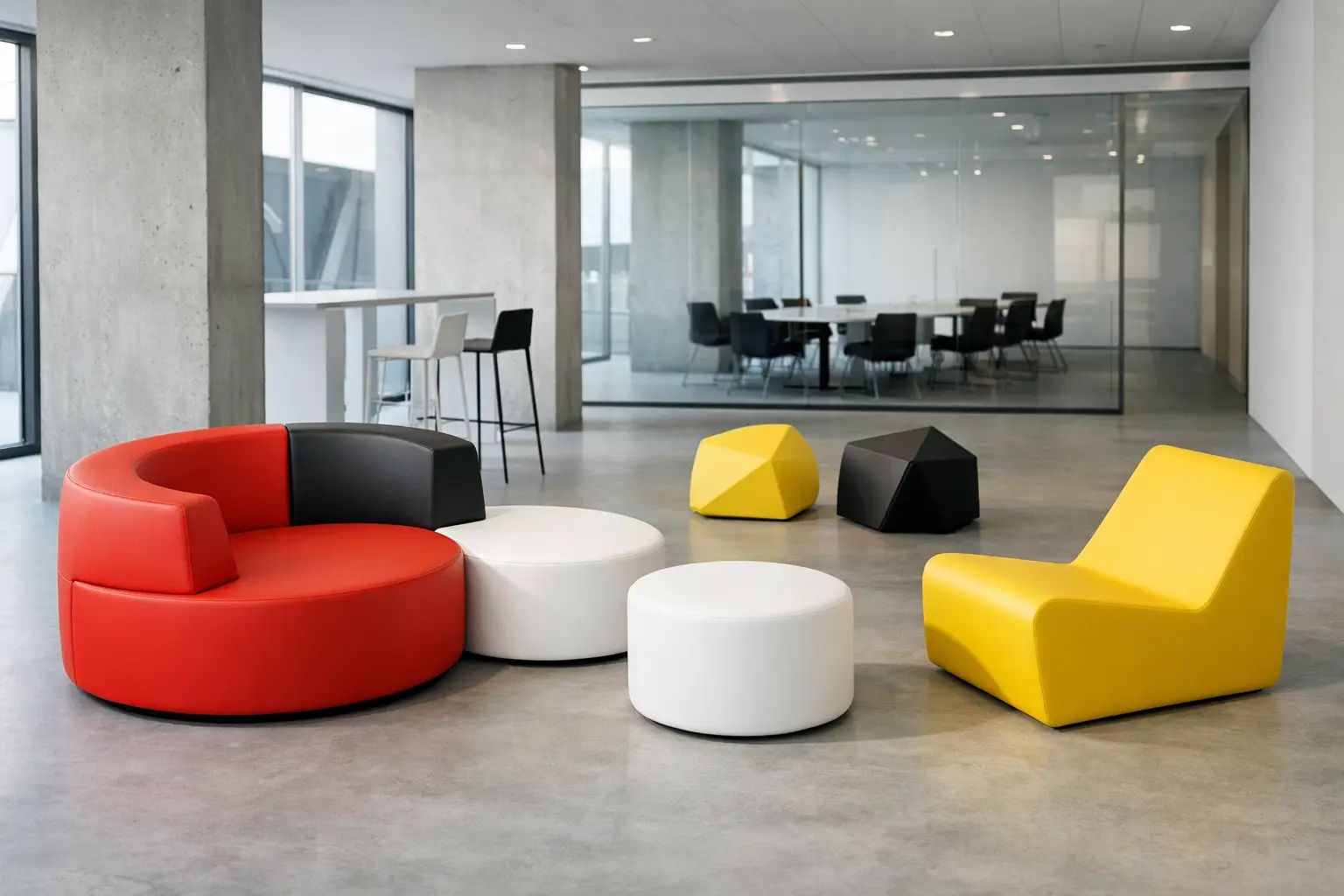
A lobby can carry a logo without feeling branded. A retail lounge can use the company palette without becoming a color chart. The difference is whether the environment translates a brand into an experience people can physically inhabit. This guide to custom branded interiors is built for designers and specifiers who need that experience to be distinctive, durable, and credible in use.
Branded interiors are often reduced to graphics, signage, and a carefully selected paint color. Those elements matter, but they rarely create the strongest memory of a space. Scale, tactility, silhouette, and the way people gather are more immediate. A sculptural seat that invites a pause, a reception element with a recognizable curve, or a series of planters that establishes rhythm can make the brand feel present before anyone reads a word.
Start With the Brand Behavior, Not the Brand Book
A visual identity is a useful reference, not a finished interior concept. Before selecting furniture, isolate the qualities the brand needs to express in three dimensions. Is it precise and restrained, playful and social, future-facing, grounded in craft, or deliberately unexpected? These are behavioral cues. They should guide form, material, proportion, and placement.
A hospitality concept built around warmth may call for generous radii, layered lounge groupings, and surfaces that encourage touch. A technology brand may benefit from controlled geometry, high-definition color blocking, and objects with a monolithic presence. Neither approach is automatically more branded. The right direction depends on the audience, the setting, and the way the organization wants people to feel while they wait, meet, work, or browse.
This early definition also prevents a common mistake: applying a corporate color to standard furniture and calling it custom. Color can signal ownership, but it does not solve circulation, comfort, durability, or visual impact. A stronger brief identifies where the brand should be quiet and where it should make a decisive statement.
Map the Moments That Deserve a Signature
Not every square foot needs a bespoke object. In fact, concentration usually creates more impact than repetition. Identify the points where visitors form an impression, make a decision, or spend enough time to notice the environment. Entry zones, waiting areas, collaborative lounges, fitting spaces, event platforms, and social hubs often justify the greatest level of customization.
Think in terms of a spatial hierarchy. A large feature seat can anchor an atrium and establish the brand’s visual language. Smaller benches, ottomans, or modular components can repeat selected cues elsewhere without competing for attention. In a retail setting, a sculptural display or integrated seating element may become both a photo moment and a practical pause point. In a workplace, a custom soft-seating landscape can clarify where informal interaction belongs.
The best signature pieces have a job beyond looking remarkable. They organize traffic, support dwell time, soften acoustics, define a zone, or create an intuitive meeting point. When an object performs several roles, its visual ambition is easier to defend in a project budget.
Design for Form, Scale, and Human Use
Custom work earns its place when standard dimensions and silhouettes cannot deliver the intended experience. Coated foam fabrication is especially effective when the concept relies on continuous curves, oversized volumes, integrated forms, or soft-looking objects with a highly finished surface. It allows designers to pursue expressive geometry without treating a sculptural idea as a purely decorative prop.
But visual freedom needs discipline. A low, broad lounge island may look powerful in a rendering while proving difficult for older guests to rise from. An extremely deep seat may communicate relaxation but fail in a quick-service setting where turnover matters. A dramatic vertical element can improve wayfinding, yet it may obstruct sightlines across a public space.
Test the concept against the actual user scenario. Who will use it? For how long? Will they carry bags, laptops, drinks, or children? Is the furniture a destination, a waiting point, or a brief touchpoint between activities? These questions shape seat height, back support, spacing, edge radii, and the relationship between individual pieces.
Scale deserves equal attention. An object that feels iconic in a large terminal can overwhelm a boutique lobby. Conversely, an undersized branded feature disappears in a convention center. Draw the furniture into the complete elevation and circulation plan, not just a clean product visualization. Its success depends on the room around it.
Specify Materials for the Real Environment
The most compelling branded interiors are designed for the conditions they will face after opening day. High-touch public spaces need surfaces that can be cleaned consistently without losing their intended finish. Hospitality environments may need to resist spills and heavy use. Outdoor-adjacent areas need a clear response to weather, UV exposure, drainage, and seasonal maintenance.
A coated foam finish offers a distinctive advantage for custom forms because it can create a continuous, durable skin over complex geometry. That continuity can reduce visual clutter from seams and supports a clean, architectural expression. It also changes how a piece reads: a soft volume can become precise, graphic, playful, or monumental depending on its coating, color, and scale.
Material selection is not simply a question of durability versus aesthetics. The finish must reinforce the concept. A high-saturation color can make a seating element feel energetic and unmistakably branded, but it may show scuffs more readily in an airport-style circulation zone. A lighter neutral can support a refined lounge atmosphere, but it may require a maintenance plan that matches the traffic level. The right choice is specific to the project, not a generic finish schedule.
Ask for clarity on cleaning protocols, expected wear, repairability, fire requirements, and whether the installation will experience direct sunlight or major temperature swings. Technical decisions made early preserve the integrity of the design later.
Build Custom Branded Interiors Around Production Reality
A bold concept becomes a successful project when design intent and fabrication logic meet early. Bring the manufacturer into the conversation while forms are still flexible, especially for large-scale, multi-part, or integrated elements. This is where a production partner can assess structure, break down transportable components, refine transitions, and protect the original silhouette.
Provide more than inspirational images. A useful custom brief includes dimensions, intended use, target colors, site conditions, floor plans, desired delivery timing, and any relevant code or performance requirements. If the piece connects to architecture, clarify interfaces with walls, flooring, power, lighting, and adjacent millwork. The more exact the context, the more accurately a concept can be engineered.
Prototyping is often worth the time for a feature installation. It may reveal that a curve needs adjustment for comfort, that a color shifts under the project lighting, or that a multi-piece join needs a different resolution. These are not failures of the original idea. They are the normal refinement that turns an expressive sketch into an object people will use every day.
Sixinch works at this intersection of design freedom and fabrication precision, translating unconventional furniture concepts into production-ready coated foam forms for demanding commercial settings.
Avoid the Shortcuts That Dilute the Idea
The most frequent problem in branded environments is overapplication. When every chair, wall, counter, and accessory carries the same visual signal, the space loses contrast. Brand expression needs moments of release. Let neutral architecture, quieter furniture, or negative space make the custom elements more legible.
Another shortcut is treating custom furniture as a late-stage styling layer. By then, circulation routes, electrical locations, accessibility clearances, and budgets are often fixed. The result can be a compromised object squeezed into a leftover footprint. Place key branded elements in the plan from the beginning, alongside the operational decisions that govern the space.
Finally, do not confuse novelty with relevance. An unusual shape earns attention once. A well-considered shape continues to earn its place because it makes the space easier to understand, more comfortable to use, and impossible to mistake for somewhere else.
The strongest branded interior does not ask visitors to notice the brand at every turn. It gives them a setting they can remember, describe, and want to return to. Make the signature elements purposeful, give them enough space to speak, and let craftsmanship carry the idea from first impression to daily use.