
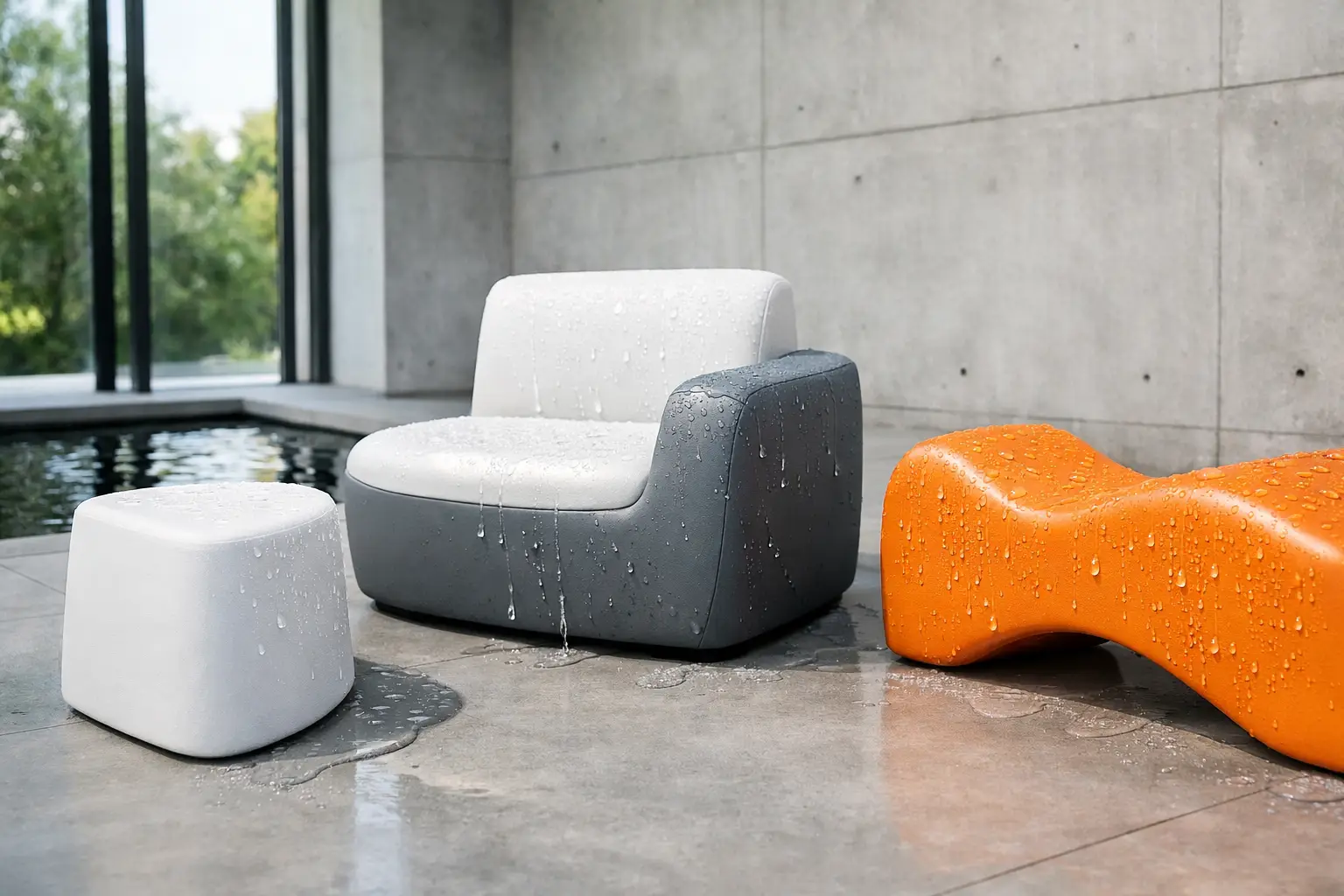
A sculptural bench beside a hotel pool, a playful public-space seat under a canopy, or a statement lounge piece in a busy lobby all face the same specification question: are coated foam finishes waterproof? The useful answer is not a blanket yes or no. A properly selected and fabricated coated foam finish can create a highly water-resistant, easy-clean surface suited to demanding environments. Whether it is truly waterproof in a project sense depends on the coating system, the object’s construction, exposure conditions, and the way water is allowed to drain.
For architects and designers, this distinction protects both the concept and the installation. Coated foam makes fluid, expressive forms possible without the visual interruption of conventional upholstery, but material performance must be designed into the piece from the beginning.
Are Coated Foam Finishes Waterproof in Practice?
A continuous polymer coating can form a nonporous outer skin over foam. Water beads on the surface rather than soaking into the material immediately, making the finish appropriate for wipe-down cleaning, occasional spills, wet clothing, and many sheltered outdoor applications. This is a major advantage over woven textiles, which can retain moisture, staining agents, and contaminants within their structure.
But waterproof is not a single universal condition. In furniture specifications, it can refer to resistance against rain, splashes, regular cleaning, or prolonged standing water. Those are very different demands. A coated foam seat designed for an indoor wellness area, for example, does not need the same construction as a landscape element left exposed to driving rain, freeze-thaw cycles, and direct sun.
The coating itself is only one layer of the performance story. Even an exceptionally water-resistant surface can be compromised by an unsealed joint, a damaged edge, a mounting penetration, or a low point that holds water for extended periods. The right question is therefore: waterproof against what, for how long, and under what conditions?
The Four Details That Determine Water Resistance
1. The coating formulation
Not every foam coating has the same elasticity, thickness, UV stability, chemical resistance, or ability to withstand repeated wetting. High-performance coating systems are engineered to flex with the foam substrate while maintaining a continuous skin. That flexibility matters. A rigid finish may look sound at installation but eventually crack where a seat compresses, where a backrest flexes, or where an object receives impact.
For commercial interiors, the key requirement may be resistance to spills and frequent cleaning. For exterior applications, specify a finish developed to manage UV exposure, temperature variation, and moisture. Color choice can matter as well: very dark surfaces can become significantly hotter in direct sun, increasing thermal stress and affecting user comfort.
2. Seams, transitions, and penetrations
A monolithic-looking object is easier to protect from moisture than an assembly with multiple seams. Where components meet, where a base is attached, and where hardware passes through the coating, the construction must be resolved with precision.
This is especially relevant for custom furniture. A dramatic curved form may be visually continuous, yet its underside, connection points, and service access need equal attention. Water will find the least protected route. Specifying water resistance without reviewing these details is how a strong material choice becomes a weak installation.
3. Foam type and internal construction
The foam core affects what happens if water does get beyond the outer coating. Closed-cell foam generally resists water absorption more effectively than open-cell foam, while different densities and structures influence comfort, shape retention, and structural behavior.
That does not mean every project requires the same core. Indoor seating may prioritize softness and long-term comfort. Outdoor or high-exposure elements may call for a more resilient internal specification and a construction that limits water retention. The ideal solution balances intended use, ergonomic expectations, form complexity, and environmental exposure.
4. Drainage and installation conditions
No finish benefits from standing water. If a bench, planter surround, or lounge element is installed on a surface that ponds after rain, moisture will remain in contact with its base and joints far longer than intended. Good drainage, a slight fall in the supporting surface, and a considered base detail are practical safeguards.
Outdoor pieces should also be placed with their real environment in mind. Is the site fully exposed, partly sheltered, coastal, near a pool, or beneath trees that leave organic debris on the surface? Each condition changes the maintenance plan and the level of material resistance required.
Water-Resistant Does Not Mean Maintenance-Free
One of coated foam’s most valuable qualities is its cleanable skin. In hospitality, retail, education, and public settings, a smooth surface supports quick routine care and reduces the visual clutter of removable covers or heavily stitched upholstery. Still, easy cleaning is not the same as no maintenance.
Routine care should remove dirt, sunscreen, food residue, leaves, and standing water before these materials remain on the surface for extended periods. Use mild cleaning methods appropriate to the selected coating. Harsh abrasives, aggressive solvents, and unsuitable pressure washing can dull, weaken, or damage a finish that would otherwise perform well for years.
Inspection is equally practical. In high-use areas, check for cuts, abrasion, lifting around attachments, and surface wear at frequent contact points. Small damage addressed early is far less likely to become a pathway for moisture. This is particularly important for public seating, where bags, shoes, wheeled equipment, and repeated cleaning can create localized stress.
When Coated Foam Is the Right Choice
Coated foam is compelling when the project needs more than moisture resistance. It gives designers the freedom to create rounded volumes, oversized gestures, integrated seating landscapes, branded forms, and sculptural furniture that would be difficult to upholster or fabricate conventionally.
It is particularly effective for reception lounges, retail experiences, family-oriented public spaces, wellness environments, hospitality terraces, and sheltered exterior settings. The continuous finish can visually unify a collection of complex shapes while offering a practical surface for daily use.
At Sixinch, coating is treated as part of the fabrication language, not as a superficial add-on. The process allows form, color, tactile character, and project requirements to be considered together, which is essential when a custom object must deliver visual impact without ignoring operational realities.
There are limits. A coated foam finish is not automatically the best solution for permanent submersion, continuously flooded locations, or installations where sharp-edge abuse is expected without protection. In those cases, another material strategy, a protective detail, or a revised placement may be the more responsible specification.
How to Specify Coated Foam for Wet or Outdoor Use
Start with the exposure scenario rather than the product category. Describe whether the object will face indoor spills, covered exterior moisture, open-air rain, poolside chlorinated water, salt air, or intensive cleaning. That clarity helps the manufacturer recommend the right coating and construction rather than relying on a generic claim.
Next, review the geometry. Does the shape shed water naturally? Are there horizontal recesses, deep seams, or unsupported overhangs that can collect moisture? Can the underside breathe and drain? Design freedom is greatest when these questions guide the form early, not after fabrication has begun.
Finally, align expectations with the maintenance team. A high-traffic terrace seat can be specified for outdoor exposure, but it should also have a cleaning and inspection routine appropriate to its environment. Material performance is strongest when design intent, fabrication detail, installation, and care all work together.
The most successful coated foam projects do not merely ask whether a finish is waterproof. They specify the exact kind of water exposure the object must withstand, then turn that requirement into a form that remains bold, comfortable, and built for its setting.