
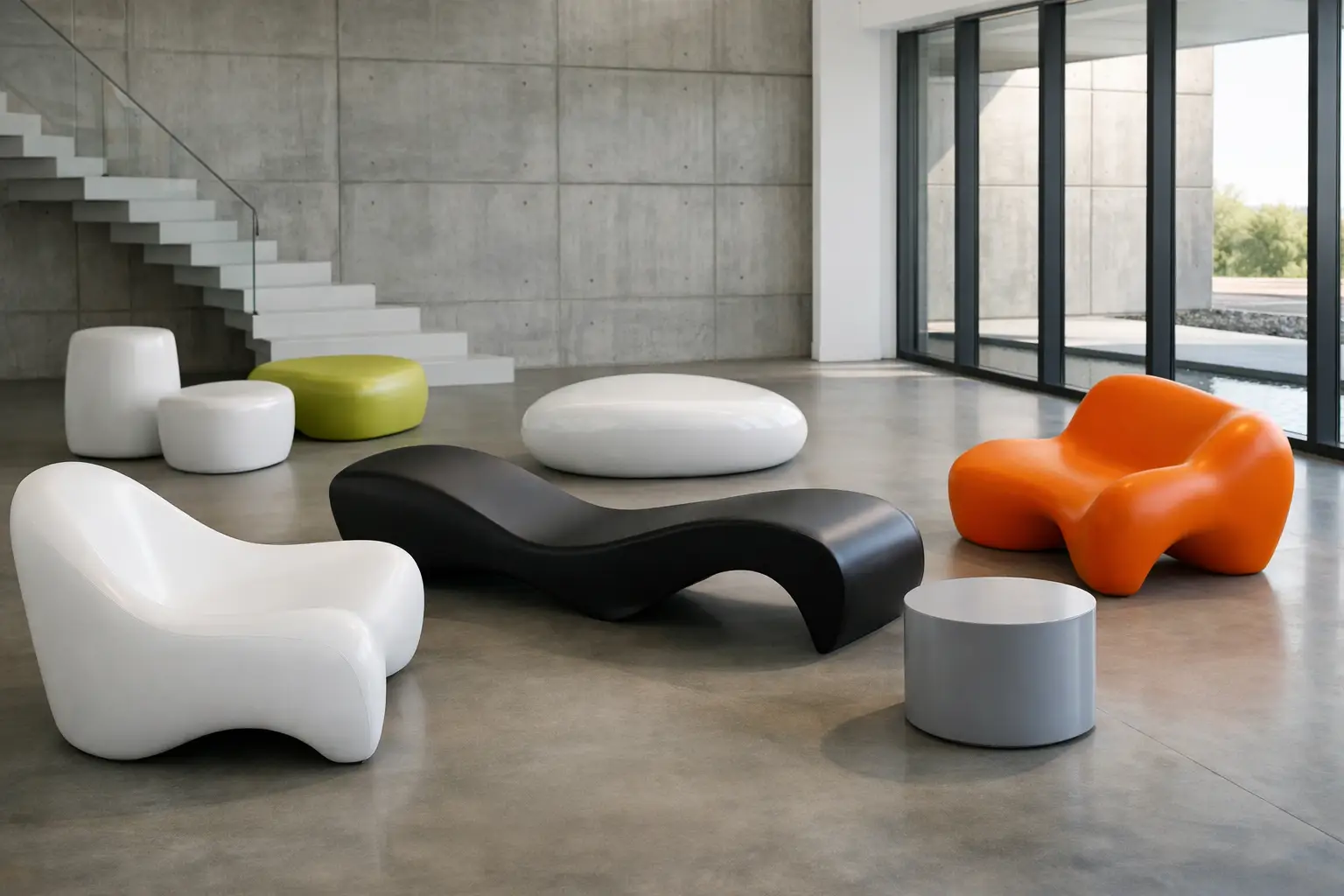
A bench with a deep radius, a lounge seat that seems carved from one volume, a planter that carries the same visual language as the seating around it: these are the moments where seamless coating changes what furniture can be. Rather than building an object from visibly separate hard components, coated foam fabrication creates a continuous, tactile surface around a sculptural core.
For architects and designers, the result is more than a distinctive finish. It is a practical route to expressive forms that conventional upholstery, molded plastic, metalwork, or joinery may struggle to deliver with the same visual clarity. Curves remain clean. Edges can be softened or sharpened with intention. Color can extend across an entire object without being interrupted by fabric panels, stitching, or exposed construction.
What Seamless Coating Actually Does
A coated foam object begins with a shaped foam core. That core may be cut, assembled, sculpted, or developed around a highly specific geometry. A specialized coating is then applied by hand to create a durable outer skin. The finished surface reads as one unified form, even where the underlying foam construction contains multiple elements.
The word “seamless” refers primarily to this uninterrupted visual and tactile experience. It does not mean every internal assembly line disappears from the engineering process. Complex pieces still require considered construction, reinforcement, and production planning. The difference is that those technical decisions do not have to dictate the visible language of the final piece.
This freedom matters in projects built around a strong spatial identity. A hospitality lounge may need seating that echoes an architectural curve. A retail environment may call for oversized branded forms in a precise color. A public waiting area may need soft, welcoming volumes that can stand up to frequent use. Coated foam provides a way to make those ideas feel intentional rather than improvised.
Why Designers Specify a Seamless Coating
The strongest argument for a seamless coating is formal freedom. A designer can work with inflated silhouettes, low monolithic blocks, organic landscapes, graphic geometry, or hybrid furniture-architecture elements without defaulting to conventional furniture typologies. The material language supports objects that look designed from every angle.
It also creates visual continuity. When a sofa, pouf, bench, and planter share a related coating and color, they can operate as a family across a large interior or exterior setting. This is especially valuable in branded environments, where furniture is part of the customer experience rather than a background necessity.
The surface has a character of its own. It is smooth but not cold, soft in appearance while retaining a defined sculptural presence. Unlike fabric upholstery, it does not introduce weave, seams, piping, or loose drape into the composition. Unlike rigid molded materials, it can communicate comfort before anyone sits down.
For high-traffic settings, the practical advantages are equally relevant. A continuous coated surface is straightforward to wipe clean and avoids many of the dirt-catching details found in stitched upholstery. That does not make every application maintenance-free. It does, however, give project teams a finish designed for real use in lounges, lobbies, education spaces, retail, and public interiors.
Form Is a Performance Decision
A dramatic shape has to work beyond the presentation render. Seat height, back support, stability, access, drainage for outdoor pieces, and circulation around an object all influence whether a concept succeeds after installation. Coated foam fabrication allows these requirements to be considered early, rather than treated as compromises after the form is fixed.
This is where a fabrication partner becomes essential. The best custom pieces preserve the original design idea while resolving the details that determine durability, comfort, transport, installation, and repeatability. Sixinch approaches coating as part of that full production conversation, not as a decorative layer applied at the end.
Designing With Coated Foam From Day One
The most successful projects start by defining what the object must do. Is it a single focal point in a hotel lobby, modular seating for a flexible workplace, an outdoor social landscape, or a sculptural retail display that also needs to support guests? The answer shapes everything from density and scale to surface specification and base construction.
Designers should also be clear about the intended interaction. Furniture that invites lounging needs different geometry from a display pedestal. A piece used by children, guests carrying bags, or visitors in a busy transit area will experience different types of contact and abrasion. The coating specification should match that reality rather than rely on appearance alone.
Color deserves the same level of attention. A coating can reinforce a project palette with saturated statement colors, quiet neutrals, or custom tones developed for a specific identity. Yet color selection is not only aesthetic. Very light finishes may need more frequent cleaning in high-contact environments, while dark tones can show dust or scuffing differently depending on lighting. Sample review in the actual project conditions is a worthwhile step, especially for large installations.
Indoor and Outdoor Conditions Are Not Interchangeable
A coated foam bench in an indoor lounge and a sculptural seat exposed to weather are not the same specification challenge. Outdoor applications must account for UV exposure, temperature changes, water management, cleaning practices, and the way a piece is anchored or positioned. A form that looks perfect indoors may need adjusted proportions, drainage strategy, or a different coating approach outside.
There are trade-offs. Extremely complex geometry can require more handwork and longer development. Oversized objects may need to be produced in sections for transportation and site access. A very crisp edge may be possible, but it may not have the same impact resistance as a generously rounded one. These are not reasons to reduce ambition. They are the conversations that turn ambition into a reliable object.
The Detail That Makes a Concept Believable
In design-led environments, furniture often becomes part of the architecture. It guides movement, frames a view, creates a gathering point, or gives a large room an immediate emotional center. A continuous coated surface helps these pieces hold their visual authority because the object is not broken apart by the usual signals of furniture construction.
That effect is particularly powerful with modular systems. Individual units can stand alone, combine into extended seating landscapes, or be rearranged as a space evolves. When the modules share consistent proportions, coating, and color, the composition remains coherent even as the layout changes.
The same principle applies to custom work. A concept may begin as a loose sketch, a 3D model, or a reference for a mood rather than a finished product. The production process must translate that intent into dimensions, material behavior, joining logic, and a finish that looks convincing at close range. Handcrafted coating techniques are valuable because they allow close control over this transition from concept to finished form.
Specifying for Longevity, Not Just Launch Day
A bold object should still look purposeful after months of use. That starts with selecting the right product category and coating solution for the setting, then giving facilities teams clear expectations for cleaning and care. Routine maintenance is usually simple: remove surface debris, clean spills promptly, and use methods appropriate to the specified finish. Harsh abrasives or untested chemicals can damage any specialized surface, so maintenance should follow the product guidance provided for the project.
Placement also matters. Consider direct sun, sharp architectural edges, rolling luggage, heavy movable tables, and the cleaning equipment used on site. In public environments, a small adjustment to circulation or protective spacing can preserve a feature piece far better than treating repair as inevitable.
The real value of coated foam is not that it eliminates every design constraint. It is that it moves the constraint to a more productive place. Instead of asking whether a furniture category can accommodate the concept, designers can ask how the concept should perform, feel, and endure once it becomes part of the space.
When a project calls for furniture with a strong point of view, begin with the form you actually want to see in the room. Then let material expertise, thoughtful specification, and skilled fabrication give that form a life beyond the rendering.