
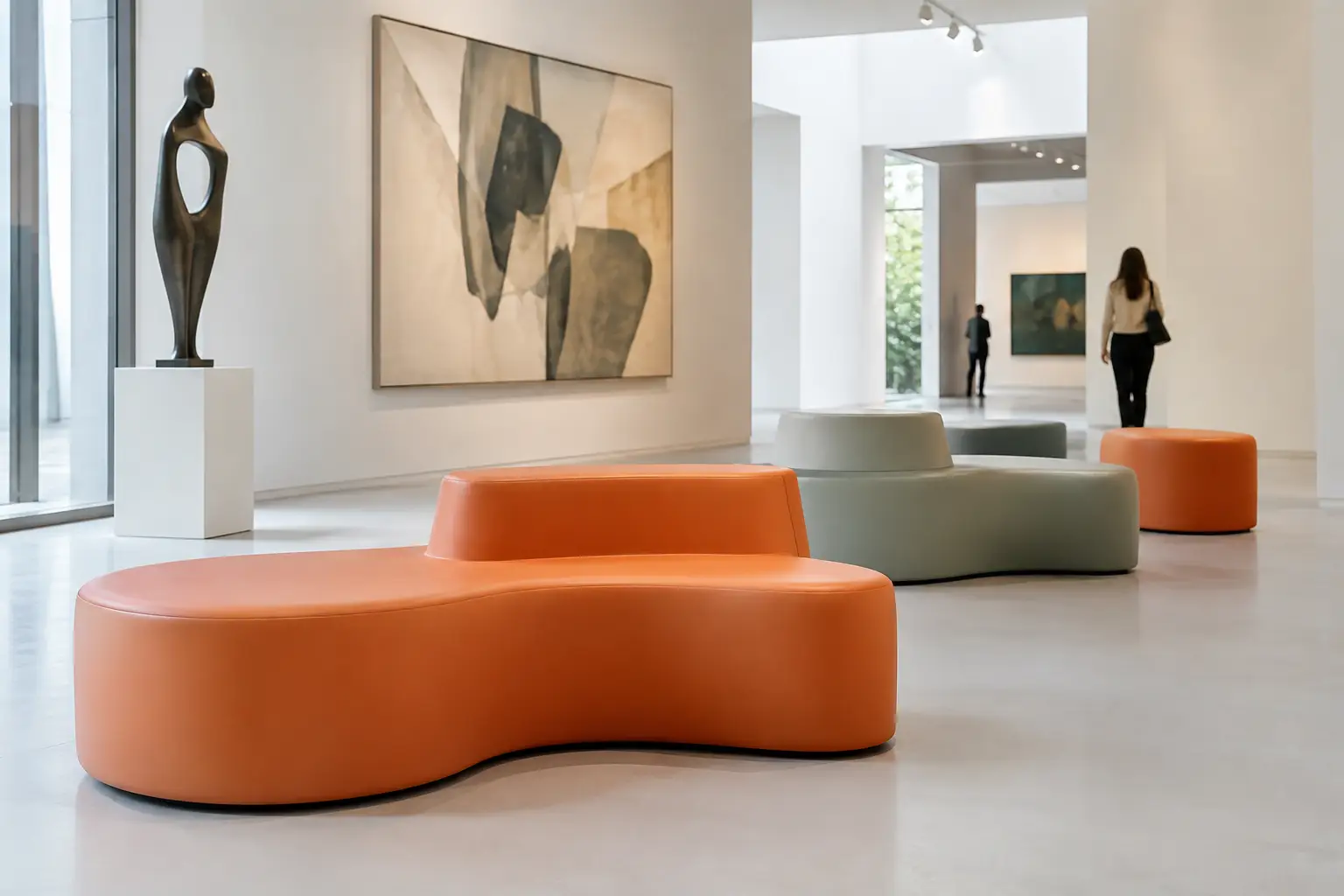
A successful museum seating project does more than give visitors somewhere to sit. It controls pace, frames a view, encourages reflection, and helps people remain engaged with an exhibition for longer. In galleries where every object, sightline, and square foot has been carefully considered, seating cannot be an afterthought.
For architects, exhibition designers, and museum teams, the challenge is to create comfort without visual noise. The strongest solutions feel native to the space: sculptural where the interior calls for a gesture, restrained where the collection must remain dominant, and durable enough for constant public use. That balance requires design thinking well before furniture is selected.
Start the Museum Seating Project With Visitor Behavior
The best place for a bench is rarely determined by an empty patch of floor. It is determined by what visitors need at that moment in their journey. A seat near a large-scale painting or media installation invites a longer encounter. A compact perch at a transition point gives visitors a chance to reset before entering the next gallery. A continuous lounge element can slow circulation in a lobby, education zone, or museum café.
Begin by mapping dwell time, traffic direction, and the moments where fatigue is likely to build. Large institutions may need regular resting intervals across a long route, while a smaller contemporary gallery may benefit from one carefully positioned seating object that doubles as an architectural focal point.
There is a trade-off. More seating can improve comfort and accessibility, but too much can fragment the gallery floor or compete with the work on display. Rather than treating seating as a quantity problem, treat it as a choreography problem. Each piece should have a reason to occupy its location.
Protect the View Before Defining the Form
A museum seat changes how a visitor sees the room. Its height, back profile, length, and orientation can either support the curatorial intent or interrupt it. Low-profile benches preserve open views through a gallery and keep attention on artworks. Higher-backed lounge pieces create intimacy, but they should be reserved for areas where visual separation is useful, such as reading rooms, screening zones, and informal gathering spaces.
Orientation deserves the same scrutiny. A bench aimed directly at a key work establishes an invitation to pause. Seating placed parallel to a wall can serve several works without prescribing a single viewing position. Curved forms may gather people around an installation or soften a rigid gallery plan, but they require enough surrounding clearance to avoid becoming an obstacle in circulation.
Material Decisions That Hold Up in Public Spaces
Museum seating lives under demanding conditions. It encounters high visitor turnover, bags, wheels, cleaning routines, food and drink risks in adjacent public areas, and constant contact with hands and clothing. Material selection has to meet those realities while preserving the intended visual character.
For gallery interiors, the conversation should include cleanability, abrasion resistance, color stability, tactile comfort, and compatibility with the museum’s maintenance procedures. If seating sits close to sensitive collections, material emissions and cleaning chemicals also need early review with conservation teams. A dramatic material choice that creates an avoidable operational concern is not a successful specification.
Coated foam offers a distinct route for projects that need a continuous, sculptural surface without the visual interruption of conventional upholstery seams. The finish can wrap complex curves, radiused edges, and monolithic volumes while remaining practical for active public environments. It is particularly compelling when a seat needs to read as part furniture, part spatial object.
That does not mean every project needs a coated form. Timber may be appropriate for a historic context, while upholstered seating can bring warmth and acoustic softness to a lounge or learning space. The right material depends on the architecture, the visitor experience, and the level of maintenance support available after installation.
Design for Cleaning Without Designing for Sterility
Public furniture should be easy to maintain, but it should not feel clinical. This is where texture, geometry, and color selection matter. Deep crevices can trap dust. Very light colors may show wear quickly in high-contact zones. Extremely dark finishes can reveal fingerprints and scuffs under gallery lighting.
A well-developed form minimizes awkward junctions and hard-to-reach surfaces. Slightly raised bases can simplify floor cleaning and make a substantial bench appear lighter. Rounded corners reduce impact risk in busy circulation routes and create a more welcoming presence for visitors of all ages.
Specify realistic maintenance expectations from the start. Ask who will clean the seating, how often, with which products, and whether the space has staff available for spot maintenance during opening hours. Those answers should influence the final finish, not arrive after production is complete.
Accessibility Is a Design Opportunity
Accessible seating should not be isolated, apologetic, or visually secondary. A museum environment works best when visitors with different mobility needs can share the same moments of rest, orientation, and engagement.
This means considering varied seat heights, supportive backrests where appropriate, stable surfaces for standing up, and clear paths around every piece. Wheelchair users need spaces integrated into the layout, not residual gaps at the edge of the room. Visitors using canes, walkers, or strollers need circulation routes that remain intuitive when seating is occupied.
For long benches, a backless format can be flexible and visually quiet, but it does not suit every visitor. Combining a sculptural communal bench with nearby chairs or backed seating can provide choice without turning the gallery into a waiting room. In museum settings, inclusivity often comes from a family of complementary seating types rather than one universal object.
Build Identity Into the Form, Not Just the Color
Museums increasingly use social spaces, retail zones, education areas, and temporary exhibitions to express a more visible institutional identity. Seating can support that ambition without relying on logos or overt branding.
A custom silhouette can echo the geometry of an exhibition, a building façade, or a collection theme. A bold color can guide visitors toward a family area or signal a moment of interaction. Modular pieces can be reconfigured for talks, workshops, openings, and changing seasonal programs. When the form itself carries the concept, the result feels more considered than a standard product finished in a signature hue.
For ambitious custom work, early collaboration between the designer and fabricator is essential. Scale drawings alone may not reveal how a deep curve will feel, how a large form will break down for delivery, or how a chosen finish will behave across an expansive surface. Prototypes, material samples, and technical review make the difference between a compelling concept and a buildable object.
Sixinch approaches this stage as both a design and fabrication exercise, translating expressive seating concepts into production-ready pieces with coated-foam expertise. That matters when a museum requires more than an off-the-shelf bench: a precise radius, an uninterrupted color field, an unconventional scale, or a form that must function as part of the interior architecture.
Plan for Installation, Change, and Longevity
A visually strong seating installation still needs to arrive, fit, and remain useful over time. Confirm access routes early, including door widths, elevators, loading docks, turning radii, and gallery protection requirements. A large monolithic bench may need to be fabricated in sections, with joins designed to remain discreet once assembled.
Temporary exhibitions introduce another variable. If the seating is intended to move between galleries or adapt to future programming, consider modular construction, manageable component weights, and finishes that can withstand repeated handling. Permanent installations can prioritize a more integrated, site-specific gesture, but they still benefit from repairable components and a clear care plan.
Museum lighting also deserves a final review. A glossy or highly saturated surface may look entirely different under warm track lighting, daylight, or projection spill. View samples in conditions close to the finished space whenever possible. The seating should support the atmosphere of the exhibition at every hour, not only in a studio or showroom.
The most memorable museum seating does not ask visitors to admire the furniture instead of the art. It gives them the comfort, orientation, and permission to stay with the art a little longer. When form, function, and fabrication are resolved together, the pause becomes part of the exhibition itself.