
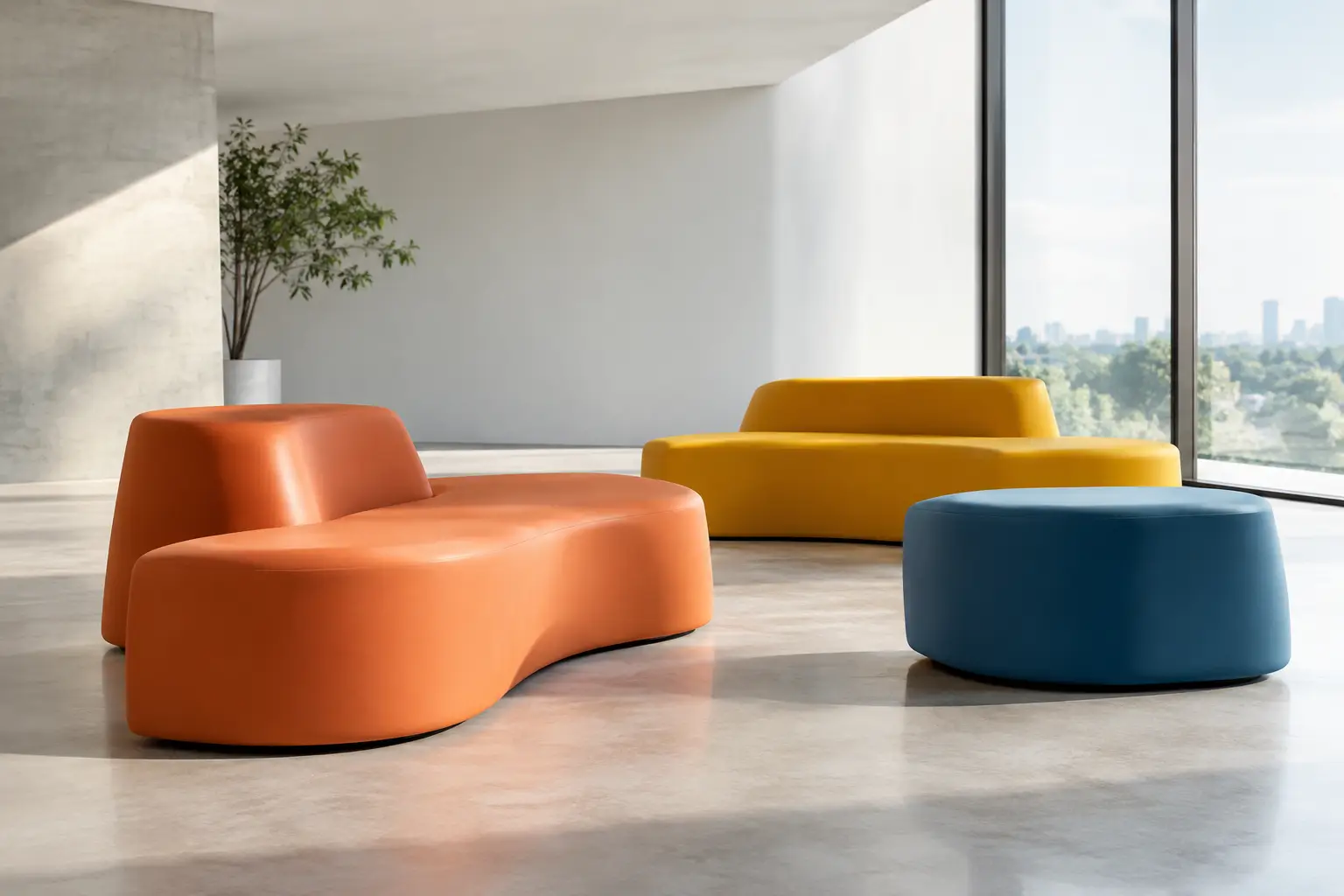
A curved lounge island that guides circulation. A sculptural bench that becomes a brand landmark. A series of oversized planters that gives a hospitality terrace its own visual language. Digital furniture fabrication makes these ideas more buildable, but it does not reduce them to a file and a machine.
For architects and designers, the real value is control: control over form, repetition, scale, material behavior, and the details that determine whether a dramatic rendering becomes a durable, usable object. The strongest results come from treating digital tools and hands-on fabrication as one continuous design process.
What Digital Furniture Fabrication Makes Possible
Digital fabrication uses three-dimensional modeling, computer-guided cutting, scanning, and other data-driven production methods to move from design intent to physical form. In furniture, that can mean a sculpted seat developed as a precise digital volume, a modular system engineered for repeatable production, or a custom public-space element shaped around an architectural plan.
The advantage is not simply speed. A digital model gives a design team a shared source of truth. It can define the overall silhouette, mounting zones, radii, seam locations, drainage requirements, and clearances before material is cut. That clarity is especially valuable when furniture must perform as part of an interior or landscape rather than sit independently within it.
For a hospitality lobby, the model can coordinate a long, curving sofa with columns, power access, circulation paths, and sightlines. For retail, it can translate a brand gesture into seating, display plinths, or soft architectural forms with repeatable dimensions. For public environments, it can establish modules that simplify transport and installation without making the final composition feel standardized.
Digital workflows also support variation. A family of seats may share one visual language while shifting in length, height, or curvature to suit several zones in a project. This is where parametric thinking becomes useful. Rather than redrawing every object, designers can establish rules for how an element changes. The result is a more coherent environment and a more informed path to fabrication.
Digital Furniture Fabrication Is Not Push-Button Production
The digital model is decisive, but it is not the finished object. Furniture is experienced through touch, weight, edge conditions, comfort, acoustic behavior, and the way a surface ages under real use. Those qualities require manufacturing judgment.
A form that looks effortless on screen may be difficult to coat consistently around a tight inside curve. An extremely thin edge may need reinforcement. A broad cantilever may require an internal strategy that protects both the silhouette and the object’s long-term stability. A large piece may need to separate into sections for freight access, then reconnect with joints that disappear visually on site.
These are not reasons to retreat to conventional forms. They are the questions that turn a concept into an object that can survive a busy lounge, a hotel terrace, a campus commons, or a retail flagship. The earlier they are addressed, the more design freedom remains intact.
Geometry needs to be honest about use
Furniture fabrication starts with purpose. Is the object intended for short-stay waiting, relaxed social seating, children’s play, or landscape use? Will people sit on the edge, climb onto it, move it frequently, or clean it every day? The answers affect proportions, base details, ergonomics, surface finish, and the degree of softness needed beneath a coated exterior.
A digitally generated form can be expressive without becoming arbitrary. Curves should support the body or create a deliberate interaction. Openings should be large enough to clean. Planters should account for soil, water, and maintenance access. When an object is intended for a public setting, the design should make durability visible in its logic, not treat it as an afterthought.
Material behavior shapes the final expression
Coated foam fabrication offers a distinctive route to soft, continuous volumes. Foam can be shaped into generous curves, integrated backs, rounded corners, and forms that would be cumbersome or visually fragmented in rigid, panel-based construction. A specialized coating then creates a durable skin that protects the form while preserving its sculptural character.
That combination changes how designers can think about furniture. A bench can read as one monolithic gesture rather than a collection of assembled parts. A lounge element can carry a custom color across its entire volume. A branded feature can combine seating, display, and spatial identity in a single object.
Yet material selection always depends on context. Indoor applications may prioritize tactile finish and color expression. Outdoor pieces require attention to weather exposure, UV performance, drainage, thermal conditions, and the realities of seasonal maintenance. Highly textured or deeply recessed geometry can produce a stronger visual effect, but it may demand more care in high-traffic settings. The right answer is rarely the most complex one. It is the one that gives the project its intended impact with an appropriate service life.
A Better Process for Bespoke Pieces
Custom furniture benefits from an active dialogue between the design team and fabricator. Waiting until construction documents are complete to ask whether an ambitious object can be made usually creates unnecessary compromise. Early fabrication input does not limit creativity. It protects it.
The process often begins with a concept model, reference imagery, dimensions, a material direction, and a clear understanding of the environment. From there, the most useful conversations are specific: Where will the piece be installed? What are the access constraints? Does it need to be freestanding or fixed? Is the finish expected to match a brand color? What level of use and cleaning should it withstand?
A fabrication-ready model then translates visual intent into buildable geometry. This may include rationalizing surface transitions, defining sectional breaks, locating internal supports, and setting tolerances for adjacent architectural elements. On complex projects, a prototype or sample is not a formality. It is a design tool. It allows the team to evaluate scale, comfort, sheen, edge softness, and color under actual lighting conditions.
At Sixinch, this intersection of digital precision and handcrafted coated-foam expertise is central to custom production. The objective is not to force every idea into a catalog format. It is to give unusual forms a credible production path while retaining the visual force that made the concept worth pursuing.
Specify the Details That Protect the Concept
A persuasive rendering does not provide enough information for a successful fabrication package. Designers and specifiers should establish the non-negotiables early: overall dimensions, intended orientation, finish and color expectations, indoor or outdoor use, anchoring requirements, delivery route, and installation conditions.
Color deserves particular attention. Digital swatches are useful for direction, but they are not a substitute for physical review. Surrounding materials, daylight, warm interior lighting, and surface texture can all change how a color is perceived. A sample allows the team to assess not only hue but also gloss, tactility, and how the finish supports the project’s wider palette.
Scale is equally important. A compact model can make an oversized form appear more delicate than it will feel in a room. Full-size mockups are not always necessary, but tape layouts, cardboard profiles, or partial prototypes can reveal circulation conflicts and ergonomic issues before production begins. For a major public-facing installation, this is often a small investment compared with the cost of revising a finished object.
Design Freedom Requires Discipline
Digital furniture fabrication expands the vocabulary of commercial interiors and landscapes. It allows designers to move beyond standard rectangles, predictable upholstery, and furniture that could belong anywhere. But originality performs best when every curve has a purpose, every material choice reflects the environment, and every digital decision anticipates the physical world.
The most memorable pieces do more than fill a floor plan. They invite use, frame movement, carry identity, and give people a reason to remember the space. Start with the gesture that makes the project distinct, then give it the technical care required to last.