
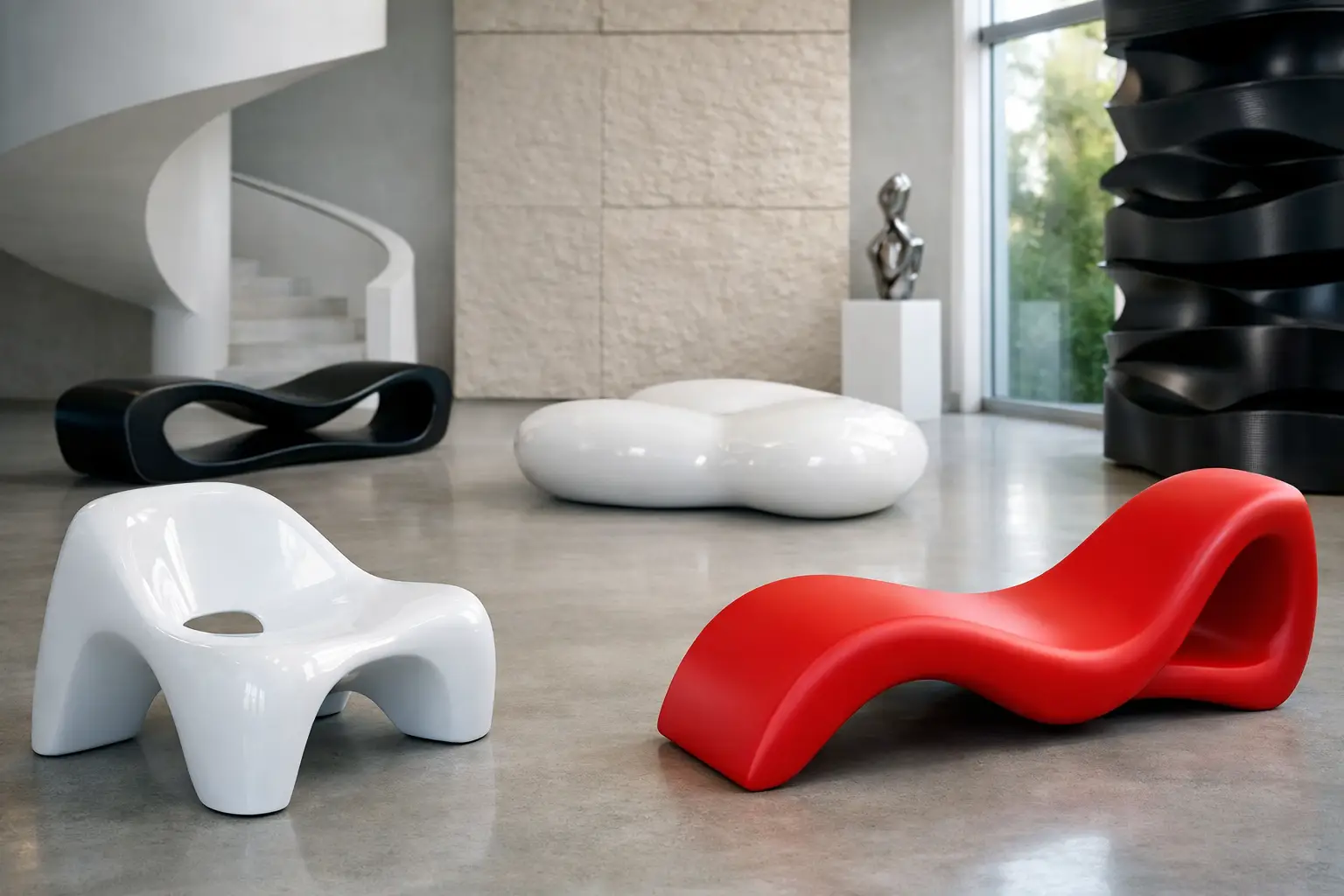
A sculptural bench that looks flawless in a rendering can become awkward, heavy, fragile, or impossible to manufacture once it moves into production. That is why choosing the best materials for sculptural furniture is never just an aesthetic decision. For architects, interior designers, and specifiers, material choice determines whether a dramatic concept holds its shape, meets performance demands, and still feels intentional after years of use.
Sculptural furniture asks more from materials than standard contract seating. Curves need continuity. Surfaces need precision. Edges, transitions, and volume all have to read cleanly from every angle. At the same time, the piece may need to withstand hospitality traffic, public use, outdoor exposure, or brand-specific customization. The right material is the one that supports the form, the finish, and the function together.
What makes a material right for sculptural furniture
When a furniture piece is driven by geometry rather than convention, the usual checklist changes. Weight still matters, but so does the ability to create fluid monolithic forms. Durability still matters, but so does how the surface handles compound curves, integrated backs, soft radii, and oversized volumes.
This is where many materials reveal their limits. Some are visually striking but difficult to shape at scale. Others are easy to fabricate but lack the finish quality needed for high-concept environments. The best results usually come from matching the material to the project intent rather than chasing a single “premium” option.
In practical terms, specifiers should evaluate sculptural furniture materials against six factors: formability, structural stability, surface finish, indoor or outdoor performance, maintenance, and customization potential. A lounge element for a branded retail environment will not need the same material logic as a public plaza seat or a hospitality centerpiece in constant use.
Best materials for sculptural furniture by application
Coated foam for expressive, seamless forms
For soft geometries, oversized volumes, and seamless monoblock pieces, coated foam is one of the strongest options available. It allows designers to realize forms that would be difficult, expensive, or visually compromised in wood, metal, or upholstered construction. Rounded benches, organic seating islands, playful public-space elements, and custom brand-driven forms all benefit from the freedom this material system offers.
The real advantage is not just shape making. It is the combination of sculptural flexibility and a finished surface that feels resolved rather than provisional. With the right coating technology, foam can become suitable for demanding environments while preserving a soft visual language and high level of design precision. That makes it especially effective for hospitality, retail, lounges, experiential spaces, and selected outdoor settings.
There are trade-offs. Not every foam-based piece should be specified as if it were a hard structural object, and detailing still matters. Scale, load conditions, anchoring, and use patterns should be considered early. But when the design intent is bold, rounded, custom, and visually continuous, coated foam offers a level of formal freedom that few materials can match.
Fiberglass for rigid complex shells
Fiberglass remains a useful choice when a project calls for rigid sculptural shells with relatively thin profiles. It can achieve dramatic curves and smooth surfaces, which makes it attractive for statement chairs, reception elements, and custom feature pieces.
Its strength lies in stiffness and visual crispness. Compared with softer material systems, fiberglass can produce a more architectural reading, especially when the form needs to feel sharp, polished, and structural. It also works well when a painted finish is part of the concept.
The downside is that fiberglass fabrication can become labor-intensive, especially for one-off or highly customized production. Surface quality depends heavily on tooling and finishing, and repairs are not always discreet in high-traffic environments. For projects that require frequent iteration, fast customization, or a softer tactile presence, fiberglass may not be the most agile option.
Wood for warmth and crafted geometry
Wood brings a natural depth that many commercial environments still want, even in highly contemporary schemes. Bent plywood, CNC-milled solid wood, and laminated constructions can all produce sculptural furniture with a strong sense of material richness.
This is often the right choice when the design language wants to balance expressive form with warmth and authenticity. In hospitality lounges, cultural spaces, and premium workplace interiors, wood can soften a sculptural gesture and make it feel more grounded.
Still, wood has limits when curves become too fluid or volumes become too large. Tight compound forms can push cost up quickly, and visible joints may interrupt the purity of the shape. Wood also moves with humidity and requires a realistic conversation about wear, refinishing, and edge vulnerability. It performs beautifully when the form respects the grain and fabrication logic. It performs less beautifully when forced into shapes another material could achieve more naturally.
Metal for structure and visual lightness
Metal is often essential in sculptural furniture, though not always as the main visible material. Steel and aluminum are particularly effective when the piece needs slender strength, long spans, or outdoor durability. They can create an elegant tension between structural discipline and expressive form.
For visible sculptural seating or tables, metal works best when the design embraces line, frame, or folded surfaces. It is less convincing when trying to imitate softness or monolithic volume. In those cases, the result can feel overengineered or visually hard.
Metal also invites a careful finish strategy. Powder coating, brushing, polishing, and weather-resistant treatments all change how the object reads. A strong form can be diminished by the wrong sheen or texture. For public and exterior settings, however, metal remains a reliable performer when corrosion resistance and structural integrity lead the specification.
Solid surface and resin-based composites for smooth precision
Solid surface materials and other resin-based composites are useful when a project demands a refined, continuous appearance with a highly controlled finish. They are common in reception desks, integrated furniture elements, and high-design interiors where clean geometry and easy maintenance are priorities.
Their advantage is surface consistency. They can read as sharp, smooth, and premium, especially in minimalist environments. Some can also be repaired or refinished more easily than expected, which adds value in commercial use.
The trade-off is weight, cost, and formal limitation at larger scales. While these materials can create impressive surfaces, they are not always the most efficient route for large, soft sculptural seating. They excel in precision and hygiene-focused applications, but they are not the answer to every expressive furniture concept.
Concrete and stone for permanence and impact
For landscape projects, public installations, and monumental furniture, concrete and stone have obvious appeal. They deliver mass, permanence, and a strong architectural presence. In the right context, that heft is exactly the point.
But these materials are highly specific tools. They are rarely ideal if the project needs flexibility, easy relocation, or inviting ergonomics over long dwell times. They can also make sculptural forms feel static rather than dynamic unless the designer uses profile and proportion very carefully.
In exterior environments, they are often best reserved for pieces where durability, anchoring, and vandal resistance matter more than tactile comfort. Pairing them with softer or more adaptive materials can create a better user experience without losing the intended visual weight.
How to choose the best materials for sculptural furniture
The best specification process starts with one question: what should the piece feel like in the space? Not just visually, but physically and operationally. A statement sofa in a hotel lobby should invite use while holding a strong identity. A branded retail installation may prioritize form and color impact. A public-space element needs a very different performance profile.
Once that is clear, the material decision becomes more precise. If the design depends on continuous volume, soft geometry, and custom color, coated foam may be the smartest path. If the object needs a rigid shell with thin edges, fiberglass may be more appropriate. If tactile warmth is central to the concept, wood earns its place. If outdoor exposure or structural lightness drives the brief, metal may lead.
It also helps to think in hybrids. Many successful sculptural pieces rely on more than one material system, with each doing the work it does best. A metal substructure might support a soft sculptural body. A wood element may introduce contrast within a larger coated form. The strongest result is rarely about material purity for its own sake. It is about alignment between concept, fabrication, and use.
For ambitious custom work, manufacturing expertise matters as much as the material itself. A bold form can only succeed if the production method respects tolerances, finish quality, and repeatability. That is where experienced fabrication partners create real value. They do not simply ask what looks good on paper. They help determine what can be built beautifully, consistently, and at the scale the project demands.
Sculptural furniture earns its place when the material does more than support the silhouette. It should sharpen the idea, improve the experience, and make the piece feel inevitable in its setting. When that alignment happens, form stops being decorative and starts becoming memorable.