
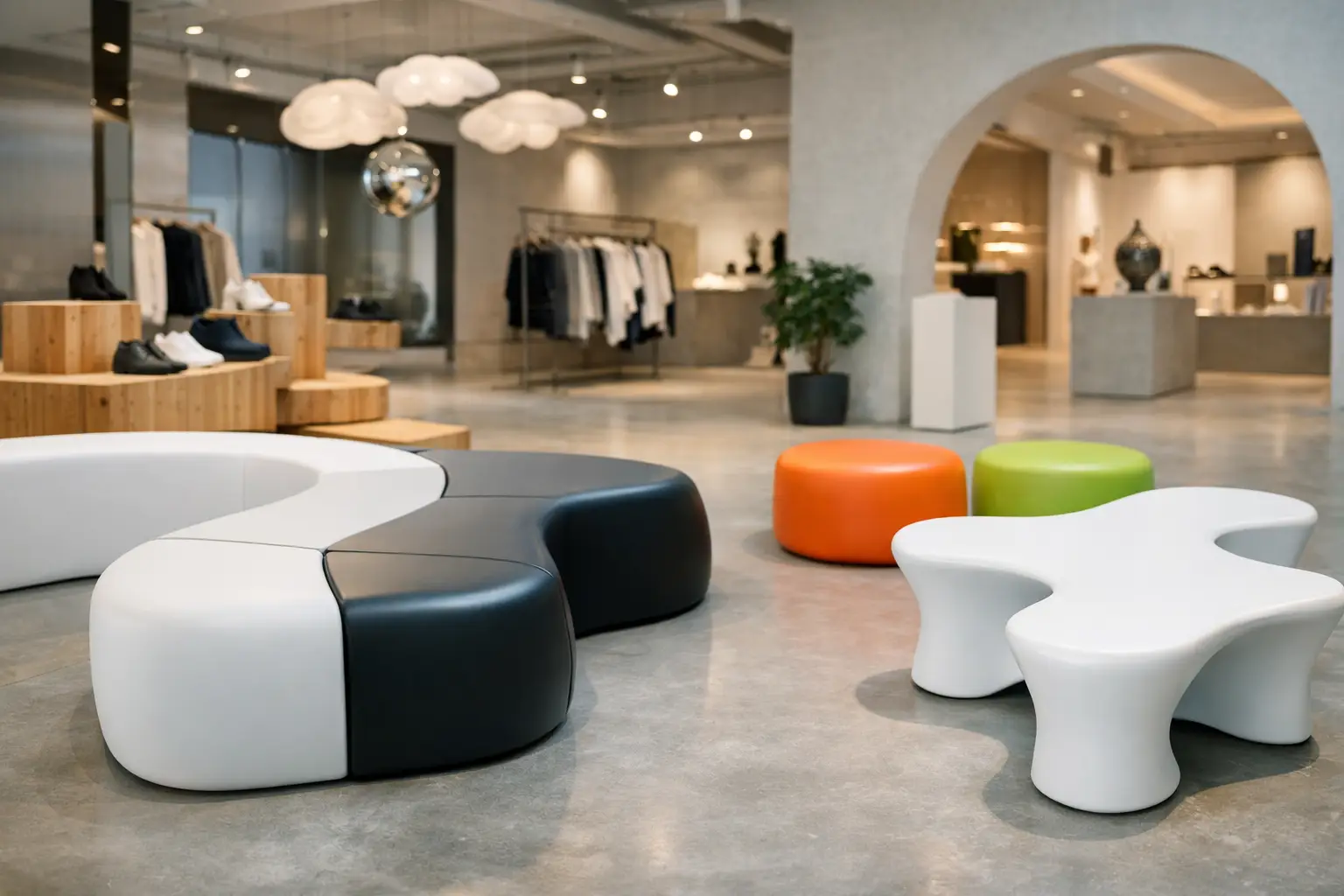
A retail space can have perfect lighting, a sharp product edit, and a strong brand story – and still feel flat the moment a customer walks in. That usually comes down to the environment itself. The best furniture for experiential retail does more than fill square footage. It directs movement, creates pause points, invites interaction, and turns a store into something people remember after they leave.
For architects, retail designers, and brand teams, that changes the specification brief. Furniture is no longer a finishing layer added after the concept is set. It is part of the concept. In experiential retail, every bench, plinth, lounge element, and branded object contributes to how the space performs.
What the best furniture for experiential retail actually does
Experiential retail asks furniture to work harder than standard store fixtures. It must support product presentation, customer comfort, circulation, and brand expression at the same time. That means the right piece is rarely defined by category alone. A bench is not just a bench if it also anchors a social zone, frames a launch display, or becomes a photo moment.
The strongest furniture choices usually do three things well. First, they create a visual signature. Bold form, unexpected scale, and strong color can make a retail environment instantly legible. Second, they support behavior. Customers need places to sit, wait, test, gather, and interact without disrupting traffic flow. Third, they hold up physically. High-touch retail environments punish weak materials and generic construction quickly.
This is where trade-offs start to matter. A highly sculptural piece may deliver impact but fail if it is uncomfortable for longer dwell times. A modular system may be flexible, but if it looks temporary, it can dilute a premium brand message. The best solution depends on whether the space is built for events, everyday browsing, product trials, or a hybrid of all three.
Why generic retail furniture usually falls short
Commodity furniture is built to be broadly acceptable. Experiential retail needs the opposite. It needs pieces with character, presence, and enough technical adaptability to support a specific concept. Standard benches, café tables, and lounge chairs can solve a basic seating requirement, but they rarely shape atmosphere or strengthen brand identity.
There is also the issue of fit. Experiential environments often rely on curved plans, layered zones, branded geometry, and custom color stories. Off-the-shelf furniture can look disconnected in these settings because it was not designed for the architecture or the customer journey. Even when the forms are attractive, dimensions, finishes, or detailing may feel like a compromise.
That does not mean every project needs fully bespoke furniture. It means designers should be selective about where standard products are sufficient and where custom or highly design-led pieces create measurable value. In a feature zone, entrance sequence, or social hub, furniture often needs to do more than solve function.
Best furniture types for experiential retail spaces
Sculptural seating
Sculptural seating is one of the most effective tools in experiential retail because it merges utility with image-making. A seat can define a focal point, soften a hard architectural shell, or carry a brand’s visual language through form rather than graphics. This matters in stores designed to be photographed, shared, and remembered.
Curved benches, monolithic lounge forms, oversized poufs, and integrated seating islands work especially well when the goal is to encourage dwell time without making the environment feel static. Soft geometry can also make a space feel more approachable, which is useful in beauty, fashion, lifestyle, and tech retail where customers are meant to explore rather than move through quickly.
The key is proportion. Sculptural seating should feel intentional, not obstructive. If the form dominates circulation or competes too aggressively with merchandise, it stops helping the space perform.
Modular furniture
Modularity is valuable when a store needs to shift between daily trading, launches, activations, workshops, and seasonal resets. The best modular furniture for experiential retail allows teams to reconfigure layouts without making the space feel provisional.
This is not just about moving cubes around. Well-designed modular systems can create steps, amphitheater seating, display platforms, temporary stages, or lounge clusters from the same family of elements. For brands running frequent events, that flexibility reduces the need for separate event infrastructure while keeping the environment visually consistent.
There is a balance to strike here. Highly flexible systems are useful only if they are easy to handle, durable enough for repeated movement, and attractive in every configuration. Otherwise, adaptability becomes operational friction.
Display furniture with architectural presence
Display should not read like warehouse shelving dressed up for a concept store. In experiential retail, display furniture often needs an architectural quality – something that frames product while contributing to the spatial identity of the store.
Pedestals, low plinths, integrated product-seating hybrids, and freestanding sculptural display volumes can create stronger composition than standard fixture systems. This is particularly effective for limited assortments, premium launches, or environments where fewer products are shown with more intention.
Pieces with soft edges or unusual silhouettes can also shift the emotional tone of the store. They make the environment feel designed rather than stocked, which is a meaningful distinction for brands selling experience as much as product.
Social zone furniture
Experiential retail often includes a zone where customers linger without directly shopping – a waiting area, community table, consultation corner, or event perch. Furniture in these areas should support conversation and comfort, but it still needs visual discipline.
Loose lounge seating can work in some formats, but integrated benches, clustered poufs, and custom seat landscapes often create a cleaner and more branded solution. They also help control layout more precisely. In higher-traffic stores, that level of control matters because it keeps social use from spilling into merchandising zones.
Outdoor-capable pieces for threshold spaces
Retail experiences increasingly begin before the customer crosses the door line. Exterior benches, planters, and branded forms can extend the concept outward and create transition. For street-facing stores, hospitality-driven retail, and mixed-use destinations, these threshold elements are often underestimated.
The right outdoor-capable furniture can frame an entrance, support queueing, or turn a frontage into a gathering point. But exterior use raises technical demands. UV stability, cleanability, drainage, surface durability, and anchoring all need to be considered early in specification.
Material and fabrication matter as much as form
A memorable concept is only useful if it survives opening month. Retail furniture is exposed to constant contact, bag strikes, cleaning products, friction, and sometimes misuse. Materials need to perform under pressure while still delivering visual clarity.
This is why coated foam and other specialized fabrication methods are so relevant to experiential retail. They allow designers to work with softer, more fluid, and more distinctive forms without giving up durability. Large monolithic shapes, rounded edges, integrated color, and custom geometry become achievable in a way that standard upholstery or hard-case goods often cannot match.
For design teams, the advantage is not only aesthetic. It is practical. Fewer joins can mean easier maintenance. Soft-touch forms can improve user comfort and safety in high-traffic settings. Custom colors and shapes can carry branding without relying on applied graphics that date quickly or wear poorly.
How to specify furniture for experiential performance
The best process starts with behavior, not product category. Ask what each zone needs customers to do. Pause, post, test, wait, gather, or move? Once that is clear, furniture can be specified as part of the spatial choreography rather than as isolated objects.
Next, assess where visual impact is most valuable. Not every piece needs to be a statement, but the pieces that shape first impression, social interaction, and branded memory should earn their place. This is where custom fabrication or highly expressive collections often make the biggest difference.
Then test durability assumptions honestly. A beautiful finish that cannot tolerate heavy cleaning is a risk. A striking profile that chips at corners is a risk. A movable element that staff avoid moving is a risk. Good experiential furniture should be expressive, but it should also be easy to live with operationally.
One of the strongest approaches is to combine permanent anchor pieces with flexible supporting elements. The anchors carry identity. The supporting pieces adapt to programming. That mix gives stores staying power without making them rigid.
Best furniture for experiential retail is brand-specific
There is no universal answer because experiential retail is not one format. A sneaker launch space, a beauty studio, a museum shop, and a luxury fashion concept all define experience differently. What they share is the need for furniture that does more than perform a basic function.
For some brands, the best solution is a family of clean, modular elements that can shift weekly. For others, it is a dramatic sculptural landscape that becomes inseparable from the store image. Often, the strongest projects combine both. Sixinch approaches this territory with that exact logic – bold forms, custom freedom, and manufacturing precision built to support ambitious commercial concepts.
The right furniture should make the brand feel more like itself, not more like retail in general. That is the standard worth designing for.
When a customer remembers the shape they sat on, the platform that framed the product, or the object that made them stop at the door, the furniture did its job.