
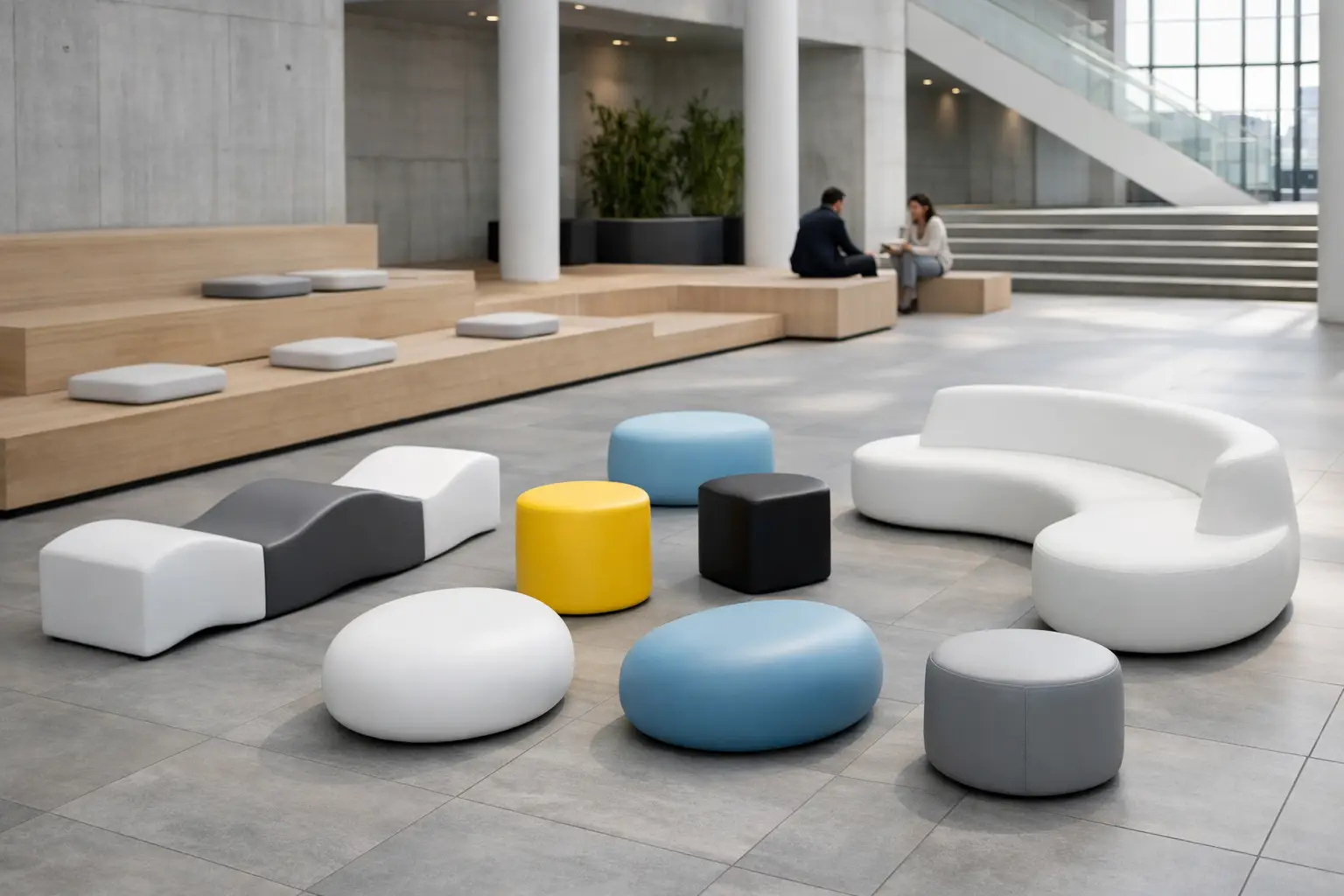
A plaza can look finished on paper and still fail the moment people arrive. The usual culprit is not paving, planting, or lighting. It is seating. The best public plaza seating design examples do more than provide a place to pause – they shape circulation, invite social use, support dwell time, and give the space a clear identity.
For architects, landscape designers, and public-space specifiers, seating is rarely a standalone object. It is part infrastructure, part social cue, part sculptural element. A bench can direct movement, soften a hard urban field, create a branded gesture, or anchor a plaza that would otherwise read as oversized and anonymous. That is why the most successful solutions are not selected by catalog logic alone. They are designed in response to behavior, climate, maintenance, and the visual language of the project.
What strong public plaza seating design examples have in common
The strongest projects usually balance five pressures at once. They need to feel intuitive for the public, durable for operators, legible within the larger site plan, comfortable across short and medium dwell times, and distinctive enough to make the plaza memorable.
That sounds straightforward until real-world constraints arrive. A municipal plaza may need anti-skate detailing and easy cleaning. A mixed-use development may want seating that doubles as placemaking. A cultural campus may prioritize sculptural presence over maximum seating count. In each case, the right answer changes.
This is why plaza seating should be evaluated as a spatial system rather than a row of objects. Material, geometry, edge condition, height variation, and placement all influence whether people actually use the space the way it was intended.
10 public plaza seating design examples worth studying
1. The perimeter bench that frames the square
One of the most reliable moves is a continuous bench along the plaza edge. This works especially well when the center of the space needs to stay open for events, markets, or heavy pedestrian flow. The seating defines the boundary, offers clear resting points, and gives users a way to observe activity without sitting in the middle of circulation.
Its strength is flexibility. Its weakness is social distance. If every seat is pushed to the edge, the center can feel exposed and underused on ordinary days.
2. Integrated planter seating
When seating and planting are designed as one composition, the plaza gains both comfort and structure. Planter edges create informal resting zones, reduce the visual hardness of paved ground planes, and help break large areas into usable pockets.
This approach works best when seat heights and edge widths are carefully controlled. Too narrow, and it becomes perch seating at best. Too tall, and it starts to read as a barrier. The best versions make greenery feel inhabitable, not decorative.
3. Sculptural monolithic seating
Some public plaza seating design examples succeed because they operate as functional landmarks. A sculptural monolithic form can give a plaza immediate visual identity while still serving as communal seating. This is especially effective in cultural, retail, hospitality, and campus settings where the public realm is expected to carry a stronger design signature.
The trade-off is precision. Bold form only works if ergonomics, drainage, finish quality, and surface durability are resolved with equal discipline. A dramatic object that is awkward to sit on quickly becomes public art with no social return.
4. Modular seating islands
Instead of one long gesture, some plazas benefit from clusters of seating placed as islands across the site. This creates smaller social territories and helps scale down large open areas. People tend to choose these zones when they want casual conversation, short breaks, or a degree of personal space without isolation.
Modular systems also allow adaptation over time. Elements can be repeated, reconfigured, or combined with planters and tables. For developments expecting phased growth or seasonal programming, that flexibility matters.
5. Terraced seat steps
Where the site has topography or level changes, stepped seating can do more than solve grade. It can turn a circulation challenge into a social asset. Seat steps often perform well in plazas connected to transit, schools, amphitheater-style events, or food-oriented environments where people gather informally.
Comfort, however, depends on proportion. If tread depths are too shallow or risers too high, people will use them reluctantly. Adding back support in selected sections or combining steps with adjacent benches often improves longer dwell times.
6. Backed benches for extended use
Not every plaza is about quick turnover. In healthcare, education, civic, and mixed-use settings, backed seating supports longer stays and broader accessibility. It is often the difference between seating that is technically present and seating that is genuinely welcoming.
This type may be less visually radical than sculptural forms, but it can be integrated into a stronger overall composition through custom geometry, color, and placement. Function does not require visual compromise.
7. Curved social seating
Curved benches and looping forms create a more conversational dynamic than strictly linear layouts. They soften large hardscapes and guide people into shared orientation rather than parallel isolation. In plazas intended for community use, that subtle shift can change how the space feels.
Curves also help resolve awkward site geometries. The caution is that custom curvature needs manufacturing discipline. Irregular forms that look effortless on a rendering require exact execution to maintain comfort, consistency, and alignment on site.
8. Movable seating zones
Fixed seating is not always the smartest answer. Some of the most active plazas rely on movable chairs or lightweight pieces that let users control their own arrangement. This can be especially effective in temperate climates, food plazas, and spaces that need to support both solitary and group use throughout the day.
The obvious issue is management. Movable seating depends on operations, storage strategy, replacement planning, and a realistic assessment of misuse. It creates freedom, but it also asks more from the client.
9. Multi-height seating for mixed behavior
A single seat height assumes a single use pattern. The better plazas often include standard seat height, low lounging edges, and occasional perch points within the same composition. That variety supports different postures, age groups, dwell times, and social situations without overcomplicating the layout.
For design-led projects, this is where custom fabrication becomes especially valuable. Variation can be intentional rather than improvised, giving the plaza a clear visual rhythm while broadening usability.
10. Branded or site-specific seating elements
In commercial and experiential environments, seating can carry more than function. It can express the identity of the place. Custom forms, signature colors, integrated graphics, or architectural seating objects can turn the plaza into a recognizable destination rather than a generic forecourt.
This approach works when brand expression is built into the design language of the project, not applied as decoration. The best site-specific seating feels native to the architecture and landscape. It does not look like a logo scaled up into furniture.
How to evaluate plaza seating beyond appearance
Visual impact matters, but public use is unforgiving. If the seating heats up too much in sun, collects water, stains easily, or creates uncomfortable edge conditions, the design will underperform no matter how strong it looks in presentation materials.
Material choice is central here. Outdoor public seating has to absorb impact, resist weather, clean easily, and retain its finish under repeated use. For projects pushing toward more expressive forms, the manufacturing method becomes just as important as the material itself. Complex geometry is only useful if it can be produced consistently and installed without compromising durability.
Comfort also needs a more precise definition than soft versus hard. In a plaza, comfort means correct height, stable posture, approachable edges, and a form that fits intended dwell time. A lunch plaza, transit forecourt, museum entry, and civic square may all require different seating behavior. There is no universal benchmark.
Where custom seating changes the project
Standard benches can solve basic capacity, but they rarely shape a place with much conviction. Custom seating becomes valuable when the plaza needs to do more – handle unusual geometry, merge seating with planters or topography, express a strong design concept, or support a branded environment without defaulting to off-the-shelf repetition.
This is where a fabrication partner matters. Design freedom only becomes an asset when it is paired with technical control. Coated foam, for example, opens a different range of possibilities for sculptural and highly customized seating because it allows fluid forms, integrated volumes, and a strong visual presence without abandoning practical performance. For designers trying to create public environments that feel original rather than assembled, that flexibility can reshape the entire seating strategy.
Sixinch approaches this space with that exact mindset: not as a supplier of isolated objects, but as a production partner for bold seating concepts that need to perform in real environments.
Choosing the right example for your plaza
The right precedent depends on what the plaza is trying to become. If the goal is efficient daily use, perimeter benches and backed seating may do most of the work. If the project needs a stronger visual signature, sculptural forms, curved social seating, or site-specific elements may carry more value. If adaptability matters most, modular islands and movable pieces offer a different kind of intelligence.
The key is resisting the temptation to treat seating as the final layer. In strong public space design, it is one of the primary tools for defining use, mood, and memory. When seating is conceived early, resolved technically, and shaped for real behavior, the plaza stops being just open space and starts becoming a place people choose to stay.