
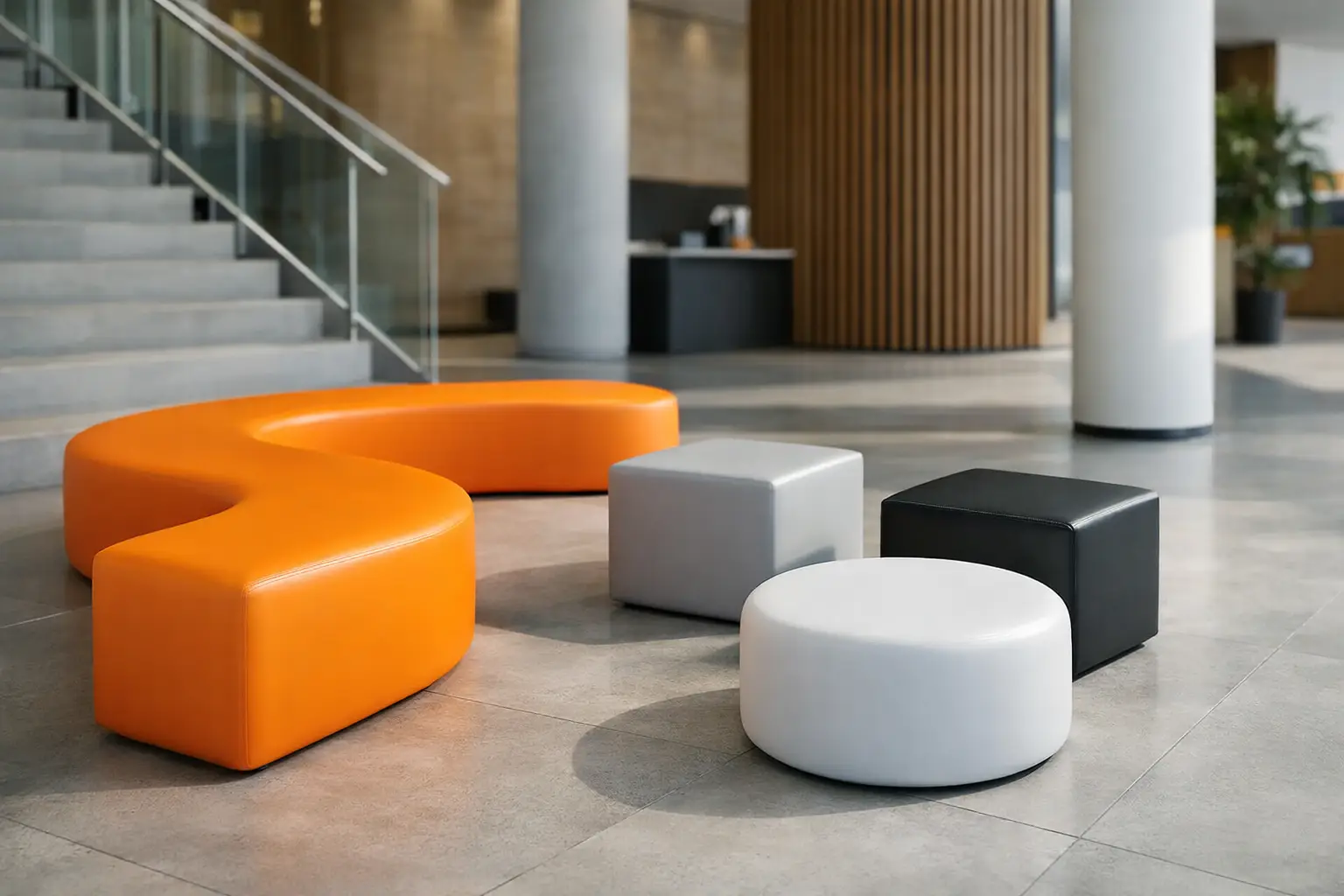
A sculptural bench in a hotel lobby has a harder job than it appears to. It must hold its shape under constant use, tolerate cleaning, resist scuffs from luggage and shoes, and still deliver the visual impact that made it worth specifying. What makes coated foam durable is not one magic surface treatment. It is the disciplined combination of foam engineering, coating performance, construction detail, and a specification that reflects the actual environment.
For architects and designers, that distinction matters. Coated foam makes forms possible that conventional upholstered furniture often cannot: continuous curves, generous radii, oversized volumes, integrated seating, and custom pieces that read as a single sculpted object. But design freedom only becomes a long-term asset when the material system is matched to the project.
What Makes Coated Foam Durable?
Durability begins with the relationship between the foam core and its protective coating. The foam provides volume, comfort, and structural behavior. The coating creates the finished skin: a resilient, cleanable surface that protects the core while preserving the intended form and tactile character.
A durable result depends on both layers performing together. A high-performing coating cannot compensate for a foam core that compresses too easily or lacks appropriate support. Likewise, excellent foam will not stay visually refined if its exterior finish is poorly matched to traffic, weather exposure, or maintenance routines.
The strongest coated-foam pieces are engineered as complete objects rather than treated as foam shapes with a finish applied afterward. That is especially relevant in hospitality, retail, workplace, education, and public settings, where a piece may be touched, moved, leaned on, and cleaned hundreds of times a week.
The Foam Core Sets the Foundation
Foam is not a generic material. Its density, firmness, cell structure, and intended loading all influence how a finished piece performs over time. Density is particularly relevant because it relates to the amount of material supporting the shape. In broad terms, denser foam is better equipped to resist permanent compression and retain its profile under repeated use.
Firmness is a separate decision. A seat needs enough support to prevent excessive bottoming out, while a lounge form may require more give for comfort. The right balance depends on the geometry and use case. A low, broad public lounge seat experiences force differently from a compact ottoman or a vertical-backed banquette.
Complex forms also need thoughtful internal design. Large cantilevers, very thin edges, deep channels, or unusually tall volumes may require reinforcement, layered foam construction, or concealed support elements. These choices protect the silhouette designers care about most. A visually light form should not begin to sag simply because the internal build was too literal.
Shape Retention Is a Design Requirement
When specifying custom furniture, shape retention should be discussed as early as color and dimensions. Ask how the piece will be used, whether users will perch or fully sit, and whether the furniture will be repositioned frequently. These details affect the foam selection and the way the object is constructed.
A durable coated-foam seat is designed for realistic behavior, not ideal behavior. People sit on edges. Children climb. Guests drag bags across surfaces. Staff move furniture quickly during event changeovers. Good fabrication anticipates those moments without forcing the design into a conventional furniture language.
The Coating Is a Flexible Protective Skin
The coating is what gives coated foam its distinctive visual continuity. Rather than relying on seams, loose textile covers, or separately upholstered panels, the finish can follow a sculptural form across curves and transitions. This creates a clean, monolithic appearance while adding practical protection.
A quality coating must remain flexible as the foam compresses and recovers. If the skin is too rigid for the movement beneath it, cracking can develop around high-flex areas such as front seat edges, corners, and heavily used backrests. If it is too soft or too thin for the application, it may show wear earlier than expected.
Coating chemistry, thickness, adhesion, and curing all affect the outcome. The surface needs to bond securely to the foam while retaining enough elasticity to move with it. Skilled application is critical, particularly where several planes meet or where a design includes tight radii, sharp visual edges, or deeply sculpted details.
The finish also influences the sensory experience. Depending on the selected system, coated foam can feel smooth, soft-touch, textured, or more architectural. That choice is not purely aesthetic. Texture can influence how scuffs show, how easy the surface is to clean, and how the object performs in a high-contact setting.
Construction Details Determine Where Wear Appears First
Most furniture does not fail uniformly. Wear usually begins at stress points: edges that receive repeated impact, corners that are bumped by carts, undersides exposed during movement, and areas where users consistently push themselves up from a seat.
That is why details matter. Generous radii generally distribute impact better than extremely sharp corners. Properly finished transitions reduce the risk of localized stress in the coating. Well-considered bases and feet can keep the seating surface clear of abrasive floors and limit damage when an item is moved.
For larger pieces, handling strategy is part of durability. A custom lounge island may need discreet lifting points, modular sections, or an internal support approach that allows installation teams to move it without pulling on the coated surface. The most striking pieces are often the most unconventional, so practical logistics should be designed into the object from the start.
At Sixinch, coated-foam fabrication is approached as a way to turn expressive concepts into production-ready furniture, not as a shortcut around engineering. The form, the foam, the coating, and the use environment all need to agree.
Durability Depends on the Environment
There is no single “durable” specification that suits every project. A private residence, a busy airport lounge, a poolside terrace, and a branded retail activation impose very different demands.
Indoor public-space furniture typically needs strong resistance to repeated contact, routine cleaning, staining, and incidental abrasion. In a restaurant or hospitality setting, food and beverage exposure may be central to the brief. In a workplace, frequent rearrangement and cleaning protocols may matter more. For outdoor use, UV exposure, standing water, temperature swings, and drainage become essential considerations.
Outdoor coated foam requires particularly careful material selection. Sunlight can alter color over time, and water should not be allowed to remain trapped against the furniture or within its construction. A coating intended for interior use may deliver excellent results indoors yet be the wrong choice for a terrace or landscape installation. The design may look identical on day one, but the specification behind it should not be.
Color deserves the same practical attention. Dark colors can make scuffs less visible in some interiors, while lighter colors may better support a brand or spatial concept but demand more frequent care. Saturated colors create dramatic impact, yet outdoor exposure can make color stability a more prominent issue. The right choice is not always the safest color. It is the color supported by a realistic maintenance plan and the right coating system.
Cleaning Preserves Both Appearance and Performance
Coated foam is valued in part because it can be easier to maintain than many porous upholstery materials. A continuous surface gives dirt, spills, and dust fewer places to collect. Still, cleanability does not mean every cleaning method is appropriate.
Routine care should be gentle and consistent. Remove loose dirt before it becomes abrasive, clean spills promptly, and use products approved for the selected finish. Harsh solvents, aggressive scrub pads, and untested disinfectants can dull a surface, affect color, or compromise the coating over time.
For commercial projects, maintenance should be part of the handover conversation. Facilities teams need straightforward guidance on what to use, what to avoid, and how to respond to common incidents. This is especially useful where furniture is specified in a distinctive custom color or where replacement is less immediate than with standard catalog seating.
Specify for the Real Brief, Not the Best-Case Scenario
The most reliable way to achieve longevity is to give the fabrication partner a precise brief. Describe the setting, expected traffic, cleaning regime, indoor or outdoor exposure, desired comfort, installation constraints, and visual priorities. If a piece will be used for events, moved daily, or exposed to direct sun, say so early.
That information allows informed trade-offs. A softer feel may require a different internal construction. An ultra-sharp geometric profile may benefit from slight refinement at vulnerable edges. A delicate matte surface may be ideal for a controlled interior but less suited to a busy venue where chairs, bags, and equipment regularly make contact.
Coated foam is durable when it is specified with the same intention as the space around it. Give the material a clear job to do, and it can carry ambitious forms through years of real use without losing the character that made the design memorable.