
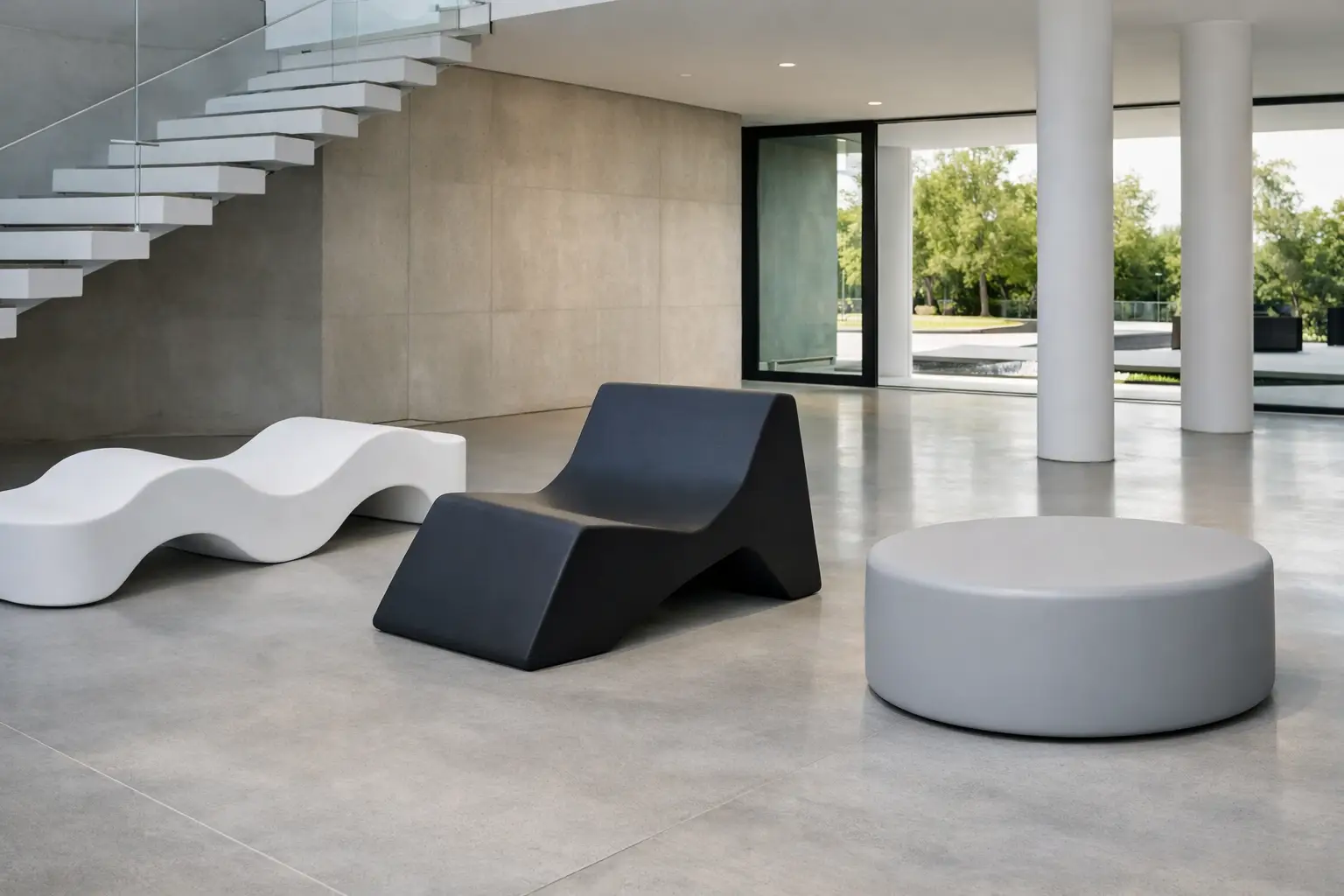
A lobby bench does more than fill a footprint. It directs movement, sets the visual temperature of a room, and gives guests a reason to remember the space. This guide to architectural foam products is for specifiers who want that level of impact without forcing a sculptural concept into the limited geometry of conventional furniture.
Architectural foam products make it possible to produce seating, planters, landscape elements, and spatial objects with soft profiles, continuous surfaces, and highly specific proportions. Their value is not simply that they are lightweight. It is that foam can become a production-ready medium for forms that would be difficult, costly, or visually compromised in wood, metal, or hard plastic.
What Architectural Foam Products Are
Architectural foam products are fabricated objects built around a shaped foam core and finished with a protective coating system. Depending on the design, the result can function as a lounge seat, ottoman, bench, planter, reception element, play object, or outdoor landscape feature.
The foam core is cut, formed, or assembled to achieve the intended volume. It may be simple and geometric, or it may contain compound curves, exaggerated radii, integrated backrests, and organic silhouettes. A specialized coating then creates a durable, continuous skin over the form. This is where a sculptural foam object becomes a practical furnishing element.
That distinction matters. Exposed foam is not appropriate for most commercial environments. A professionally coated foam product is designed as a complete system: core density, internal reinforcement where needed, coating selection, finish texture, color, and intended use all work together.
For design teams, this opens a different way of thinking about furniture. Instead of choosing from fixed seat modules and adapting the concept around them, the object can be shaped around circulation, branding, architecture, and human behavior.
Where Coated Foam Has the Strongest Advantage
Architectural foam is particularly effective where visual continuity matters. A long communal seat can flow into a low divider. A series of pebble-shaped lounge pieces can create an informal waiting area. A planter can match the language of seating rather than looking like an unrelated accessory.
Hospitality interiors benefit from this freedom because they often require custom dimensions, memorable silhouettes, and furniture that supports a distinct guest experience. In retail, foam products can reinforce brand identity through color, oversized form, or unusual display geometry. Offices and public interiors use them to soften large open areas and create inviting places to pause.
Exterior applications are equally compelling when the coating and construction are selected for the site. Pool decks, terraces, courtyards, campuses, and public landscapes often call for objects that feel more integrated than standard outdoor furniture. A coated foam bench or planter can carry a bold form across an entire setting while remaining visually clean and easy to understand from a distance.
The trade-off is that architectural foam is not the default answer for every object. Extremely thin profiles, high point loads, heavily abrasive conditions, or applications requiring structural spans may call for another material or a hybrid construction. The strongest projects begin with an honest assessment of performance, not an assumption that one material solves every problem.
A Guide to Architectural Foam Products by Application
Seating and lounge furniture
Foam is naturally suited to comfort, which makes it a strong foundation for ottomans, low lounge seating, benches, and sculptural sofas. However, comfort should be specified, not assumed. Seat height, edge softness, back angle, and foam density all affect how a piece performs once people use it for more than a quick photograph.
For hospitality lounges, consider how long guests will sit and whether they need back support. For public waiting areas, stability and ease of entry may matter more than deep relaxation. In informal workplace settings, a mix of perch-height seats and lower lounge forms often supports a broader range of postures.
Planters and landscape elements
Coated foam planters can bring oversized scale and distinctive geometry to indoor or outdoor schemes without the handling challenges of cast concrete or solid stone. They are especially useful when a project calls for a family of forms in multiple sizes, custom colors, or expressive contours.
Planters still need proper technical coordination. Confirm planting volume, liner requirements, drainage, irrigation access, ballast, and the expected weight of wet soil. A dramatic planter should look effortless, but its internal details must accommodate the realities of landscape maintenance.
Public-space and experiential objects
In airports, museums, campuses, retail environments, and event spaces, architectural foam can create furniture that also acts as visual infrastructure. It can define a zone, guide circulation, offer informal seating, or turn a branded shape into a usable object.
These applications demand careful attention to user behavior. Will visitors sit, lean, climb, drag bags across the surface, or move the piece? Is the object freestanding, grouped, or fixed in place? The answers influence geometry, base details, coating choice, and whether anchoring is required.
The Specification Decisions That Shape Performance
The visible form may lead the conversation, but the brief should also establish how the object will live. Start with the environment: indoor, covered outdoor, or fully exposed exterior. Then define the intensity of use, cleaning routine, and realistic risks such as food service, sunscreen, moisture, foot traffic, or repeated impact.
Coating selection is central. Different coating systems can offer different tactile qualities, surface textures, degrees of softness, and resistance to environmental stress. A refined matte finish may suit a controlled interior, while a more resilient outdoor-oriented finish may be better for a terrace or public plaza. Ask for a recommendation based on the actual project conditions, not only on a finish sample viewed in a studio.
Color requires the same discipline. Bright colors create immediate impact and can make an object feel like a signature installation. Darker tones may conceal everyday marks more effectively, while very pale colors can sharpen a minimal interior but demand a more attentive maintenance plan. Color matching is valuable for branded spaces, yet slight variation can occur across materials, lighting conditions, and production batches. Review physical samples under project lighting whenever possible.
Dimensions should account for both design intent and logistics. Large one-piece forms can create an exceptional uninterrupted silhouette, but door openings, elevators, loading routes, and site access may make sectional construction the smarter choice. A visible joint is sometimes preferable to a last-minute installation problem. Good fabrication planning resolves this early, before the final form is locked.
From Concept Sketch to Production-Ready Object
The most successful custom foam projects are developed through a focused exchange between designer and fabricator. A compelling sketch is a useful beginning, but it does not yet define the product. The design needs dimensions, intended use, color direction, installation conditions, and a clear understanding of what the user will encounter.
Digital models are valuable for reviewing proportions, but physical samples remain important. They reveal surface feel, edge behavior, coating texture, and the way light moves across a curved form. For projects with unusual geometry or high visibility, a prototype or scale model can prevent expensive assumptions.
At Sixinch, custom development is approached as both a creative and manufacturing exercise. The objective is not to dilute an ambitious concept into a standard product, but to engineer the concept so it can be fabricated, finished, transported, and used with confidence.
Be precise about what must remain non-negotiable. It may be the silhouette, a signature color, a continuous visual line, or a specific interaction between multiple objects. Other aspects, such as internal construction or hidden sectional breaks, may have more flexibility. This clarity helps preserve the design while making practical decisions quickly.
Care, Maintenance, and Lifecycle Thinking
A coated foam product should be treated as a contract-grade furnishing element, not as an indestructible object. Routine cleaning usually begins with mild soap, water, and a soft cloth, following the manufacturer’s guidance for the specific finish. Avoid harsh abrasives and unapproved solvents, which can damage the surface or alter its appearance.
For exterior pieces, maintenance also includes checking drainage, keeping standing water from accumulating where it should not, and reviewing the condition of the product after severe weather or seasonal storage. In high-traffic interiors, define who is responsible for cleaning and how frequently the objects will be inspected. This is especially useful for light-colored seating and public installations.
Lifecycle value comes from matching the product to its setting. A well-specified foam object can retain its visual presence for years because its form is not dependent on upholstery that can sag, shift, or introduce seam lines. Yet it must be designed for the real environment, with an appropriate coating, handling plan, and maintenance routine.
The best architectural foam products do not look like a material experiment. They look inevitable in the space: a seat that belongs to the architecture, a planter that carries the project’s identity, or a sculptural object that invites use before anyone asks what it is made from.