
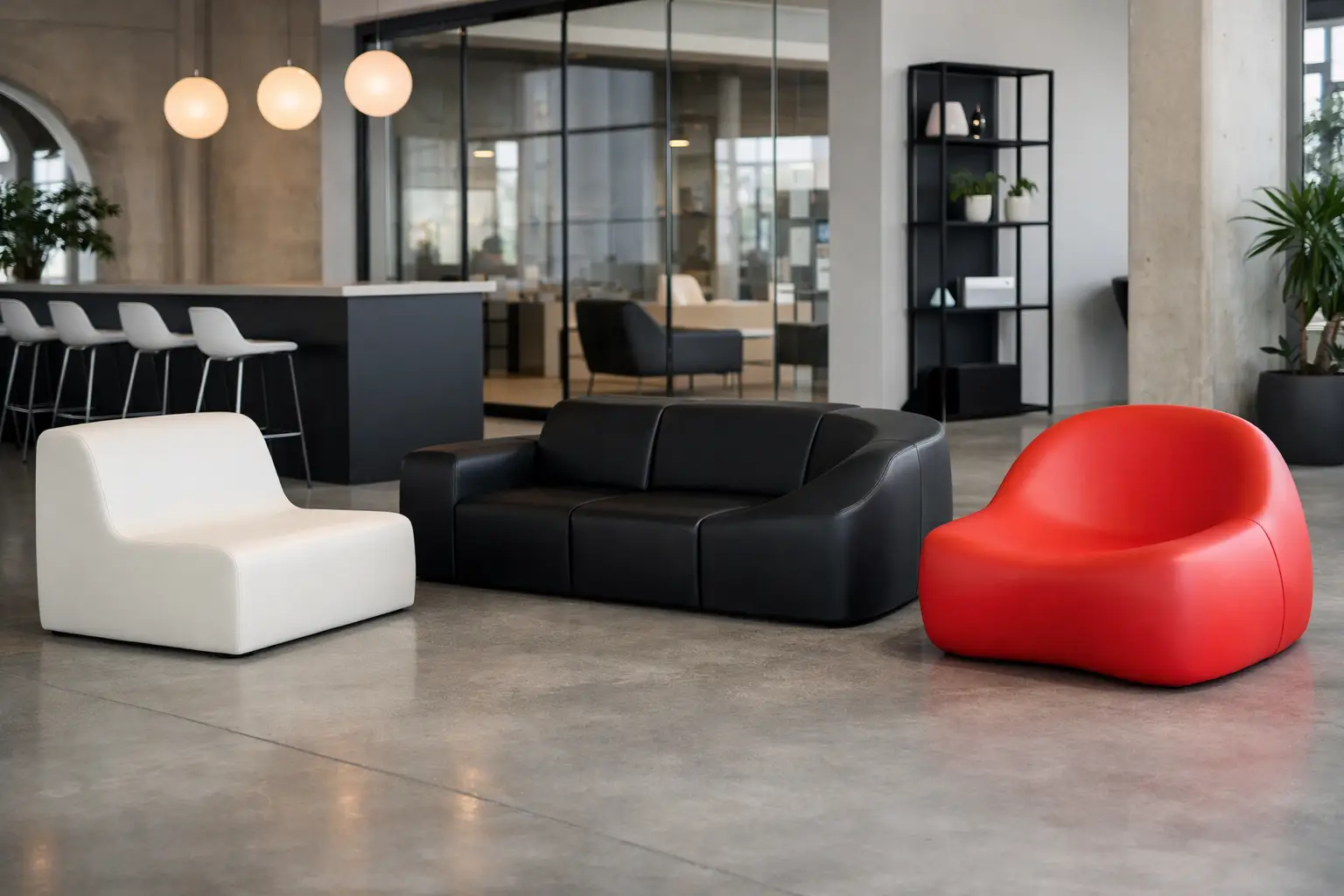
A lobby chair may be photographed on opening night, but its real test begins the next morning: rolling luggage, wet coats, impatient guests, cleaning crews, and hundreds of daily interactions. That is why commercial seating manufacturers Europe-based specifiers consider are not simply suppliers of attractive objects. They are production partners whose materials, engineering, capacity, and design language shape how a space performs long after the renderings are approved.
For hospitality, workplace, retail, cultural, and public projects, seating has to do more than fill a floor plan. It establishes rhythm, signals brand character, absorbs use, and gives people a reason to pause. The right manufacturer can turn a strong concept into a durable, production-ready feature of the environment. The wrong one can reduce an ambitious interior to a collection of compromises.
What Sets Commercial Seating Manufacturers in Europe Apart
Europe has a deep furniture-making culture, but commercial work demands a different level of coordination than residential production. Projects often require repeatable quality across large quantities, clear technical documentation, defined lead times, and materials suited to intensive use. For a designer, the question is not merely whether a lounge chair looks refined in a studio. It is whether it can be specified confidently for a hotel reception, airport lounge, flagship store, or university commons.
The strongest manufacturers combine design fluency with manufacturing discipline. They understand proportion, upholstery, color, and form, while also managing tooling, tolerances, packaging, logistics, and quality control. This balance matters most when the seating is central to the project concept rather than a background component.
There is also no single European manufacturing model. Some producers excel at standardized collections with efficient specification paths. Others are built for custom fabrication, where the designer begins with a sketch, a spatial problem, or a brand gesture instead of a catalog item. Neither approach is automatically better. The right choice depends on whether the project needs speed and repeatability, or a seating language that cannot be found on every other hospitality floor.
Start With the Spatial Idea, Not the Product Category
Commercial seating is often sourced too late, after the plan, palette, and circulation strategy have already hardened. That process encourages safe substitutions: a standard sofa where a sculptural bench was intended, individual chairs where a continuous landscape would better organize the room.
A better brief describes the desired experience first. Should seating create a social island in a large lobby? Define a softer edge around a retail installation? Carry a brand color through a public waiting area? Support informal work without making the setting feel corporate? These questions reveal whether modular pieces, curved benches, oversized poufs, integrated planters, or fully bespoke forms are appropriate.
For design-led interiors, geometry is not decoration. A radius can direct movement. A low, wide profile can make a public room feel more relaxed. An asymmetric form can become the visual anchor that makes a large space memorable. Manufacturers with real custom capability can preserve these intentions through development rather than forcing the concept into a familiar template.
Evaluate Material Performance in Real Conditions
A beautiful finish is only useful if it suits the space. Commercial environments introduce abrasion, spills, UV exposure, frequent cleaning, shifting temperatures, and varying levels of public contact. The seating specification should reflect the actual conditions, not an idealized version of them.
Traditional upholstered seating can bring warmth and tactility, but it may require careful textile selection and maintenance planning in high-traffic settings. Hard-shell seating can be practical and visually precise, though it may feel less inviting in long-dwell lounge areas. Coated foam occupies a distinctive position between those approaches: it can deliver soft, expressive volume with a continuous, resilient surface that is easier to wipe down than conventional upholstery.
This is where material expertise becomes a design advantage. Foam can support exaggerated curves, generous rounded edges, and integrated forms that would be difficult or costly to achieve with rigid construction. A specialized coating can create a consistent visual skin across seating, architectural elements, and planters, helping a project read as one designed environment rather than a set of unrelated purchases.
Performance still needs to be discussed in project-specific terms. An indoor lounge, an outdoor terrace, and a public transit setting demand different answers. Ask how the finish responds to cleaning agents, sunlight, moisture, and regular impact. Ask how repairs are handled if damage occurs. Ask whether the specified color and texture are practical for the traffic level. A white sculptural seating installation can be extraordinary, but it requires an honest maintenance strategy.
Custom Seating Needs a Clear Development Process
Bespoke commercial seating is not simply a matter of selecting a custom color. Genuine customization may involve new dimensions, altered ergonomics, branded geometry, integrated power, unusual curves, or a form developed specifically for one location. That freedom is valuable, but it requires a manufacturer that can guide the project from concept to production without losing the original idea.
The process should begin with usable inputs: plans, elevations, 3D files, reference imagery, material expectations, and intended use. From there, the manufacturer should be able to identify practical issues early. Can the piece pass through the building entry? Does it need to ship in sections? Where will seams or joins fall? Is the seat height appropriate for the audience? How will the object be anchored, moved, or maintained?
Prototyping is especially valuable when scale, comfort, or finish is unconventional. A small sample can confirm color and texture, but a full-size mockup may be necessary to evaluate body position, sightlines, and visual weight in the room. This adds time and cost, yet it often prevents expensive changes after production begins.
Sixinch approaches this territory through coated-foam fabrication, where sculptural freedom and practical project requirements can be developed together. For architects and designers, that means a bench does not have to remain a bench in the conventional sense. It can become a continuous form, a branded object, a spatial divider, or part of a larger architectural gesture.
Ask the Questions That Protect the Specification
A polished presentation is not enough for a commercial purchase. Before committing, establish how the manufacturer manages the details that affect approval, installation, and lifecycle value.
Ask about the production location and capacity relevant to your delivery schedule, but do not treat geography as a shortcut for quality. Ask for realistic lead times that account for approvals, sampling, customization, and shipping. A fast quote is useful only when it is matched by a credible production plan.
Clarify fire performance, applicable project requirements, and documentation needed for the market where the furniture will be installed. Requirements vary by use case and jurisdiction, so broad assurances should be replaced with project-specific confirmation. The same applies to sustainability information, material declarations, and maintenance guidance.
Finally, discuss logistics before the forms are finalized. Large, soft, sculptural seating may be visually simple but operationally complex. Break-down points, crate dimensions, site access, elevator size, and installation sequence can shape the design. The best commercial seating manufacturers surface these issues early, when there is still room to solve them elegantly.
Choose a Partner That Can Carry the Design Through
The most successful commercial interiors do not rely on seating as an afterthought. They use it to control scale, invite interaction, and give a place a character people remember. That calls for more than a broad catalog or an appealing price point. It calls for a manufacturer that understands how material behavior, human use, and visual ambition meet on the shop floor.
When reviewing commercial seating manufacturers in Europe, look for a partner willing to engage with the real demands behind the concept: performance, repetition, customization, installation, and maintenance. A bold idea deserves more than a close approximation. Give it a manufacturing path precise enough to make it last.