
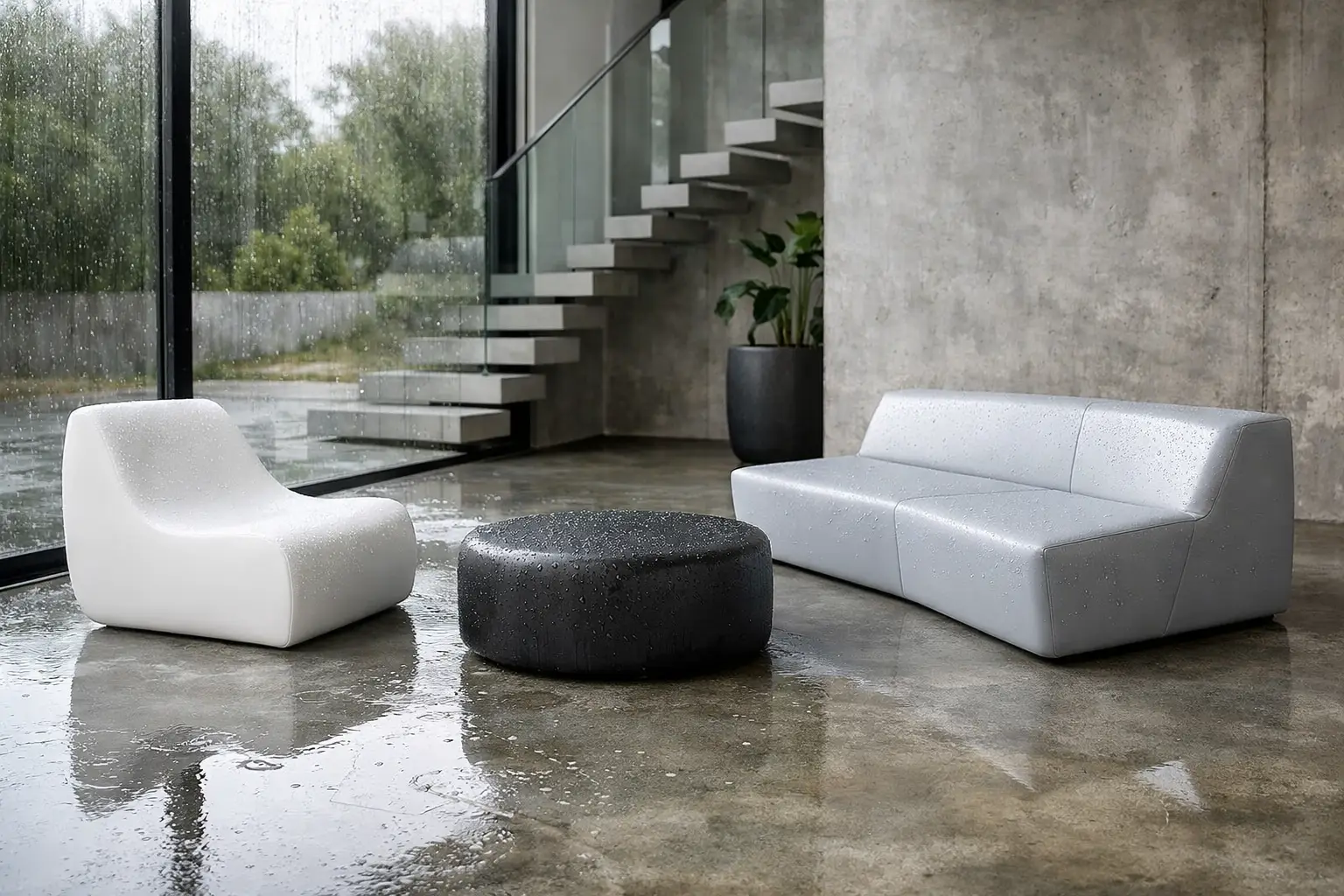
A weather resistant coating is not simply an exterior finish added at the end of a furniture project. For sculptural seating, oversized planters, playful landscape forms, and branded public-space installations, it is part of the object’s performance and visual identity from the first sketch. The right coating allows designers to take soft foam into settings where conventional upholstered furniture would be impractical, while preserving a clean, monolithic form.
For architects and specifiers, that creates a useful design advantage. Curves can remain continuous. Junctions can disappear. A bench can read as one bold gesture rather than a collection of upholstered components, seams, legs, and protective trim. Yet outdoor and semi-outdoor specification requires precision. Weather resistance is not a single promise. It is a set of material behaviors that must match the site, the use case, and the expected maintenance level.
What a Weather Resistant Coating Must Do
A coated-foam object is only as dependable as the system surrounding its core. The foam establishes volume, comfort, and freedom of form. The coating creates the protective skin: a flexible barrier designed to help the object withstand moisture, changing temperatures, direct contact, and regular cleaning.
For exterior-facing applications, that skin needs to resist water penetration, retain flexibility through thermal movement, and hold its color and surface integrity under ultraviolet exposure. It must also tolerate the ordinary realities of commercial environments: wet clothing, sunscreen, spilled drinks, cleaning products, dragged bags, and repeated use by people who will never treat the furniture delicately.
The distinction between water-resistant and waterproof matters. A weather resistant coating can repel rain and moisture while still requiring sensible installation conditions. Standing water, continually saturated surfaces, poor drainage, and freeze-thaw exposure place a much higher demand on any furniture finish. A rooftop lounge with covered storage has different requirements than permanently exposed seating beside a pool or in an open civic plaza.
This is why a successful specification begins with questions, not a color chip. Where will the piece sit? Will rain drain freely from the form? Is the location shaded, fully exposed, or intermittently covered? How frequently will it be moved, cleaned, or subjected to high-volume traffic? These details determine whether a standard exterior-oriented finish is appropriate or whether the geometry, placement, and maintenance plan need further attention.
Weather Resistant Coating Performance in Real Projects
Outdoor performance begins with surface continuity. Traditional furniture often has seams, fasteners, crevices, and separate cushions that collect water and dirt. A well-executed coated form reduces many of those collection points. This supports a sharper visual result and can simplify day-to-day care, especially in hospitality, education, retail, and public settings.
That does not mean every shape performs equally outdoors. Deep horizontal recesses can retain water. Low points in a sculptural form can become collection areas. Extremely dark colors may absorb more heat in intense sun, which can affect surface temperature and the user experience. The best exterior designs balance drama with practical decisions about slope, orientation, drainage, and access for cleaning.
Flexibility is equally critical. Furniture moves in small ways as temperatures change and people sit, lean, or climb on it. A rigid finish may look intact at first but can crack when the substrate flexes. A properly formulated coating is designed to move with the foam rather than behave like a brittle shell. This relationship between core and skin is central to coated-foam fabrication.
Color stability should be evaluated realistically. Exposure to strong sunlight affects almost every exterior material over time, particularly saturated hues and dark tones. The goal is not to claim that a product will remain untouched by years of weather. The goal is to specify a coating and color strategy suited to the exposure level, then establish reasonable expectations for service life and care. For a coastal terrace, high-altitude project, or sun-drenched pool deck, early material consultation is far more valuable than an after-the-fact replacement plan.
Mechanical durability also depends on the setting. A low lounge piece in a private garden sees a different kind of use than a large seat in a hotel arrival zone. Public furniture may encounter abrasive footwear, luggage wheels, sharp objects, and constant cleaning. In these environments, the design should consider not only visual impact but also edge geometry, placement, and the likelihood of intentional or accidental misuse.
Specify the System, Not Just the Finish
A weather resistant coating should be specified as part of a complete furniture system. The form, foam density, coating build, color, intended environment, and maintenance expectations all work together. Asking for a generic “outdoor coating” without defining the project conditions can lead to an object that looks right in renderings but is mismatched to its actual location.
Start with the installation category. Fully indoor spaces may need a durable, easily cleanable surface without the same ultraviolet and rain exposure demands. Covered terraces and lobbies open to the elements need a more cautious approach because wind-driven rain and temperature shifts still reach the furniture. Fully exposed exterior areas require the most disciplined evaluation of drainage, sun, seasonal conditions, and storage options.
Then consider the object’s use. A statement planter is largely static, while a modular lounge must maintain comfort and surface performance under repeated loading. A children’s play form needs rounded geometry and a finish that can handle energetic contact. A branded retail installation may be temporary but subject to intense traffic over a short period. Durability is not just about how long a product exists. It is about whether it performs convincingly throughout the intended experience.
Scale also changes the specification conversation. Large forms can become highly visible landmarks in a space, making surface consistency especially important. They may require careful planning for delivery, access, anchoring, and drainage around the installation. Custom fabrication offers the opportunity to address these details before production, rather than forcing an ambitious concept into a standard product logic.
At Sixinch, coated foam is treated as a design material with technical discipline behind it. That perspective matters when a project calls for furniture that must be soft, expressive, easy to recognize, and capable of working beyond the predictable rectangle of conventional seating.
Design Freedom Without Visual Compromise
The appeal of coated foam is not merely its ability to survive a demanding environment. It is the way the material changes what can be designed. A seat can become a landscape gesture. A planter can become part of a retail identity. A lounge element can echo a building’s curves, a hospitality brand’s palette, or an artist’s graphic language.
The coating supports this by creating a unified finish over complex geometry. Organic silhouettes, inflated profiles, exaggerated proportions, and custom color fields can remain visually direct. There is no need to disguise construction under layers of upholstery. The object can communicate its shape immediately.
For commercial environments, that clarity has practical value. Distinctive furniture helps define zones within open spaces, creates recognizable gathering points, and gives visitors a reason to pause. In an outdoor hospitality setting, a memorable seat can do more for atmosphere than a row of generic tables ever will. The key is ensuring that the performance specification is as considered as the concept.
Maintenance Is Part of Long-Term Performance
Even the best weather-resistant furniture benefits from routine care. Regular cleaning removes dirt, environmental deposits, and residue before they become harder to manage. Use mild cleaning methods appropriate to the specified surface, and avoid aggressive abrasives or unapproved solvents that may damage the finish.
Project teams should also inspect furniture periodically for cuts, impact damage, and areas where water may be pooling around the installation. Addressing minor damage early helps protect the underlying foam and extends the useful life of the piece. For seasonal locations, sheltered storage or protective planning during severe weather can be a sensible part of the operational strategy.
The most compelling exterior furniture does more than endure the forecast. It gives a site a distinct character, invites interaction, and makes the design intent visible at full scale. Specify the coating with the same ambition you bring to the form, and the finished piece can remain both expressive and ready for real life.