
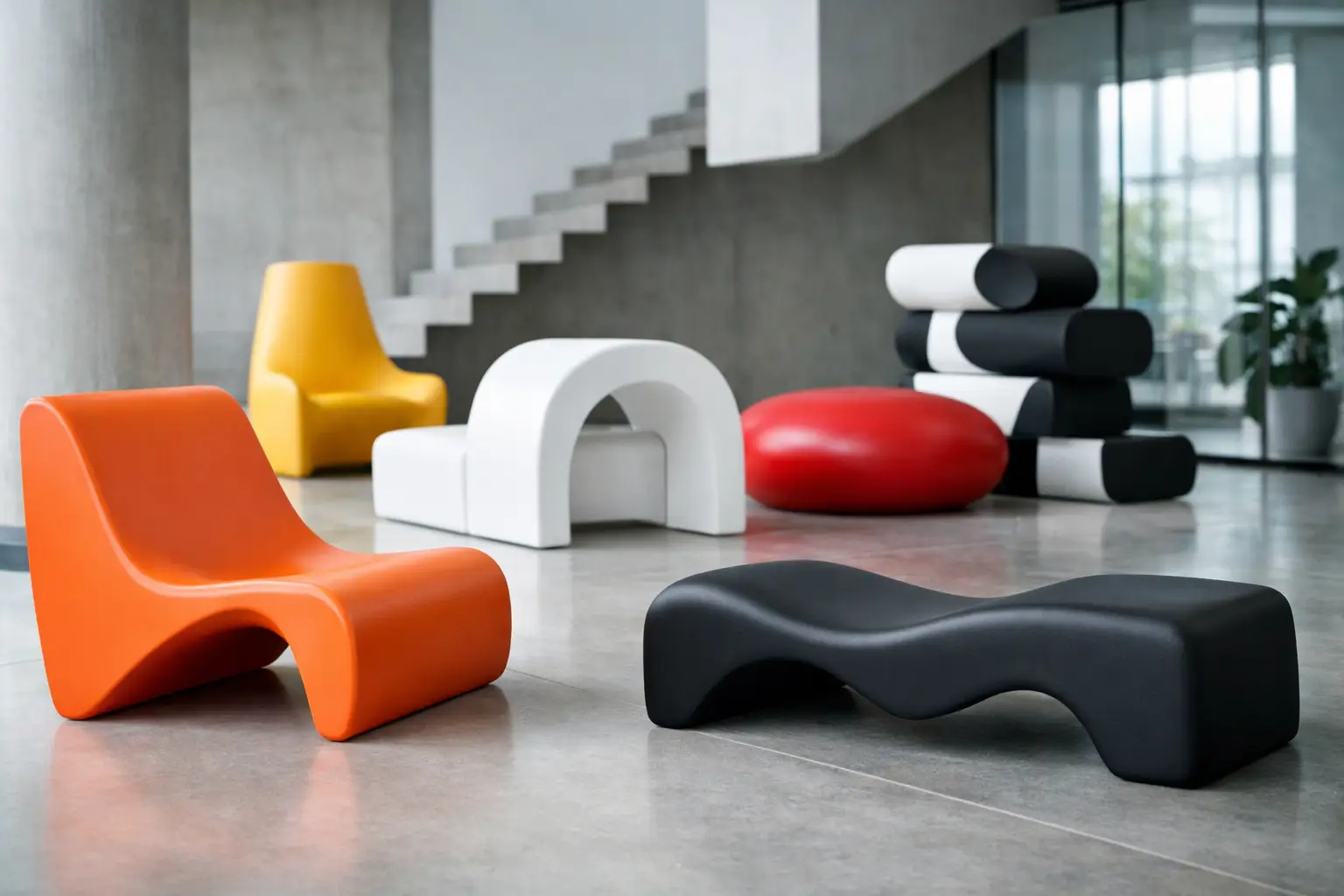
What Polyurethane Coating Technology Changes
A sharp radius, an oversized curve, a seat that appears carved from one continuous volume: these are difficult ideas to deliver with conventional upholstery, hard-shell seating, or joinery. Polyurethane coating technology changes the equation by giving shaped foam a durable outer skin that can follow complex geometry without turning the object into a visual assembly of seams, panels, and exposed structure.
For architects and designers, that difference is not merely aesthetic. It expands what can be specified. Seating, planters, benches, landscape elements, and architectural objects can be conceived as expressive volumes first, then engineered for use. The coating becomes the visible performance layer: it establishes color, texture, tactility, cleanability, and resistance to the everyday contact a commercial environment demands.
The result is furniture that can feel playful, monolithic, soft, graphic, or highly refined while retaining the production discipline required for hospitality, retail, workplace, education, and public-space projects.
A Coating System, Not Just a Finish
It is easy to describe polyurethane as a finish. In practice, polyurethane coating technology is a system in which the foam substrate, coating formulation, application method, curing process, and final texture work together. A strong result depends on every one of those decisions.
The Foam Core Establishes the Form
Foam makes sculptural freedom possible. It can be cut, shaped, molded, or built into volumes that would be costly or impractical in timber, metal, or solid plastic. Its density and composition must suit the intended application. A lounge seat needs controlled comfort and recovery; a freestanding display object may prioritize crisp geometry; an exterior element needs a structure selected for its climate and use conditions.
The foam is not simply hidden beneath the coating. Its construction influences how the finished piece performs under compression, how precisely edges are held, and how the object responds over time. Large spans, deep cantilevers, and heavily used seating may also require an internal support strategy. Design freedom is substantial, but it is most successful when form and structural logic develop together.
The Coating Creates a Continuous Skin
Applied in layers, the polyurethane coating forms a flexible skin around the prepared foam shape. That skin can be smooth and quiet, lightly textured, or more tactile depending on the intended visual language and application. Unlike a traditional upholstered cover, it can preserve the continuity of a sculptural form across corners, curves, and transitions.
This continuity is especially valuable in public-facing projects. Fewer visible seams can support a cleaner visual expression and reduce places where debris can collect. It also allows color to travel across an entire object, making a bench, pouf, or custom-built form read as a deliberate spatial gesture rather than a collection of components.
The Final Surface Must Match the Project
Not every polyurethane surface should be specified in the same way. A matte finish may suit a gallery-like interior or a calm hospitality lounge, while a more textured surface can add grip and make frequent-use wear less visually apparent. Saturated colors can create a strong identity moment, but they also require thoughtful consideration of light exposure, cleaning routines, and adjacent materials.
The point is not to choose the most resistant finish in every case. The right specification balances visual intent with touch, traffic, maintenance expectations, and location. A reception feature and a poolside lounge element do not encounter the same conditions, even when they share a similar silhouette.
Why Designers Use Coated Foam for Distinctive Spaces
The greatest advantage is formal range. Polyurethane-coated foam allows furniture to be designed as volume rather than as a standard product category. A seat can be low, exaggerated, asymmetric, rounded, faceted, or integrated into a larger installation. A planter can become part of the seating landscape. A branded shape can become a functional object instead of a decorative graphic applied after the fact.
That ability matters in environments where memorability has value. Hotels need social areas with presence. Retail concepts need fixtures that support a recognizable atmosphere. Workplaces increasingly use informal gathering zones to express culture and invite interaction. Public interiors require furniture that works hard without looking generic.
Sixinch applies this material approach to both established collections and custom development, allowing designers to carry an initial sketch, reference form, or spatial concept toward a production-ready object. The objective is not novelty for its own sake. It is to give bold ideas an appropriate manufacturing route.
The Trade-Offs Worth Discussing Early
Coated foam is highly adaptable, but it is not a material solution without limits. The most effective projects address those limits before color and silhouette become fixed.
First, scale affects engineering. An unusually long bench or dramatic overhang may need internal reinforcement, sectional construction, or a modified profile to retain stability. Second, surface appearance is influenced by geometry. Tight inside corners, extremely sharp edges, and intricate undercuts require careful fabrication decisions to achieve a consistent coating result.
Third, use conditions shape the specification. High-traffic interiors may benefit from a texture and color strategy that makes everyday contact less apparent. Exterior installations require consideration of ultraviolet exposure, drainage, temperature variation, and the local maintenance plan. Polyurethane can be developed for demanding settings, but outdoor performance is always a system question rather than a promise attached to a material name.
Finally, there is the issue of repair and lifecycle. A coated surface can be maintained and, depending on the damage and product construction, repaired or refinished. Yet prevention remains preferable. Moving protocols, cleaning products, and protection from sharp impacts should be discussed with the facilities team, not left to the final handover.
How to Specify Polyurethane-Coated Furniture Well
A compelling concept becomes easier to manufacture when the brief gives the fabricator the information needed to make practical decisions. Specify the intended environment, expected traffic, dimensional constraints, desired color direction, visual reference, and whether the object must coordinate with other architectural finishes.
For custom work, a simple list of requirements is more useful than an isolated image. Include these four points:
- The intended function, from occasional lounge seating to intensive public use.
- The installation context, including interior or exterior exposure and site access.
- The desired visual character, such as soft matte, fine texture, high color contrast, or monolithic continuity.
- The critical dimensions and any interface requirements for floors, walls, planters, lighting, or built-in elements.
This information does not constrain creativity. It protects it. It allows the development team to test proportions, choose suitable foam densities, determine whether reinforcement is needed, and recommend a coating finish that supports the original idea.
Color, Texture, and Light Are Part of the Material Decision
Polyurethane-coated furniture is often selected for color, but color should not be separated from form. A bright, glossy surface can intensify a curving volume and make it read as an object of visual energy. A softer matte finish can absorb light and give the same shape more architectural weight. Fine texture may make a large object feel warmer and more approachable, particularly in lounges and shared spaces.
Light changes the experience again. Raking light will reveal curvature and surface texture. Strong daylight can make pale colors appear cleaner or more exposed, while deep hues may shift through the day. In retail, hospitality, and experiential interiors, reviewing samples under relevant lighting conditions is a practical design step, not an afterthought.
The same principle applies to placement. A vivid sculptural seat can anchor a neutral room, while a tonal piece can extend the language of a wall, floor, or landscape scheme. The coating is not simply an exterior layer. It is part of the object’s spatial role.
Maintenance Supports the Original Design Intent
Daily care is generally straightforward when the cleaning approach matches the specified surface. Routine dust and light marks should be addressed with non-abrasive methods and mild, suitable cleaning products. Aggressive solvents, harsh scouring tools, and unapproved chemicals can alter appearance or damage the surface.
For commercial projects, the most useful maintenance plan is a clear one. Facilities teams should know how to clean the furniture, what products to avoid, and how to report cuts, punctures, or unusual wear early. This preserves the finish and helps the object continue to look intentional rather than merely serviceable.
The most successful polyurethane-coated pieces begin with a confident visual idea, then earn their place through material discipline. Bring the form, the context, and the ambition to the specification conversation early. That is where a striking concept becomes furniture built to perform.