
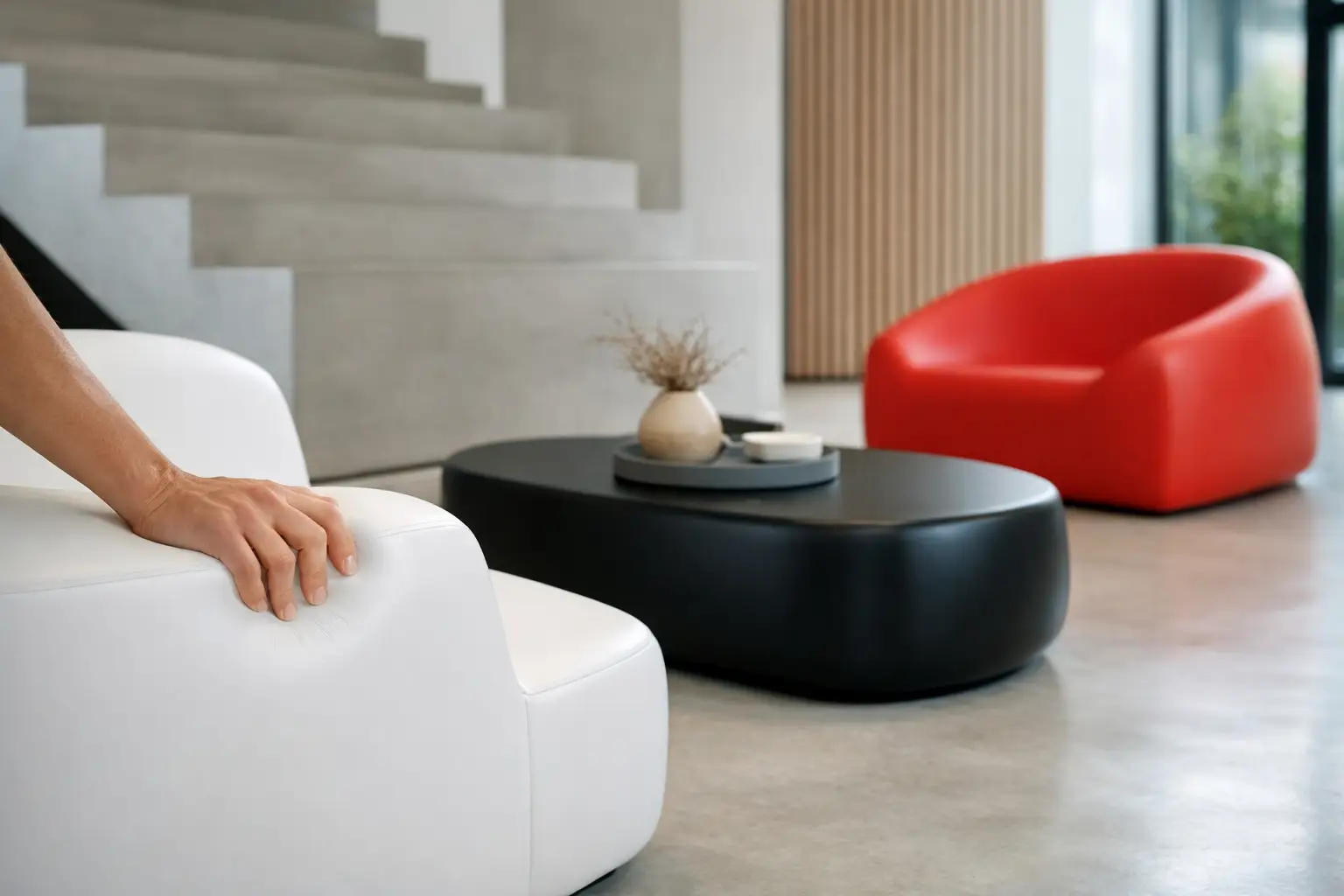
A striking furniture form can define an entire room, but a finish that scuffs, fades, cracks, or feels tired after one busy season can weaken the concept just as quickly. This guide to furniture finish durability is written for specifiers who need bold visual impact without treating performance as an afterthought. The right finish is not simply a surface decision. It is part of how a piece survives contact, cleaning, light, movement, and the daily behavior of real people.
For hospitality lounges, retail environments, public interiors, and branded spaces, durability begins with a clear understanding of use. A sculptural bench in a quiet reception area faces a different reality than modular seating in a busy airport lounge. The goal is not to choose the hardest possible finish in every case. It is to specify the right balance of tactile quality, color expression, maintainability, and long-term resilience.
A Guide to Furniture Finish Durability Starts With Use
Finish durability is often discussed as a single performance score. In practice, it is a combination of properties that matter in different proportions depending on the project. Abrasion resistance may be critical for a seating edge that receives constant friction. Stain resistance may matter more in a café, while UV stability becomes decisive for furniture near expansive glazing or in exterior settings.
Start by mapping the furniture’s actual exposure. Consider who uses it, how often, whether bags or footwear will strike it, what cleaning products facility teams use, and whether the piece will move frequently. A low lounge chair in a hotel suite may require a refined, soft-touch finish. A playful seating landscape for a public atrium needs to withstand repeated contact from many users, including children, while remaining easy to clean.
This early assessment prevents a common specification mistake: selecting a finish primarily from a small color sample. Color and texture matter deeply, especially in expressive interiors, but a material should be evaluated as a system. Its performance is shaped by the substrate, coating build, geometry, placement, and maintenance plan.
The Performance Factors That Shape a Finish
Abrasion and impact resistance
Abrasion resistance describes how well a finish holds up to rubbing, sliding, and repeated contact. It is especially relevant on seat fronts, armrests, table edges, and the corners of freestanding objects. Impact resistance concerns sudden force, such as a luggage strike, a dropped object, or a chair pushed into a bench.
These qualities are related but not identical. A hard surface can resist scratching yet be less forgiving when struck. A more elastic coating can absorb impact and flex with the object, which is valuable on complex forms or seating designed for active use. For coated foam furniture, elasticity is not a minor detail. It supports the material’s ability to follow sculptural geometry while preserving a continuous finished appearance.
Scratch, scuff, and stain resistance
A finish can be technically durable and still look worn if it readily shows scuffs. This is why visual resilience matters alongside laboratory performance. Dark matte colors, for example, can make light scuffing more visible than mid-tone or textured finishes. Highly polished surfaces may emphasize fine scratches, while a carefully selected texture can make everyday marks less apparent.
Stain resistance should be judged against the actual risks in the space. Coffee, wine, cosmetics, hand oils, ink, food, and cleaning residues leave different traces. Ask whether spills can be wiped promptly or whether the furniture may sit unattended for hours. In hospitality and public environments, finishes that allow straightforward cleaning without aggressive chemicals make long-term appearance far easier to manage.
UV stability and color retention
Sunlight changes materials slowly, then suddenly becomes obvious. Furniture placed beside windows, under skylights, or outdoors should be specified with UV exposure in mind. Pigments, coating chemistry, finish sheen, and local climate all influence how color ages.
No finish is completely untouched by years of intense sun. The practical question is how gracefully it changes and whether that change is acceptable within the broader design scheme. Strong, saturated colors can be highly effective in a project, but they deserve an informed conversation about orientation, glazing, shade, and replacement strategy. Where visual consistency is essential, consider placing the most color-sensitive elements away from direct exposure or creating a maintenance plan that accounts for environmental conditions.
Moisture, temperature, and chemical exposure
Moisture does not only mean rain. It includes wet clothing, condensation, frequent mopping, and the humid conditions of spas, pool-adjacent areas, and food service zones. Temperature shifts can also affect how a finish behaves, particularly when furniture moves between indoor and outdoor conditions.
Chemical resistance is equally practical. Cleaning teams may use disinfectants, degreasers, or products that were never intended for a particular surface. A finish should be paired with approved cleaning guidance rather than assumed to tolerate every commercial chemical. This protects both the furniture and the visual integrity of the space.
The Substrate Matters as Much as the Surface
A finish does not perform in isolation. Beneath it sits a structure that determines how the finished piece responds to pressure, movement, and impact. This is one reason coated foam fabrication offers a distinct design advantage for many projects. The substrate can support rounded volumes, oversized gestures, integrated seating forms, and unconventional silhouettes that rigid materials often make difficult or costly to achieve.
The trade-off is that flexible forms require a coating system engineered to work with that movement. A finish that is suitable for a static hard panel may not be appropriate for a seat, pouf, or sculptural element that compresses and rebounds. Adhesion, elasticity, coating thickness, and edge detailing must work together.
At Sixinch, this relationship between form and finish is central to the fabrication process. A coated foam object is not merely foam covered with color. It is a designed material assembly, developed to bring visual freedom and practical performance into the same object.
Specify for the Details People Touch First
Most premature wear begins at predictable locations: sharp projections, lower edges, seat fronts, seams between components, and points where furniture meets floors or walls. These areas deserve more than a general material note.
A very thin visual edge may look precise in a rendering but can be vulnerable in a high-contact setting. Similarly, a large monolithic seating form may benefit from subtle clearances or protective feet that reduce abrasion during cleaning and repositioning. These decisions do not dilute the design. They help protect it.
Geometry also affects maintenance. Deep grooves, tight interior corners, and highly textured surfaces create shadow and visual drama, but they may collect dust or complicate cleaning. That does not mean they should be avoided. It means the intended environment should justify the detail, and the cleaning approach should be established before installation.
Match Sheen and Texture to the Project Reality
Matte, satin, and glossy finishes each create a different spatial effect. Matte surfaces can feel architectural and soft, especially on large organic forms. Satin finishes often provide a balanced visual depth while being more forgiving of everyday handling. Gloss can create powerful reflections and an almost liquid visual presence, but it tends to reveal fingerprints, surface irregularities, and fine scratches more readily.
Texture has a similar role. A smooth finish supports a clean, graphic aesthetic and is usually straightforward to wipe down. A lightly textured finish can introduce tactile character and better disguise minor wear. The best choice depends on how close users will be to the furniture, how the lighting falls across it, and whether the project values pristine uniformity or a material character that can evolve with use.
Maintenance Is Part of the Specification
The most durable finish can still fail early if it is cleaned incorrectly. Facility managers should receive clear instructions that identify approved cleaning methods, unsuitable products, and the right response to spills or marks. This is particularly important when furniture is placed in commercial environments where staffing changes and maintenance routines are standardized across many material types.
Routine care is usually simpler than reactive care. Promptly removing spills, using soft non-abrasive cloths, and avoiding harsh solvents or abrasive pads can preserve finish quality far longer than occasional intensive cleaning. For highly visible branded installations, it is also wise to retain touch-up guidance and establish a process for assessing damage before unapproved repairs are attempted.
Ask Better Questions Before You Approve Samples
A finish sample should be evaluated under project lighting and alongside adjacent materials, but visual review is only the start. Ask how the finish responds to compression if it will be used on foam seating. Ask where wear is most likely to appear, what cleaning protocol is recommended, and how color may change under UV exposure. For custom work, ask whether the proposed form introduces thin edges, high-stress transitions, or large uninterrupted surfaces that require special fabrication consideration.
Mockups are especially valuable for ambitious projects. They reveal how a finish reads at full scale, how users interact with the form, and whether details that looked elegant on screen remain practical in the built environment. For a signature seating landscape or a large branded object, this step can protect both the creative concept and the project budget.
Durability should never force a project into generic furniture or cautious design. It should give designers the confidence to make bolder forms responsibly. When finish, structure, environment, and maintenance are considered together, the furniture can keep its presence long after the opening-day photographs are taken.