
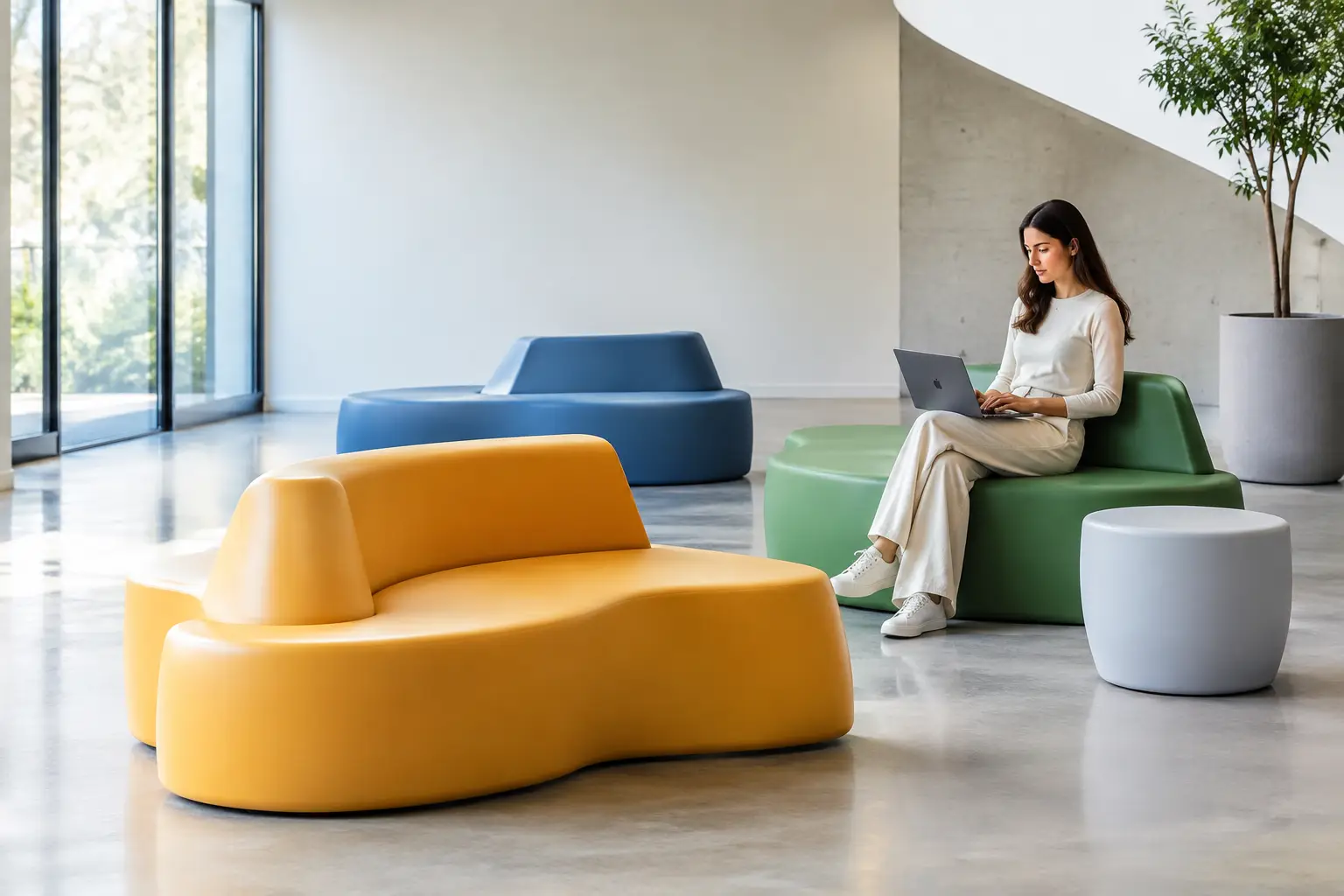
A reception lounge should not need a wall graphic to announce whose space it is. When seating carries the same confidence as the architecture, guests understand the brand before they reach the desk. That is the opportunity in learning how to create branded foam furniture: turning visual identity into sculptural objects people can touch, use, and remember.
For hospitality, retail, workplace, cultural, and public environments, branded furniture is more than a logo applied to a standard chair. It can translate a distinctive silhouette, a signature color, a campaign motif, or even the rhythm of a building into a functional three-dimensional element. Coated foam is particularly compelling because it allows a concept to move beyond the hard edges and repeated modules of conventional furniture production.
Start With the Brand Experience, Not the Logo
The strongest branded pieces do not treat identity as decoration. A logo can be present, but it should not carry the entire concept. Begin instead with the experience the space needs to create. Is the goal playful and social, refined and calm, energetic and photogenic, or unmistakably premium? The answer shapes proportion, color, tactility, seating posture, and how people gather around the object.
A hospitality lobby may need low, generous forms that encourage guests to pause. A retail activation may require graphic seating that reads instantly from across the room. A workplace social zone may benefit from flexible islands that create informal conversation without closing off circulation. Each brief calls for a different furniture language, even if all three projects use the same brand colors.
Before design development, establish four foundations: the primary brand cues to express, the expected user behavior, the installation environment, and the level of permanence required. A short-term activation can prioritize visual surprise and fast installation. A high-traffic airport lounge, by contrast, demands forms and finishes engineered for years of daily use.
How to Create Branded Foam Furniture From a Concept
The process works best when the design team and manufacturer treat the furniture as a production-ready architectural object from the beginning. A sketch is a starting point, not a specification. The transition from visual idea to finished piece requires decisions about scale, ergonomics, internal construction, coating performance, color, and site conditions.
Translate identity into form
Start by identifying what is recognizably yours without relying on printed graphics. A rounded letterform may become a pouf profile. A brand’s angular visual system can inform a faceted bench. A flowing graphic line can become a continuous serpentine seat or a sculptural divider with integrated seating.
This is where foam offers unusual freedom. It can be cut, shaped, carved, or built into volumes that would be costly or impractical in timber, metal, or molded plastic. Large soft geometries, exaggerated curves, asymmetrical silhouettes, and connected seating landscapes become viable when the material and fabrication method are considered together.
Scale is critical. A shape that feels striking in a rendering can become awkward if its seat height, depth, or back support is unresolved. For furniture intended for regular use, visual drama must coexist with human comfort. There is no single ideal dimension because use varies, but designers should define whether a piece is intended for brief perching, relaxed lounge seating, children, collaborative work, or waiting.
Choose the foam construction around the use case
Foam is not one material with one behavior. Density, firmness, resilience, and structural reinforcement influence how a piece feels and how it performs over time. A compact pouf, a long public bench, and a broad outdoor lounge island may share a visual language while requiring very different internal solutions.
For highly sculptural pieces, the manufacturer may combine foam components to achieve the intended volume and stability. Larger items may also require an internal structure or a strategy for modularizing the design for transport and installation. The right approach depends on dimensions, anticipated load, location, and whether the piece must move frequently.
Designers should be direct about performance expectations. Will people sit on the arms? Will guests drag the object across a floor? Does it need to withstand luggage, food service, children, or intensive public use? These questions are not constraints on creativity. They are the information that lets fabrication preserve the concept without creating a fragile object.
Specify a coating that supports the environment
The defining surface of coated foam furniture is not an afterthought. A specialized coating creates a continuous, tactile skin over the foam form, preserving the geometry while giving the piece a durable, easy-to-maintain finish. It also eliminates many of the seams, loose upholstery details, and rigid panel transitions that can interrupt a sculptural design.
Color is an obvious branding tool, but it should be specified with the lighting and neighboring materials in mind. A saturated corporate red may feel electric in a daylight-filled retail space and much darker in a low-lit lounge. Request color evaluation in the intended setting whenever possible, especially for large furniture volumes where color has more visual weight than it does on a small sample.
Finish selection should follow use. Interior seating may prioritize a refined matte appearance and a particular soft-touch feel. Outdoor or semi-outdoor furniture requires consideration of sun exposure, moisture, drainage, temperature variation, and cleaning practices. A high-traffic public installation may need a surface selected for frequent maintenance and visible wear resistance. The goal is not merely to make the object look new on opening day, but to make it remain convincing after real use.
Design for Recognition at Every Distance
Branded furniture needs to work at three scales. From across a room, it should create a clear silhouette or color field. At conversational distance, its proportions and material quality should reinforce the intended mood. Up close, the surface should feel considered, consistent, and appropriate for touch.
This layered recognition is why a subtle custom silhouette can be more effective than placing a large logo on every seat. A repeated family of rounded forms in a distinctive color may become inseparable from the space’s identity. In other projects, a bolder approach is right: oversized typographic forms, product-inspired shapes, or furniture that recreates a recognizable brand symbol.
The trade-off is longevity. Campaign-specific forms can deliver immediate impact but may date quickly. More abstract furniture based on a brand’s core geometry can stay relevant through changing graphics, product launches, and seasonal styling. For permanent interiors, it is often wise to reserve the most literal expressions for movable accents while building the larger seating landscape around a more enduring visual system.
Resolve the Details That Make Custom Work Buildable
Custom furniture succeeds when the details are resolved early enough to protect both the design and the schedule. Provide drawings or models that communicate overall dimensions, intended viewing angles, seating zones, color references, quantity, and installation constraints. If the furniture must fit through elevators, corridors, or tight doors, flag that immediately. A monumental object may need to arrive in sections, with joints designed to remain visually quiet once assembled.
Site conditions also matter. Floor flatness, wall clearances, sprinkler coverage, electrical access, and cleaning routes can affect the final configuration. For furniture in public settings, designers may also need to coordinate applicable fire, accessibility, and local project requirements. These considerations should inform the specification rather than appear as last-minute compromises.
A prototype or approval sample is especially valuable when the design includes an unfamiliar shape, a custom color, or a new level of surface detail. It gives the project team a chance to assess comfort, scale, finish, and visual presence under real conditions. Digital renderings are essential for communication, but they cannot fully convey how a large coated foam object sits in a room or invites people to use it.
Build a Family, Not a One-Off
A single hero piece can anchor an environment, but branded furniture becomes more powerful when it operates as a system. Consider pairing a signature sofa or bench with smaller poufs, planters, occasional seats, or landscape elements that repeat the same formal logic. The result feels authored rather than decorated.
This approach also gives the project more flexibility. Large pieces can define the focal point while smaller elements can be rearranged for events, seasonal layouts, or changing operational needs. For multi-site brands, a family of adaptable forms can create recognition across locations without making every environment identical.
Sixinch approaches this work as a conversation between ambitious design and disciplined fabrication. The most effective outcome is not simply furniture in brand colors. It is an object with enough presence to shape the room, enough comfort to earn daily use, and enough technical integrity to remain part of the brand story long after the opening photographs are taken.
When a concept is clear, involve the fabrication partner early. The sooner form, function, finish, and installation are considered as one design decision, the more freedom there is to create furniture that does not just display a brand, but gives it a place to live.