
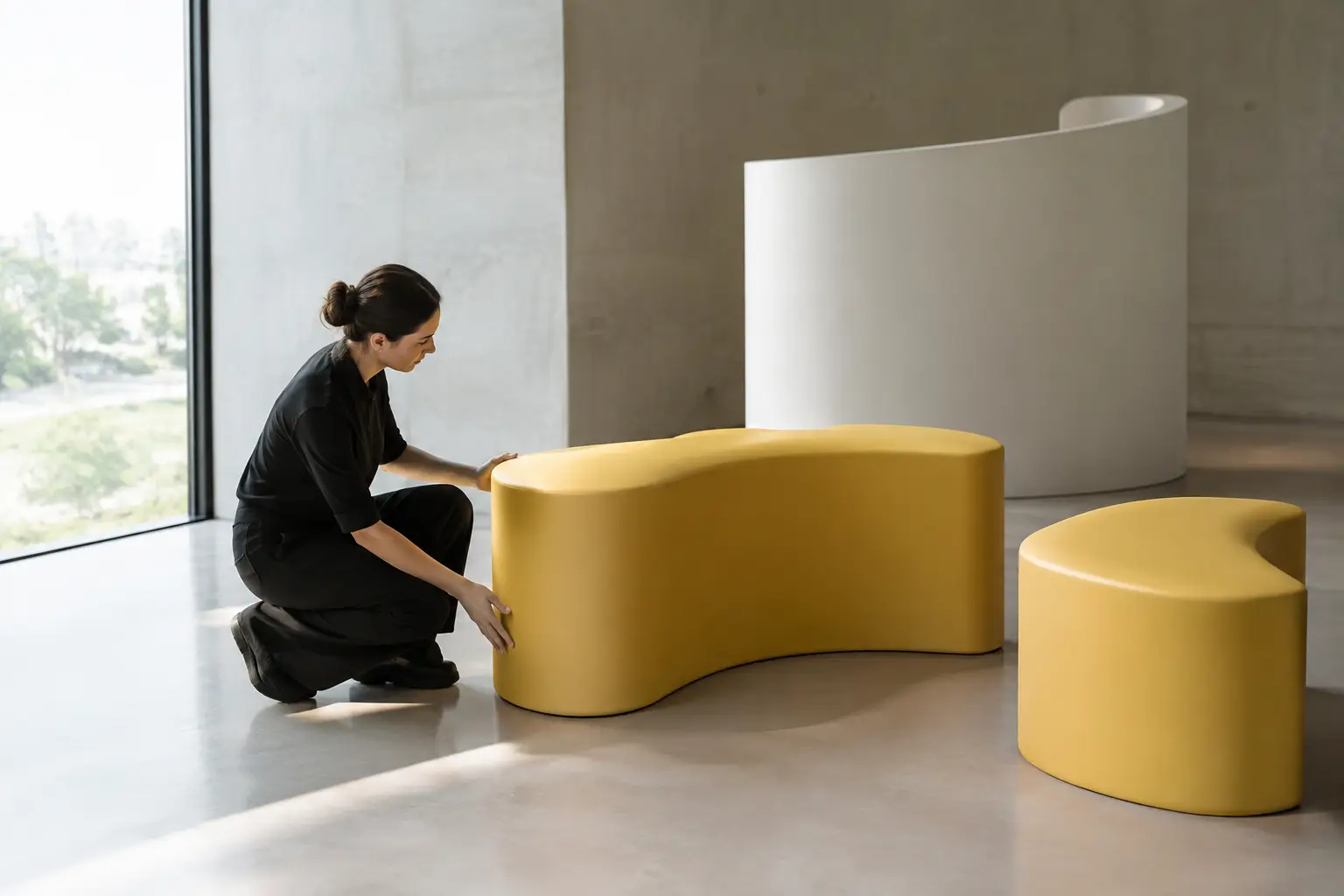
A reception bench that curves around a column. A lounge seat that doubles as a branded landmark. A planter with the same soft geometry as the interior seating. When clients ask, “can architects customize furniture shapes?” the practical answer is yes – but the material system, fabrication method, and project requirements determine how far that freedom can go.
For commercial interiors, hospitality spaces, retail environments, and public settings, custom furniture is not simply about making something unusual. It is about turning a visual idea into an object that can be manufactured consistently, installed confidently, cleaned appropriately, and used every day. That is where early collaboration between architect, designer, and manufacturer becomes part of the design process rather than a final production step.
Can Architects Customize Furniture Shapes for Real Projects?
Architects can customize furniture shapes at several levels. A project may begin with a standard collection piece adjusted in length, color, or upholstery-like finish. It may require a new arrangement of modular forms. Or it may call for a completely bespoke object built from a sketch, rendering, 3D model, or physical maquette.
The most ambitious concepts often involve geometries that conventional furniture production resists: generous radii, continuous wrapped volumes, asymmetrical profiles, integrated backrests, sculptural voids, and forms that transition from seating to landscape element. These shapes are possible when the manufacturing approach is suited to three-dimensional freedom rather than limited by flat panels, rigid molds, or standard upholstery patterns.
Coated foam fabrication is particularly effective for this work. Foam can be shaped into complex volumes, then finished with a durable coating that creates a continuous, tactile surface. The result can feel monolithic and architectural while retaining the comfort, lightness, and visual softness that hard materials often lack.
Shape Freedom Still Needs Design Discipline
Customization does not mean every imaginable shape is equally appropriate. A successful custom piece balances expressive intent with proportion, ergonomics, traffic flow, durability, and installation conditions.
A sinuous sofa may look compelling in a visualization, for example, but its seat height, depth, back angle, and access points still need to support the way guests will actually use it. A dramatic outdoor bench must address drainage, UV exposure, anchoring, and the realities of public use. In a high-traffic lobby, the sharpest visual gesture may need to be softened at corners or adjusted to prevent damage from luggage, carts, and daily impact.
This is not a reduction of creative freedom. It is what gives an original form a long, useful life. The strongest custom furniture carries the concept all the way through to performance.
Start With Intent, Not Just an Image
A rendering is a valuable starting point, but a manufacturer needs more than a silhouette to evaluate the project. The most productive design brief explains what the object must do: how many people it should seat, whether it is freestanding or fixed, the expected environment, accessibility considerations, desired finish, and the role it plays within the overall space.
It also helps to define what cannot change. Perhaps the outer curve must align with a circular ceiling feature. Perhaps the furniture needs to follow a storefront radius. Perhaps a signature color is central to the brand experience. By identifying these non-negotiables early, the design team can refine other dimensions without losing the idea.
Why Material Choice Changes What Is Possible
Every furniture material has a vocabulary. Wood excels at warmth, joinery, and crafted linearity. Metal supports fine profiles and structural precision. Upholstery introduces softness but often relies on seams, panels, and internal frames that affect the final geometry. Molded plastic can create fluid forms, although tooling costs and production volumes must justify the process.
Foam with a specialized coating offers a different set of advantages. It can support generous organic volumes, smooth transitions, and uninterrupted surfaces without forcing the design into a conventional furniture construction. This is especially useful when a piece must appear carved, inflated, folded, or formed as one continuous body.
The coating matters as much as the foam core. It establishes the visible surface, contributes to resistance and maintenance, and allows the object to take on a refined matte, textured, or more graphic character. Color can be integral to the concept rather than applied as a secondary finish.
The trade-off is that material selection must match the application. Indoor lounge seating, a poolside element, a public-space bench, and a sculptural retail display do not face the same stresses. Exposure, cleaning protocols, expected wear, and safety requirements should guide the finish specification from the beginning.
From Concept to Production-Ready Form
Custom furniture development is most efficient when design ambition and fabrication knowledge meet early. The process typically begins with a concept package, then moves into technical review, design refinement, prototyping where appropriate, and production planning.
During technical review, the manufacturer evaluates scale, foam density, structural support, seam strategy where required, coating behavior, and handling. Large pieces may need to be divided into sections for shipping and installation, even if the completed form reads as a single volume. That division can be designed into the geometry rather than treated as an afterthought.
Digital files help accelerate the discussion. A clean 3D model can communicate curvature and dimensions far more accurately than a perspective image alone. Still, physical samples remain valuable for projects where touch, color perception, or surface texture will influence approvals. A material can look perfectly smooth on screen yet feel very different under a hand or in strong directional light.
At Sixinch, this translation from creative proposal to manufacturable object is central to the work. The goal is not to make an architect’s idea more ordinary. It is to resolve the technical questions that allow the idea to be produced with clarity and repeatability.
Custom Shapes Work Best When They Belong to the Space
The most memorable custom furniture does more than occupy a floor plan. It reinforces the architecture. A curved seating island can echo a spiral stair. A low landscape seat can extend the contours of a garden path. A cluster of oversized poufs can carry a retail brand’s playful identity into its customer experience.
For hospitality, custom forms can organize a lobby without enclosing it. They direct circulation, create informal gathering zones, and introduce a focal point that photographs well without becoming decorative clutter. In workplace environments, sculptural lounge pieces can signal a less formal culture while supporting short meetings, waiting, or quiet individual work.
Public and educational spaces require another layer of thinking. Here, durability and intuitive use are as important as visual drama. A piece should invite people to sit without requiring instructions. It should withstand frequent contact while remaining easy for facilities teams to maintain. The answer is rarely a generic bench. It is a shape designed for a specific behavior in a specific place.
Questions to Resolve Before Specifying a Bespoke Piece
Before a custom shape enters final documentation, the project team should have clear answers to a few essential questions: Is the piece primarily seating, a spatial divider, a planter, or several functions at once? Will it be used indoors, outdoors, or across both environments? Does it need to move, anchor, connect to other elements, or integrate power and lighting?
It is equally useful to establish the expected visual tolerance. Highly sculptural pieces can be intentionally irregular, while branded installations may demand strict consistency across multiple locations. Budget and quantity also affect the right production route. A one-off centerpiece and a rollout across dozens of sites deserve different engineering decisions, even when they share a design language.
These conversations are not administrative friction. They protect the design. They make it possible to choose dimensions, finishes, and construction details that support the concept instead of compromising it late in the process.
Design Beyond the Standard Footprint
Architects should not have to choose between a distinctive shape and a credible specification. With the right fabrication partner, furniture can follow the logic of the architecture: curving where the space curves, carrying brand color into three dimensions, and creating functional moments that people remember.
The best next step is to bring the unconventional sketch into the technical conversation early. A shape becomes more powerful when it is not merely possible, but precisely made for the space, the people using it, and the impression the project is meant to leave.