
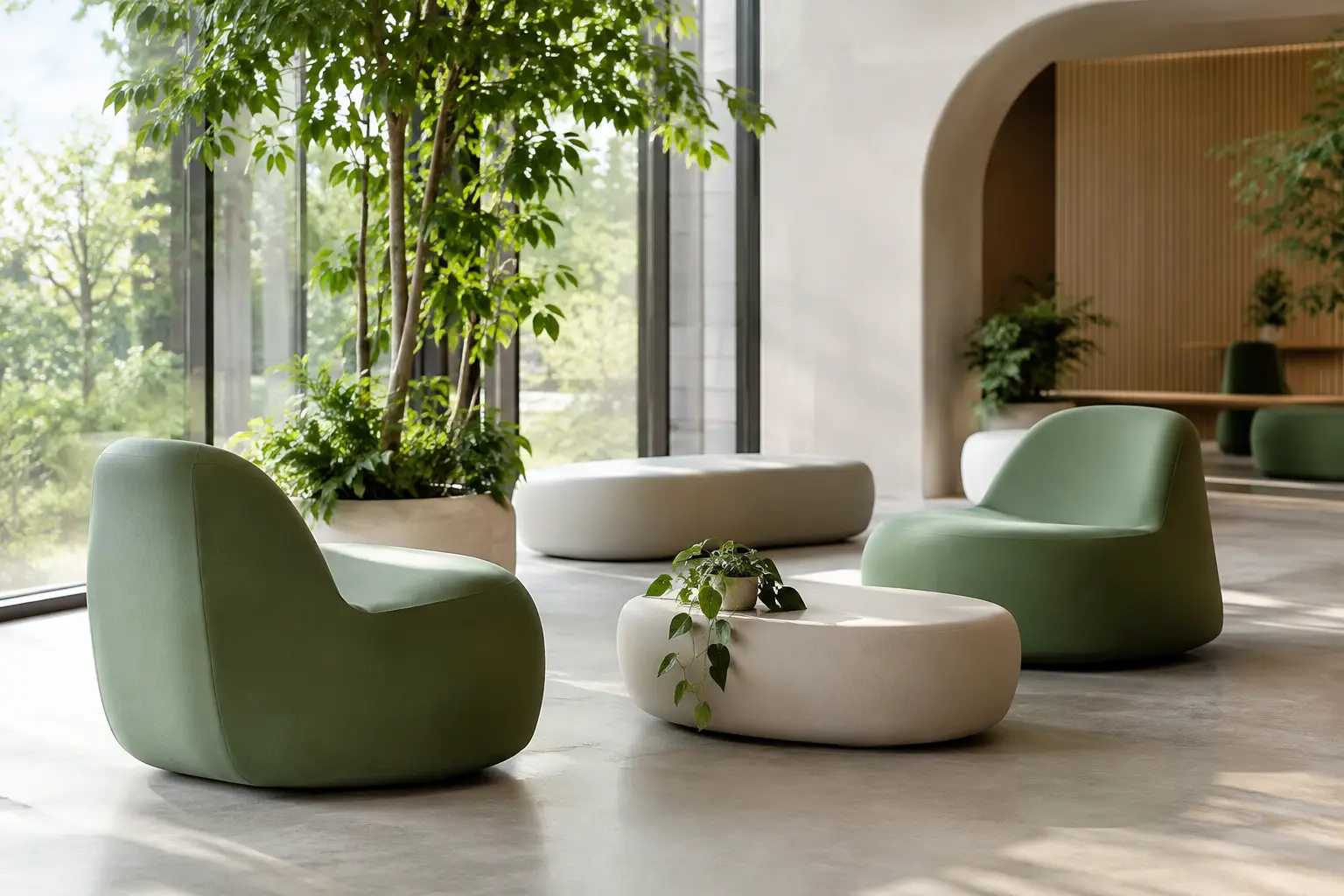
A living wall may command attention at opening night, but it is the seating, planters, and surfaces people touch every day that determine whether a biophilic interior feels truly connected to nature. Biophilic furniture trends are therefore shifting from decorative greenery toward integrated, high-performance objects that bring organic form, tactile warmth, and planted moments into the daily experience of a space.
For architects and designers, this is not a call to fill a lobby with leaf motifs. It is an opportunity to use furniture as part of the spatial ecosystem: a sculptural lounge element that softens circulation, a modular planter that organizes a social zone, or a generously curved bench that makes a public interior feel less mechanical. The strongest projects treat nature as a design logic, not a styling layer.
Biophilic furniture trends move beyond decoration
The earliest commercial expressions of biophilic design often relied on visible signals: potted plants, timber finishes, botanical graphics, and green accents. Those elements still have value, but they can become superficial when they are not supported by the architecture, furniture layout, lighting, and material palette.
Current biophilic furniture trends are more spatial. Designers are specifying pieces that create protected edges, introduce softer geometries, frame views, and make room for planting within the furniture landscape itself. A reception lounge can become a series of small habitats rather than a lineup of disconnected chairs. A workplace can offer varied postures and degrees of privacy without retreating into rows of hard-edged booths.
This matters especially in hospitality, retail, education, and public-facing workplaces, where users are seeking relief from visual density and constant stimulation. Organic furniture forms can make circulation more intuitive and waiting areas more welcoming. The goal is not to imitate the outdoors. It is to introduce the qualities people respond to outdoors: variation, comfort, shelter, texture, and a sense of calm.
Softer silhouettes are replacing rigid furniture grids
Curves are one of the clearest expressions of this movement. Rounded benches, pebble-like poufs, low sculptural seating, and meandering upholstered forms create a visual contrast to the rectilinear shell of most commercial interiors. They also support a more fluid approach to planning.
A curved configuration can gather people around a planter, follow the edge of an atrium, or turn an underused transition zone into a place to pause. In large spaces, it breaks the familiar grid without sacrificing clarity. In smaller spaces, a compact rounded seat can reduce the visual weight of furniture and improve flow around it.
The trade-off is specification discipline. Curved furniture should not be chosen simply because it looks organic. Radius, seat depth, back support, access routes, and cleaning clearances still determine whether an installation works. Modular components are particularly valuable here because they allow designers to test the balance between sculptural impact and operational reality.
Planters are becoming architectural furniture
Integrated planters are no longer accessories placed after furniture selection. They are becoming active components of zoning, wayfinding, and acoustic strategy. A planted divider can separate a café from a co-working area without introducing a solid barrier. A linear planter can guide visitors through a lobby. A broad planter with a built-in seat can turn a circulation strip into a destination.
This approach is especially effective in open-plan environments that need definition but cannot afford to feel fragmented. Planting introduces a softer boundary than millwork or partitions, while the furniture component ensures that the intervention earns its footprint through practical use.
Scale is critical. Small pots scattered across a large public space rarely create a convincing biophilic effect. Larger, deliberately positioned planter elements have greater spatial authority and provide enough soil volume for more substantial planting. At the same time, designers must coordinate drainage, irrigation, access for maintenance, plant-light requirements, and the load-bearing capacity of the floor. A planter that cannot be maintained gracefully will not remain an asset for long.
Material performance matters as much as natural expression
Biophilic design is sometimes associated with raw, untreated, or visibly handmade materials. That can be appropriate in the right setting, but commercial projects require a broader material strategy. Furniture in a hotel lobby, airport lounge, healthcare waiting area, or high-traffic retail environment must withstand cleaning, impact, spills, and repeated use.
The answer is not to abandon tactile character in favor of generic contract finishes. It is to select materials that deliver both sensory richness and a credible maintenance profile. Matte surfaces, warm neutrals, earthy saturated colors, and softly textured coatings can create visual depth without becoming difficult to care for. Durable coated foam forms are particularly compelling where designers want generous, seamless volumes that feel more like landscape than conventional furniture.
At Sixinch, this potential is central to the fabrication process: coated foam makes it possible to produce bold, continuous forms with a resilient, cleanable finish. For biophilic applications, that means a seating island can carry the softness of an eroded stone, a rolling hill, or a riverbank while meeting the demands of a commercial interior.
The right finish depends on the project. A lively family venue may prioritize resistance to hard use and fast cleaning. A boutique hospitality setting may place more emphasis on refined texture and color nuance. Outdoors or in semi-covered public areas, UV exposure, water management, temperature shifts, and anchoring become essential specification questions rather than late-stage details.
Color is getting more complex than green
Green remains a natural reference point, but the most sophisticated palettes extend far beyond a single botanical shade. Moss, olive, eucalyptus, clay, sand, bark, charcoal, and mineral blue all suggest connection to the natural world without making the environment feel themed. These colors work best when they are used with contrast and restraint.
A deep green lounge volume can ground a bright atrium. Sand and clay tones can soften a workplace dominated by glass and metal. A darker planter base may visually anchor lush foliage while concealing the marks that occur in high-contact areas. The palette should respond to daylight, artificial lighting, surrounding finishes, and the actual plants being specified.
Color also has a wayfinding role. In expansive public spaces, a distinctive furniture-and-planter composition can act as a memorable landmark. This is particularly useful when the furniture is custom-made in a controlled palette that aligns with the broader identity of the site.
Customization is where biophilic concepts become credible
Off-the-shelf furniture can support a biophilic scheme, but it rarely resolves the specific conditions of an ambitious project. The strongest concepts respond to unusual floor plates, existing columns, sloped surfaces, branded color systems, or a precise planting strategy. These conditions call for a manufacturing partner that can translate a visual idea into a stable, usable, producible object.
Customization may mean adjusting a standard shape, but it can also mean developing an entirely new family of seats, benches, and planters. A serpentine form can wrap around a structural element. Individual seating modules can create a branching social landscape. A sculptural planter can conceal technical infrastructure while establishing a focal point in a large room.
Creative freedom still needs technical rigor. Early collaboration should address dimensions, ergonomics, joint lines, internal structure, transportation constraints, installation access, and maintenance. The best custom furniture appears effortless because these decisions were resolved before fabrication, not because they were ignored.
Design for care, not just the opening image
Living elements introduce an unavoidable responsibility: maintenance. Plants need light, water, pruning, replacement, and knowledgeable care. Furniture beside them needs finishes that tolerate moisture, soil, and cleaning routines. Biophilic design succeeds when these needs are anticipated rather than handed to operations teams after handover.
For some projects, preserved planting or material references to nature may be more appropriate than live greenery. In spaces with low daylight, restricted maintenance budgets, or demanding hygiene protocols, an organic furniture language can still deliver much of the desired effect. There is no single formula. The right solution depends on who uses the space, how long they stay, and what the client can realistically maintain.
The most enduring biophilic interiors do not depend on a dramatic gesture alone. They give people a more generous place to sit, gather, wait, and reset. When furniture, planting, and architecture are developed as one landscape, the connection feels immediate – and it continues to work long after the photographs have been taken.