
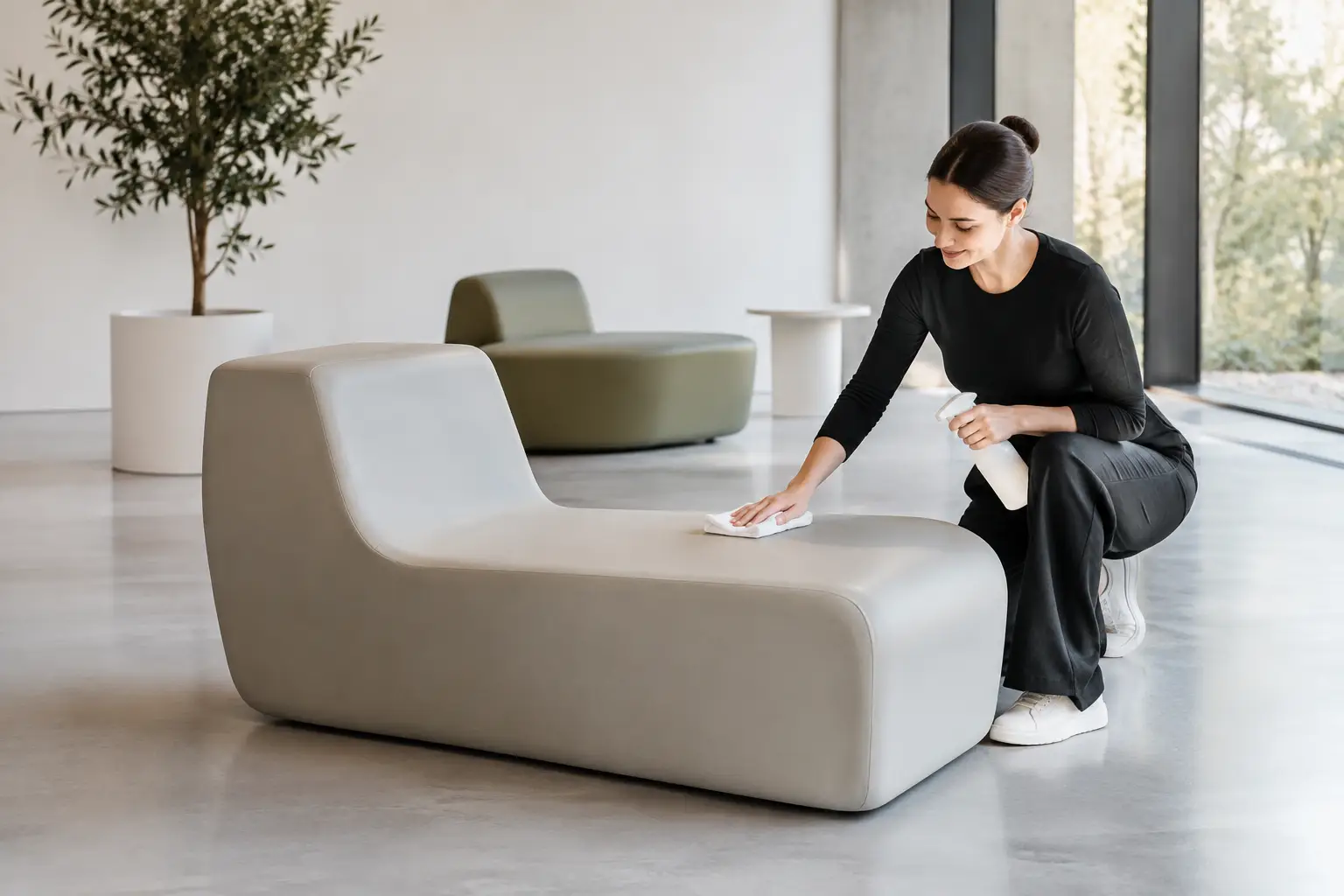
A lobby sofa can look immaculate at handover and tired six weeks later. The difference is rarely the silhouette alone. For high-traffic interiors, easy to clean furniture begins at the specification stage, where form, finish, color, placement, and maintenance expectations must work as one system.
For architects and designers, cleanability should not mean reducing a project to generic contract furniture. It should mean choosing materials and construction details that preserve the visual force of the original concept after spills, fingerprints, bags, shoes, and thousands of daily interactions. A statement piece that cannot withstand its setting is not a bold design choice. It is a maintenance problem waiting to happen.
Easy to Clean Starts With the Surface
The most practical surfaces for commercial environments are continuous, closed, and low-porosity. They provide fewer places for moisture, dust, and debris to settle, while allowing teams to wipe down furniture without specialized equipment or long drying times.
Coated foam furniture offers a particularly compelling route when a project calls for sculptural volume and simplified upkeep. A carefully applied coating creates a unified skin over the form rather than relying on stitched upholstery panels, loose covers, or exposed seams. The result can be expressive and soft in appearance while remaining suited to routine wipe-clean care.
That continuity changes more than the maintenance schedule. It gives designers greater freedom to specify rounded seating, oversized poufs, monolithic benches, playful organic shapes, and integrated landscape elements without multiplying the crevices that collect dirt. For branded interiors, hospitality lounges, retail activations, and public waiting areas, that is a meaningful design advantage.
No finish is maintenance-free, however. “Easy to clean” does not mean immune to misuse, harsh chemicals, permanent inks, abrasive cleaning tools, or damage from sharp objects. It means the material has been selected for a realistic cleaning routine and that the client understands how to protect it.
Detail the Form for Real Use
A furniture specification can have an excellent surface and still become difficult to maintain if its geometry works against the space. Deep channels, sharp internal corners, narrow gaps between modules, and low clearances can turn a quick wipe-down into a time-consuming task.
When developing custom seating, ask how the object will be approached, used, and cleaned. Will housekeeping need to access the floor beneath it? Will food and drinks be present? Is the piece next to an entrance where rain, grit, and road salt are likely? Can a cleaner reach the back edge without moving the furniture?
These questions do not require a compromise in character. They inform better character. A generous radius can make a form feel more intentional while removing a dirt-catching corner. A raised base can create a lighter visual profile and allow access beneath the piece. A single sculpted volume may be easier to maintain than a cluster of small cushions, particularly in public settings where elements can shift, separate, or disappear.
For modular installations, consider the relationship between units. A deliberate, accessible joint can be easier to clean than a nearly closed gap that traps debris. If modules must connect tightly, the connection method should be designed to prevent movement and reduce grime lines over time.
Color Is Part of Maintenance Planning
Color selection affects perceived cleanliness as much as physical cleanability. Pure white makes a dramatic statement, especially in gallery-like settings, but it asks more of the cleaning team and reveals transfer marks quickly. Very dark colors can conceal some stains yet show dust, lint, and light scuffing.
Mid-tones, nuanced neutrals, and saturated colors often provide a strong balance between visual impact and day-to-day forgiveness. In a lively hospitality environment, a rich color can reinforce the interior concept while making minor signs of use less visually dominant. The right answer depends on lighting, traffic, user behavior, and the level of operational support available.
Designers should also consider color transfer. Denim, dark bags, printed textiles, and rubber soles can leave marks on light surfaces. Where this risk is high, test the proposed finish against realistic contact materials before final approval. A physical sample is not simply a color decision tool. It is a performance tool.
Match the Finish to the Environment
The right easy-to-clean solution depends on where the furniture will live. A corporate reception area, a family-focused restaurant, a retail fitting zone, and an outdoor terrace place very different demands on the same form.
In hospitality, fast turnarounds matter. Surfaces should tolerate frequent wiping and allow staff to respond quickly to spills between guests. In retail, resistance to touch marks and the ability to maintain a consistent appearance under bright lighting may be the priority. In public spaces, durability against intensive use and practical cleaning access are often more important than delicate visual effects.
Outdoor applications add another layer of decision-making. Rain, UV exposure, airborne pollution, standing water, and temperature changes all influence material selection. A finish appropriate for an indoor lounge should never be assumed suitable for exterior use. Specify for the actual exposure, including whether furniture is fully sheltered, periodically covered, or permanently installed in the open.
Texture also deserves attention. A highly textured surface can bring tactile richness and diffuse light beautifully, but may require more deliberate cleaning than a smoother finish. That does not make texture the wrong choice. It simply means the project team should make the trade-off consciously and provide the facilities team with accurate care guidance.
Build a Cleaning Protocol Into the Handover
The most successful furniture specifications are supported by a clear, simple maintenance plan. If the care instructions are too vague, cleaning teams may reach for whatever product is already on the cart. If they are too complicated, they may not be followed.
A useful handover document identifies the approved routine cleaner, the tools to avoid, the response time for common spills, and the process for escalating stubborn marks or damage. It should be written for the people who will actually use it, not only for the design team.
In many environments, regular cleaning can be straightforward: remove loose debris, wipe with a soft cloth and approved cleaner, then dry the surface if needed. The critical point is consistency. Allowing stains to sit, using abrasive pads, or repeatedly applying unapproved chemicals can shorten the life of even a highly durable finish.
For large projects, include maintenance samples in the mock-up process. Ask the operations team to perform a realistic cleaning test before the final order is released. This small step exposes assumptions early: whether the selected color shows residue, whether the cleaning product leaves a film, whether a textured area takes longer to service, or whether staff need a different tool.
Specify Performance Without Losing the Idea
Too often, cleanability is introduced late in the process as a reason to simplify or substitute the design. It should enter early as a creative parameter. When it does, it can lead to stronger objects: fewer unnecessary seams, more confident volumes, smarter modularity, and finishes that support the intended experience.
This is where a fabrication partner matters. Custom furniture is not only about reproducing a drawing. It is about translating a visual ambition into a manufacturable object with appropriate structure, coating, color, and care requirements. At Sixinch, coated foam fabrication makes it possible to explore expressive forms while retaining a practical, continuous surface for commercial environments.
The specification conversation should be direct. Share the intended location, expected traffic, cleaning frequency, exposure to food or weather, color preferences, and visual priorities. A material recommendation is only credible when it responds to those conditions rather than treating every project as the same.
Easy-to-clean furniture should never look like an afterthought. Specify it as part of the design language, and the finished space can stay as compelling in daily use as it was on opening day.