
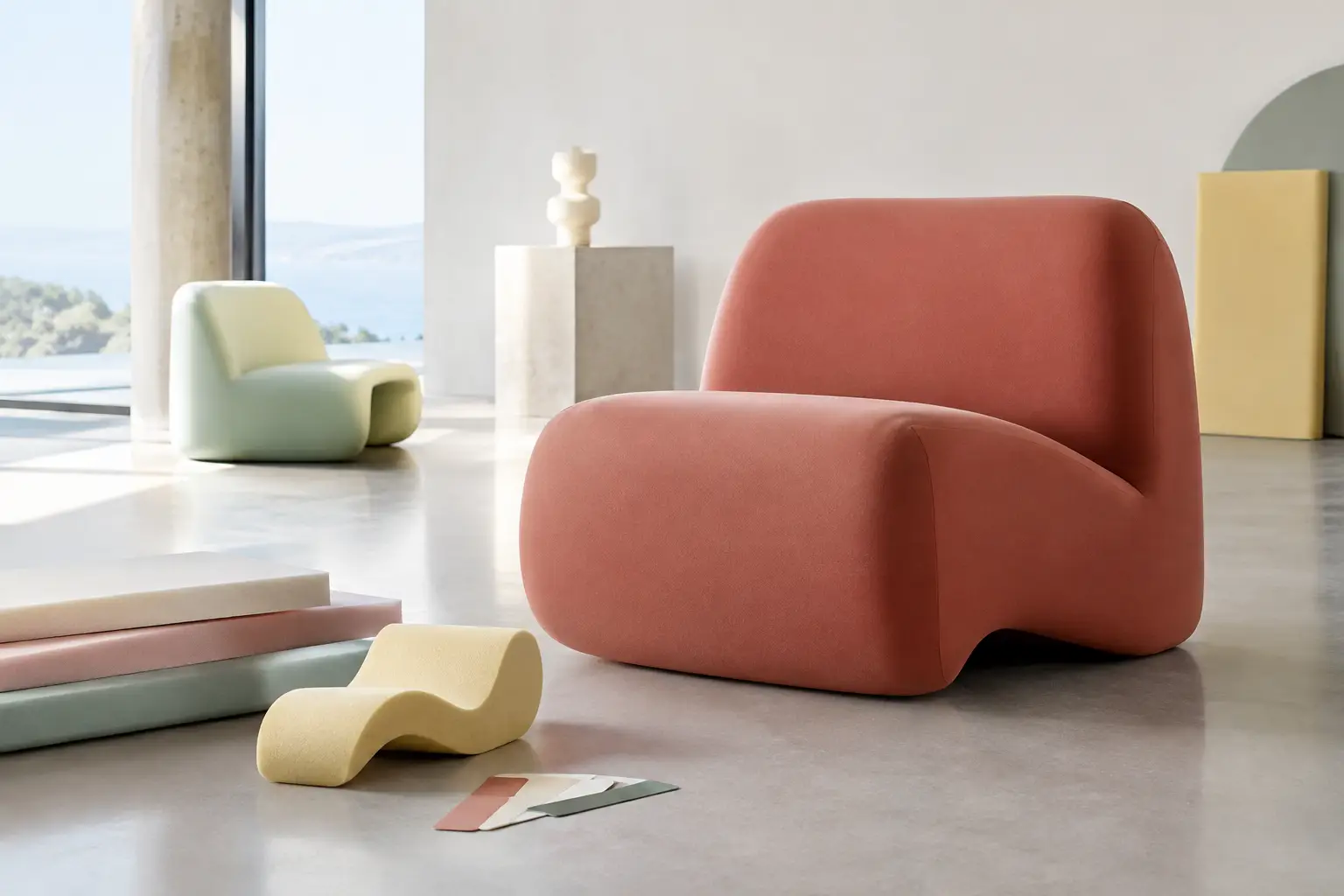
A sculptural bench with no visible frame, a monolithic lounge seat, or a branded planter that carries the same visual language as an interior can begin with a material many teams underestimate: foam. This guide to foam furniture fabrication is written for designers and specifiers who need more than an expressive sketch. It is about turning soft, oversized, unconventional forms into furniture that performs in real hospitality, retail, workplace, and public-space environments.
Foam fabrication is not a shortcut to a concept. Done well, it is a highly controlled design and manufacturing process in which form, ergonomics, coating, color, site conditions, and maintenance are considered as one system. The result can be visually direct and unusually flexible: furniture that looks carved, inflated, seamless, or architectural without being limited by the geometry of conventional hard-shell construction.
Start With the Intended Experience
Before defining a shape, define what the object needs to do. A low lounge island intended for a hotel lobby has different requirements than a playful seating element for a museum, a terrace planter, or a reception bench that must withstand constant circulation. The silhouette may be equally bold, but the specification cannot be the same.
Begin with the user relationship to the piece. Will people sit upright, recline, perch briefly, or gather around it? Is it a single statement object or part of a modular landscape? Does the project require movement, fixed placement, integrated branding, or a coordinated family of forms? These decisions affect dimensions, foam density, internal support, base treatment, and the final coating selection.
Ergonomics deserve attention early. Foam makes compound curves and generous radii possible, but freedom of form does not replace comfort. Seat height, depth, back angle, edge softness, and transitions between seating positions should be tested at scale. A digital model can communicate proportion; a full-size prototype reveals whether a form actually invites use.
Guide to Foam Furniture Fabrication: From Form to Structure
The fabrication process usually begins by translating a design intent into producible geometry. For simple volumes, this may involve cutting and laminating foam blocks. More complex pieces can require shaped components, layered construction, CNC-cut profiles, and carefully resolved joints between sections. The goal is not merely to reproduce the drawing. It is to create a stable core that supports the intended visual language over time.
Foam Is Selected for Performance, Not Just Softness
Foam varies significantly in density, firmness, resilience, and behavior under repeated load. A softer grade may suit a relaxed cushion-like seat, while a firmer construction may be necessary for crisp, architectural geometry or commercial seating subjected to heavy use. Large objects also need their own logic. A dramatic volume must remain light enough to handle while retaining a consistent shape across broad surfaces.
In many projects, the best answer is a combination of materials rather than one uniform foam. Different zones can be engineered for support, comfort, edge definition, or dimensional control. Internal reinforcement may also be needed where a piece spans long distances, interfaces with a base, receives hardware, or must resist concentrated loads.
That is why early dialogue with the fabricator matters. A form that appears simple can conceal difficult transitions, while a seemingly ambitious curve may be efficient to manufacture once its geometry is understood. The productive question is not, “Can this be made?” It is, “What construction will preserve the idea while meeting the project’s performance needs?”
Seams, Scale, and Transitions Need Deliberate Design
A coated foam finish creates a visually continuous surface, but large furniture is not always produced as a single piece. Transportation limits, access routes, installation sequencing, and future relocation can all determine where components are divided.
These divisions should be designed, not treated as an afterthought. On a long serpentine bench, for example, module breaks can follow shifts in curvature or align with functional zones. On a sculptural object, they may be placed where they are least visible from primary viewpoints. Thoughtful segmentation protects the clean appearance of the design and makes delivery far more manageable.
The Coating Defines the Character of the Object
The coating is where fabricated foam becomes a distinct furniture surface. Rather than adding a loose textile cover, a specialized flexible coating creates a skin that follows the form, maintains its visual continuity, and gives the piece a defined tactile and visual identity. This is central to the appeal of coated foam furniture: curves remain legible, edges can be softened without looking unfinished, and color becomes part of the object rather than an applied accessory.
Surface selection should respond to the setting. Interior lounge furniture may prioritize a refined touch and saturated color. A high-traffic public project may call for a finish selected for easier cleaning and greater resistance to regular use. Exterior applications introduce another set of questions, including weather exposure, drainage, UV stability, temperature variation, and how water moves around the base of the object.
No finish is maintenance-free. Specify a cleaning approach that suits the operational reality of the space, particularly in food service, education, healthcare-adjacent environments, or public waiting areas. A beautiful pale surface may be appropriate in a controlled gallery setting, while a darker or more forgiving color could be the wiser decision in a busy hospitality venue. Design ambition is strongest when it accounts for who will care for the piece after installation.
Specify Color as Part of the Architecture
With coated foam, color can make a seating object feel integrated into an environment or deliberately independent from it. A tonal piece can extend the palette of a wall, floor, or façade. A highly contrasted form can act as a wayfinding gesture, a retail focal point, or the visual anchor of a social zone.
Color decisions should be reviewed against actual light conditions whenever possible. Daylight, warm decorative lighting, and exterior exposure can alter how a hue reads across a large surface. Scale also changes perception. A color that feels restrained on a small swatch can become highly assertive when applied to a six-foot lounge form.
For branded spaces, consider whether a signature color should be used across every item or concentrated in key moments. Repetition builds recognition, but selective use can give the environment more depth. The object should support the brand experience without turning every seating zone into a logo.
Plan for Installation Before Production Begins
Furniture fabrication is only successful when the finished piece reaches its intended location in the right condition. For large or site-specific work, verify door openings, elevators, corridors, turning radii, staging areas, floor loading, and final placement before production is released. A beautifully engineered object still fails the project if it cannot enter the building or fit the designated zone.
This is especially relevant for oversized hospitality seating, retail displays, public-space installations, and exterior landscape forms. The installation plan may require modular assembly, concealed connectors, ballast, anchoring, or a specific sequence coordinated with other trades. If the object must meet a wall, column, millwork element, or flooring transition, establish tolerances clearly. Buildings are rarely as exact as renderings suggest.
Sixinch approaches this stage as part of the design execution, not simply logistics. When fabrication knowledge enters the process early, the team can protect the essential gesture of the concept while resolving the practical details that allow it to arrive intact.
Use Prototypes to Resolve What Drawings Cannot
For custom furniture, a prototype is not a luxury when the design introduces a new geometry, seating posture, finish expectation, or installation condition. It is the fastest way to assess scale, comfort, surface quality, color, and structural behavior together.
A prototype does not always need to reproduce the full piece. A representative corner, a seat section, a curved transition, or a sample of the intended coating can answer critical questions before full production begins. This is particularly valuable when a design relies on sharp visual transitions, unusual proportions, or a finish that must perform under demanding use.
The strongest custom projects leave room for refinement. A minor adjustment to a radius, seat pitch, module joint, or coating specification can substantially improve the final experience without compromising the original concept.
When specifying foam furniture, ask for the object you want people to remember, then give the fabrication process enough information to make that memory durable. The most compelling pieces are not just dramatic in a rendering. They remain inviting, precise, and unmistakable after the space opens and real life begins.