
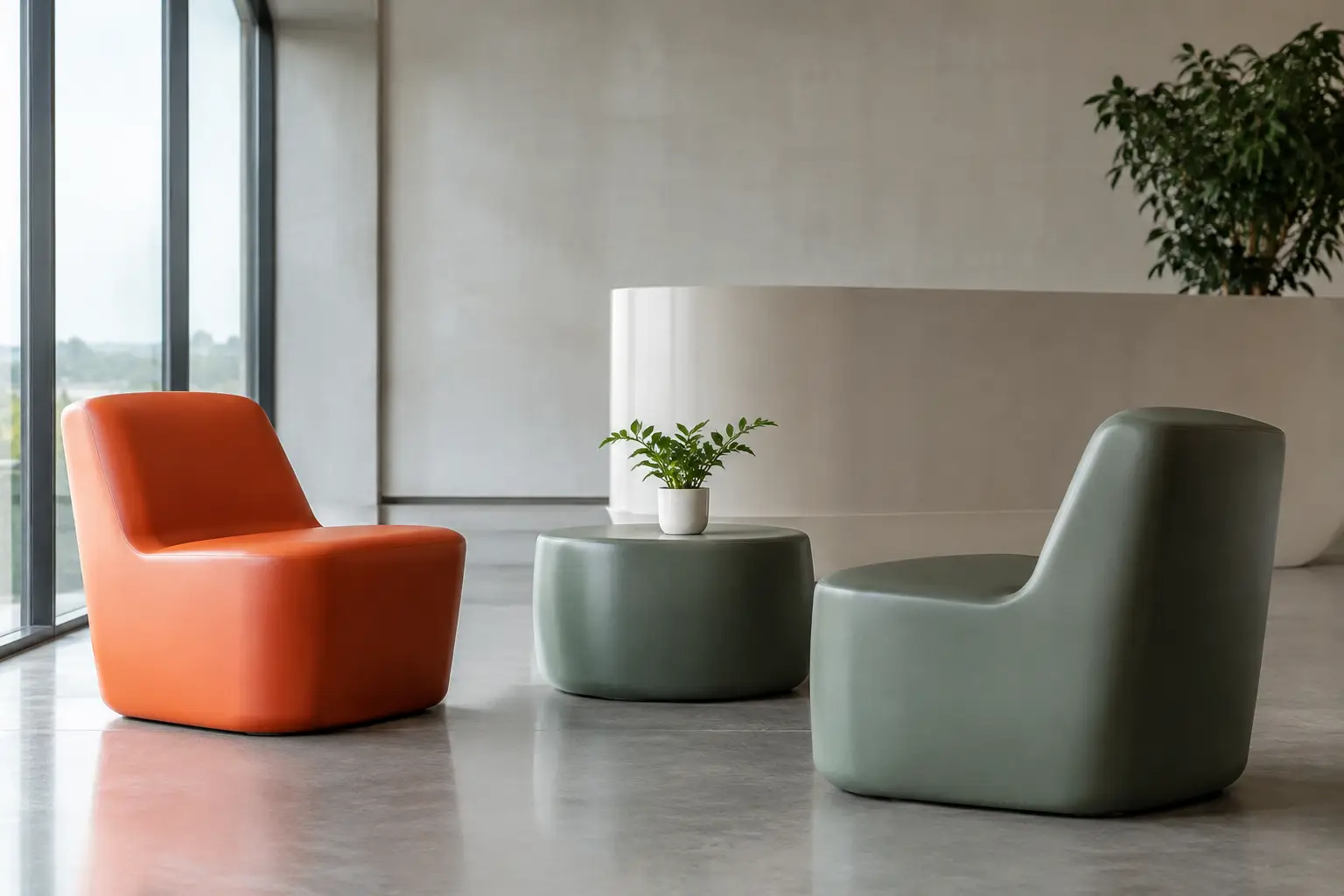
A memorable lounge, lobby, retail floor, or public plaza starts with a strong seating concept. It succeeds only when that concept can withstand the real demands of commercial use. This guide to contract seating standards helps architects, interior designers, and specifiers translate an ambitious visual direction into seating that is defensible in a submittal, appropriate for the setting, and built for its intended life.
There is no single universal certificate that makes a chair, bench, or sofa “contract grade.” Requirements depend on the product category, occupancy type, jurisdiction, exposure, and client expectations. The smartest specification process begins by defining those conditions before selecting a silhouette, material, or finish.
What Contract Seating Standards Actually Cover
Contract seating standards are a framework rather than a single checklist. They address how seating performs under repeated use, whether its materials meet applicable fire requirements, how it supports users, and how it fits into an accessible environment. For outdoor and public-space projects, weather exposure, anchoring, drainage, and vandal resistance may become equally significant.
A hospitality lounge chair used by guests for short stays has a different duty cycle from a university commons sofa, an airport bench, or a healthcare waiting-room seat. The same sculptural form may be right for each project, but the construction, coating, upholstery, mounting strategy, and test requirements may need to change.
The distinction matters because “commercial” is not a useful performance brief on its own. Specify the application: indoor or outdoor, supervised or unsupervised, fixed or movable, occasional or continuous use, and low-traffic or high-turnover. That brief gives manufacturers a practical basis for engineering the piece.
Start With Use, Load, and User Behavior
Seating fails fastest when its actual use was underestimated. A statement bench in a gallery may receive careful, intermittent use. That same bench in a transit-adjacent lobby can become a landing spot for bags, feet, children, and hundreds of users each day. Generous forms invite multiple people to sit, lean, perch, or climb – all loads worth discussing early.
Ask how many users the seating is expected to support at once, whether people will enter and exit from multiple sides, and whether the furniture will be relocated by staff. A large modular sofa introduces different risks than a single lounge chair: connections must remain secure, sections must align cleanly, and the overall composition must stay stable under uneven loading.
For freestanding pieces, stability is essential. For built-in or public-facing elements, determine whether floor anchoring is required. Anchoring can improve safety and preserve a designed layout, but it affects flooring coordination, installation sequencing, maintenance access, and future flexibility. There is no automatic right answer. A branded retail installation may benefit from fixed placement, while a hotel lobby may need the freedom to reconfigure for events.
Performance Testing: Know Which Standard Fits the Product
In the United States, ANSI/BIFMA standards are widely used references for furniture performance. The relevant standard depends on what is being specified. ANSI/BIFMA X5.1 is commonly associated with general-purpose office seating, while ANSI/BIFMA X5.4 addresses public and lounge seating. These standards can evaluate issues such as structural strength, stability, durability, and the ability of components to withstand repeated loading.
A test reference should never be copied into a specification without checking its scope. A low, oversized lounge form may not behave like a task chair, and a custom reception bench may not fit neatly within a standard chair test. In those cases, a manufacturer may recommend an appropriate test method, a project-specific load criterion, or prototype review. That is not a shortcut. It is often the more rigorous way to align a distinctive object with how people will use it.
For custom seating, request clarity on what has been tested, what is engineered by analogy to an existing construction, and what is project-specific. Performance claims should describe the actual configuration, especially where dimensions, bases, seams, upholstery, or integrated accessories differ from a tested model.
Durability Is More Than an Abrasion Number
Textile abrasion results are useful, but they do not tell the whole story. Wyzenbeek testing is common in North America, yet a high double-rub number alone cannot predict field performance. Fiber type, weave construction, coating, cleaning chemicals, color, seam placement, and user behavior all influence longevity.
For a hospitality or public project, evaluate the full finish system. Can stains be removed without changing the appearance? Does the surface resist cracking at flex points? Will a textured material trap debris? Are replacement covers or components feasible? A smooth, coated foam surface may offer a compelling alternative where designers need sculptural freedom, easy wipe-down maintenance, and a visually continuous form. The final choice still depends on the tactile experience, acoustic needs, and expected wear of the space.
Fire Requirements: Confirm the Code Before Selecting Materials
Fire performance is one of the most consequential parts of a contract seating specification, and it is also one of the easiest areas to oversimplify. California Technical Bulletin 117-2013, often written as CAL 117-2013, is a common upholstered-furniture requirement focused on smolder resistance. It is not interchangeable with every local code requirement or every project fire test.
Some projects may call for NFPA 260, which evaluates cigarette ignition resistance of upholstered seating composites. Other occupancies, jurisdictions, or client standards may have additional requirements tied to the overall building code, the use of the space, or the presence of sprinkler systems. Healthcare, education, hospitality, transportation, and assembly environments can each introduce distinct review criteria.
Do not assume that a fabric’s fire rating automatically applies to the finished seating product. The cover, foam, interliner, adhesive, and construction work together as a composite. Changing one layer can affect compliance. When specifying a custom color, an unusual upholstery, or a revised foam geometry, confirm whether the finished assembly remains within the tested or approved construction.
Accessibility Must Be Designed Into the Setting
Accessibility is not solved by selecting one compliant-looking chair. Under the Americans with Disabilities Act and applicable state or local requirements, the surrounding environment matters: accessible routes, maneuvering space, clear floor areas, and seating choices that work for a broad range of users.
A seating plan should avoid creating a beautiful obstacle course. Maintain clear circulation between groups, consider turning space near lounge arrangements, and avoid placing low tables or projecting forms where they interrupt travel paths. In dining, work, and reception settings, accessible companion seating and suitable table clearances may be required.
Seat height, arm support, firmness, and ease of egress also deserve attention, particularly in public, senior-living, and healthcare-adjacent environments. Deep, low lounge seating can be visually powerful and perfectly appropriate for a design-led social zone. It may be less suitable as the only seating option in a waiting area serving a wide user population. A layered plan usually performs better: expressive low seating balanced with chairs or benches that offer a more conventional sit-to-stand experience.
Interior, Exterior, and Public Space Need Different Specifications
Outdoor contract seating needs more than an attractive weather-resistant finish. Specify for UV exposure, temperature swings, standing water, drainage, corrosion, cleaning routines, and the probability of misuse. A coastal installation may demand a different material strategy than a shaded courtyard in a dry climate.
For outdoor furniture, ask how color will age, whether the form sheds water, and what happens at joints or ground contacts. If the piece is lightweight enough to move, determine whether that is desirable. Public spaces may require ballast, anchoring, or a construction that discourages theft and tampering.
Interior seating also needs an environmental brief. A sun-filled atrium can expose materials to ultraviolet light. A busy food-service zone requires rapid cleaning and resistance to oils, dyes, and disinfectants. A quiet library may prioritize acoustic softness over wipe-clean surfaces. Standards establish a baseline, but material selection gives the project its real operational character.
Build a Better Specification Package
A strong contract seating specification gives the manufacturer enough information to respond precisely. Include intended location, occupancy, expected traffic, applicable code requirements, desired testing references, dimensional constraints, finish expectations, cleaning protocols, installation conditions, and any need for anchoring or modular reconfiguration.
For custom work, drawings and renderings should be paired with practical questions: Where are the structural loads carried? Which edges receive the most contact? Can the form be fabricated in transportable sections? How will it enter the building? How will it be repaired if a single area is damaged? These questions protect the original design rather than limiting it.
Sixinch approaches these conversations as fabrication problems as well as design opportunities. Coated foam construction can turn bold volumes, soft geometries, integrated landscape forms, and branded seating concepts into production-ready objects – provided the performance brief is as deliberate as the visual one.
The best contract seating does not look like a compromise between compliance and creativity. It makes technical discipline part of the design language, so the finished environment remains as compelling after thousands of interactions as it was on opening day.