
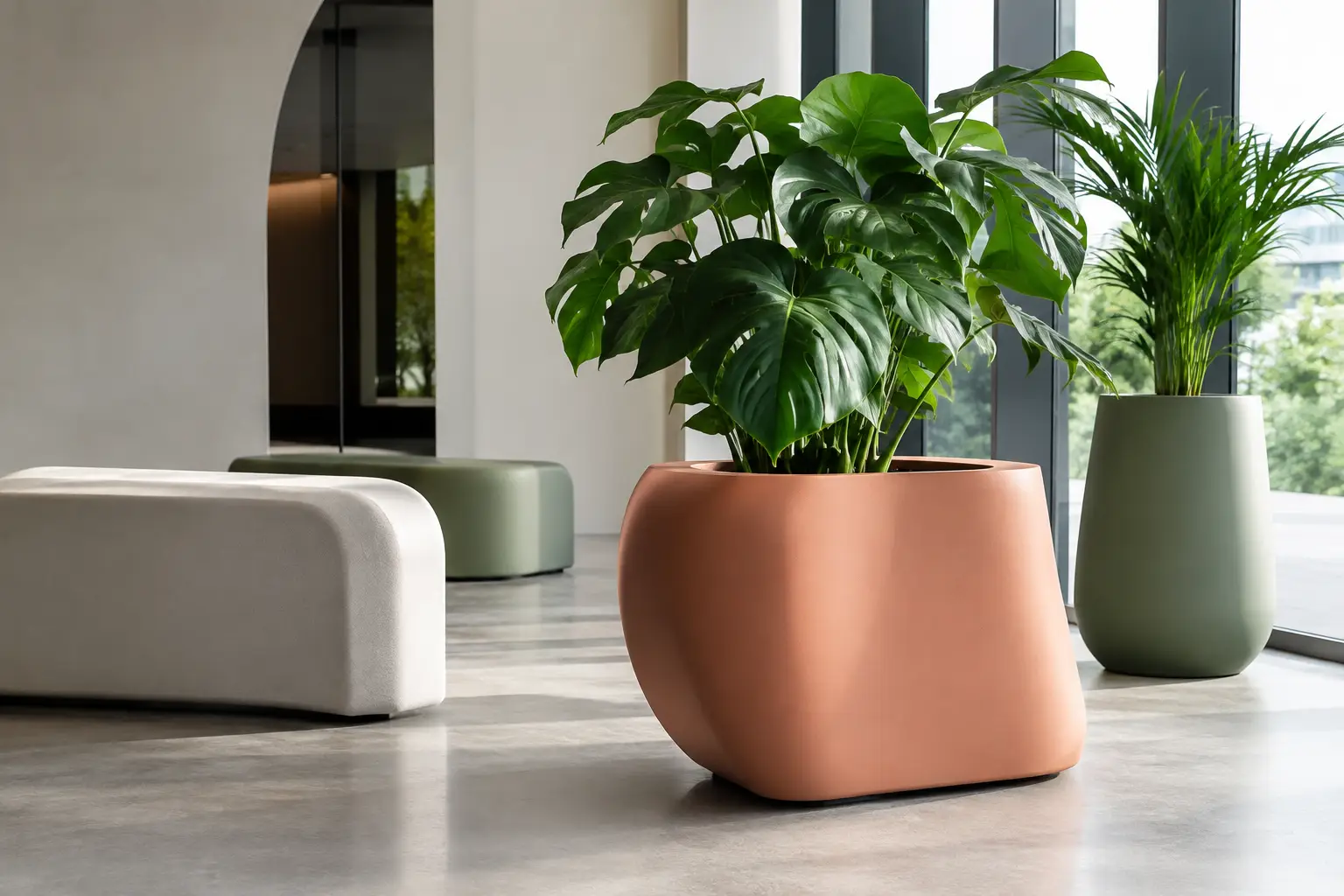
A planter can quietly hold a plant, or it can establish the visual language of an entire project. Custom planters belong in the second category. For hospitality terraces, branded retail environments, public lounges, and expressive workplaces, they turn planting into a deliberate architectural gesture rather than an afterthought.
The opportunity is not simply to choose a larger vessel or a different finish. It is to control silhouette, proportion, color, and placement so the planter works with circulation, seating, facades, and sightlines. When the form is right, greenery feels integrated into the space instead of placed beside it.
Why Custom Planters Change the Spatial Experience
Standard planters are designed to suit the broadest possible market. Their dimensions, shapes, and finishes are necessarily cautious. That can be useful for a straightforward residential setting, but it often limits projects that rely on a strong identity.
A custom approach allows the planter to answer the real conditions of the site. A narrow rooftop edge may need a long, low profile that preserves a view. A hotel arrival zone may call for generous, sculptural volumes that guide guests toward an entrance. A restaurant terrace may need planters that define intimate seating areas without constructing permanent walls.
These are functional moves, but they are also visual ones. Repeating a distinctive planter form through a project creates rhythm. Using one bold color against a neutral architectural palette can support a brand without resorting to signage. Soft, rounded forms can offset a hard-edged interior, while faceted geometries can introduce precision and tension into a more fluid setting.
For design-led spaces, planting is rarely separate from furniture. A planter may sit beside a lounge collection, extend a banquette composition, frame a communal table, or create a threshold between public and semi-private zones. Its scale must therefore feel intentional in relation to the people using the space.
Start With the Role, Not the Shape
The strongest custom planter projects begin by defining what the object must do. A compelling silhouette matters, but form should follow a clear spatial purpose.
A freestanding statement planter has different requirements than a modular divider. The first may prioritize visual impact from multiple approach angles. The second must consider linear continuity, safe circulation widths, planting depth, and how sections meet. A planter intended for a lobby may emphasize refined surface quality, while one specified for an exposed terrace must account for drainage, weather exposure, stability, and maintenance access.
Define the planting strategy early
Plant selection affects the geometry more than many projects anticipate. Mature root systems, irrigation needs, soil volume, and plant height all influence internal dimensions. A slim vessel can be visually elegant, but it may not support the planting scheme over time.
For larger trees or dense screening, the structural and horticultural requirements become especially important. Designers should establish whether the planter requires an internal liner, drainage layer, irrigation connection, ballast, or a removable planting insert. Addressing these components at concept stage protects the purity of the final form. Trying to add them after the exterior geometry is approved usually creates compromises.
Think in sightlines and movement
A planter used as a spatial divider should not become an obstacle. Its height can create privacy, direct movement, or preserve visual connection depending on the project. Low forms hold a boundary without blocking a view. Mid-height planters can shape a dining zone or waiting area. Taller planted elements can screen service zones, soften acoustic conditions, and create a sense of enclosure.
Placement also changes perceived scale. A single oversized planter can anchor a generous lobby, but the same volume may overwhelm a compact retail floor. In small footprints, a series of purpose-built forms can often create more impact than one generic object placed in the center.
Material and Finish Are Part of the Design
Material selection should not be reduced to appearance. The finish determines how a planter receives light, handles contact, ages in use, and relates to the surrounding architecture.
Coated foam fabrication opens a different design vocabulary from conventional molded or rigid planters. It allows for expressive curves, unexpected proportions, integrated details, and sculptural profiles that would be difficult or inefficient to achieve with standard production methods. The finished object can have the visual confidence of a large architectural element without forcing the design into familiar cylindrical, rectangular, or tapered forms.
This freedom is especially valuable when planters are part of a wider furniture concept. A soft-edged planter can echo the radius of a sofa. A graphic color can continue from seating to landscape elements. A series of custom forms can be designed as one family while varying in height, length, or planting capacity.
At Sixinch, specialized coating techniques make it possible to translate these ideas into durable, production-ready pieces with a highly controlled surface character. The result is not decoration applied to a standard object. It is a planter conceived as a designed volume from the beginning.
That said, there is no universal finish for every application. Exterior exposure, cleaning methods, foot traffic, and the possibility of impact all need to be considered. A highly tactile surface may be right for a protected interior lounge but less suitable for a heavily used public passage. Color selection also deserves practical attention: deep tones can create drama, while lighter colors may show scuffs or environmental staining differently. The best specification balances visual ambition with the realities of the site.
Scale Creates the Impact
Custom work is most effective when designers resist treating scale as a final sizing exercise. Scale is the project.
A planter that is only slightly larger than an off-the-shelf alternative may not change the experience of a space. Conversely, an intentionally oversized volume can turn planting into a destination, giving a courtyard, lobby, or event setting a memorable center of gravity. The decision depends on ceiling heights, surrounding furniture, viewing distances, and the density of the environment.
Large forms can also solve practical problems elegantly. In open-plan workplaces and hospitality venues, they can establish zones without closing them off. In public interiors, they can reduce the visual emptiness of expansive circulation areas. Along a facade or terrace edge, a continuous custom planter can create a disciplined architectural line while supporting substantial greenery.
There is a trade-off. Bigger is not automatically better. Oversized units may affect access routes, delivery logistics, planting maintenance, and structural loading. A custom manufacturer should be involved early enough to evaluate fabrication, transport, installation, and site constraints before the form becomes fixed in project documentation.
Color Can Carry the Brand Without Saying a Word
Planters offer a powerful surface for color because they occupy a middle ground between furniture and architecture. They are visible enough to create a statement, yet flexible enough to change the mood of a space without rebuilding it.
For a restrained interior, a monochrome planter in a strong silhouette may be enough. For retail, leisure, or experiential environments, saturated color can make the landscape component part of the brand expression. Multiple colors can also be used to establish wayfinding, distinguish zones, or bring energy to a modular composition.
The key is to use color with discipline. If the seating, walls, lighting, and planters all compete for attention, none of them will hold it. A well-chosen custom color works best when it has a clear relationship to the wider palette, whether it matches a brand tone, contrasts with a material finish, or repeats at selected moments throughout the space.
Specify for the Full Life of the Project
A custom planter should be designed for more than opening day. Maintenance teams need to understand how the planting system works, how water is managed, and how the exterior surface should be cleaned. Site teams need clarity on positioning, anchoring where required, and access for future planting replacement.
For exterior projects, local climate matters. Exposure to intense sun, freeze-thaw conditions, wind, and standing water can change the appropriate material build-up and installation method. For interior projects, the greater concern may be protecting flooring, managing concealed irrigation, and avoiding water damage during routine plant care.
These details do not diminish creative freedom. They protect it. A daring form that has been thoughtfully engineered will keep its presence long after the installation photographs are taken.
Make the Planter an Architectural Object
The most successful custom planters do more than contain greenery. They choreograph movement, establish scale, reinforce identity, and give planting an equal role in the design story. They can be quiet extensions of the architecture or unapologetically sculptural focal points.
The right question is not, “Which planter fits here?” It is, “What should this planted element make possible?” When that question drives the brief, the result can become one of the most memorable objects in the space.