
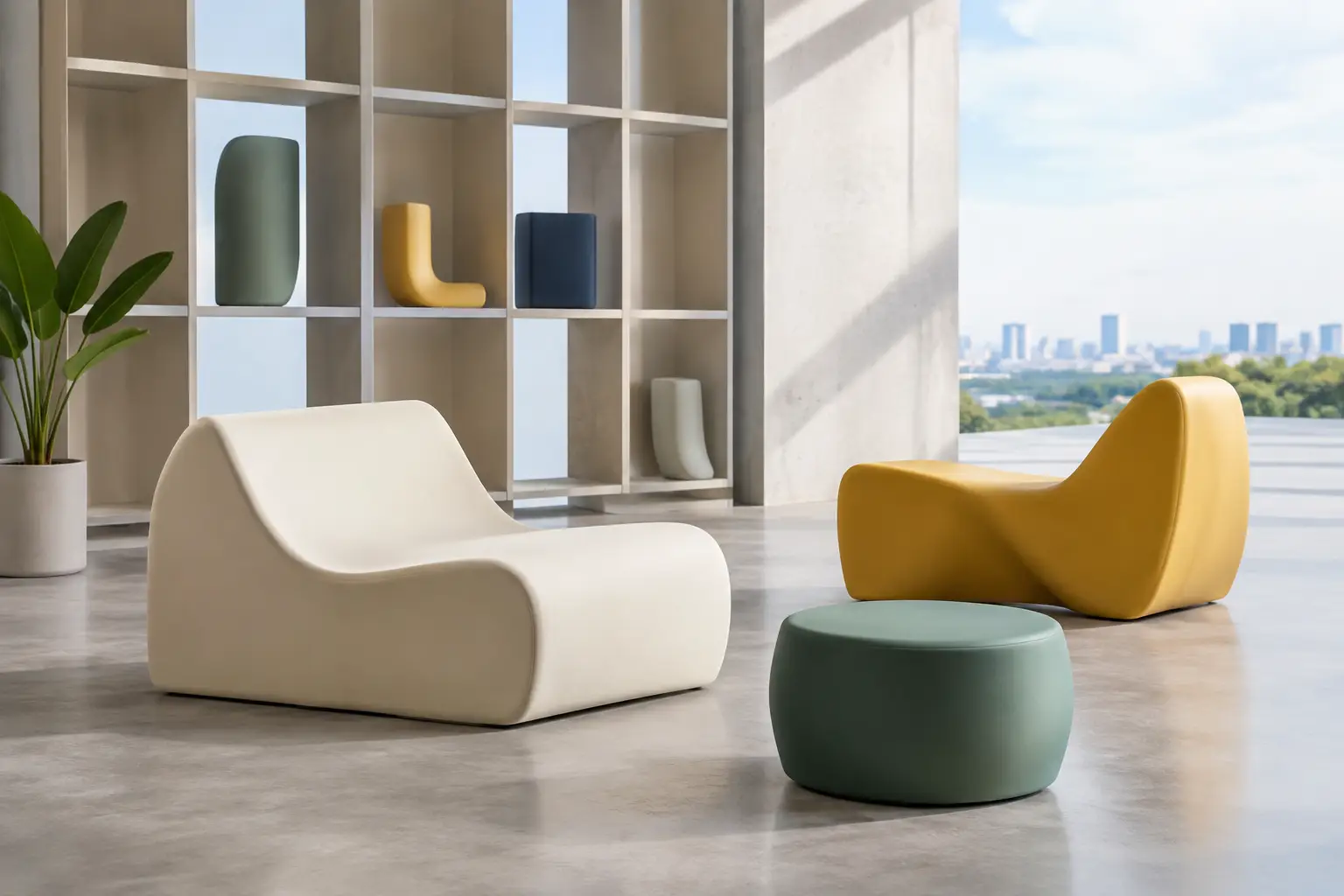
A compelling space can be compromised by one predictable object. When every chair, bench, planter, and lounge element comes from the same standard catalog, the project loses the identity it was designed to express. This global furniture manufacturing guide is for architects, designers, and specifiers who need more than a supplier: they need a production partner capable of turning unconventional ideas into dependable, buildable objects.
The right manufacturing strategy is not simply about finding the lowest unit cost or the closest factory. It is about aligning design intent, materials, engineering, finish quality, logistics, and long-term performance. For sculptural seating, branded public environments, hospitality interiors, and exterior gathering spaces, those decisions begin well before a purchase order.
Global Furniture Manufacturing Guide: Start With the Design Brief
A clear brief gives a manufacturer the information needed to assess feasibility without stripping the concept of its character. Reference images alone can establish an aesthetic direction, but they rarely resolve the practical questions that determine whether a piece can be produced, shipped, installed, and maintained successfully.
Define the intended setting first. A lobby sofa, poolside daybed, retail centerpiece, and public plaza bench may share a visual language, but they face very different demands. Foot traffic, exposure to sun and rain, cleaning protocols, fire requirements, drainage, anchoring, and access routes all influence the final construction.
Dimensions deserve the same attention as form. Oversized furniture can create an extraordinary visual moment, yet a beautiful piece is of little value if it cannot clear an elevator, pass through a doorway, or be positioned safely on site. Specify access constraints early, including delivery routes, freight elevators, ceiling heights, and installation conditions.
For custom work, distinguish between what must remain exact and what can evolve. The silhouette of a sculptural lounge element may be non-negotiable, while seam placement, internal support structure, or modular divisions may need refinement for production. This is where a technically fluent manufacturer adds value: not by flattening the original idea, but by protecting it through intelligent adaptation.
Match the Material to the Experience
Global sourcing opens access to many materials, but material choice should be driven by use rather than trend. Upholstery, molded plastic, metal, wood, composites, and coated foam each offer different advantages. There is no universally superior option. There is only the right material system for the project’s visual ambition, environment, and service expectations.
Coated foam is particularly effective when designers want continuous, soft-edged geometry without the visual interruption of traditional upholstery. It can support organic profiles, integrated seating landscapes, dramatic monolithic forms, and custom color statements that would be difficult to achieve with conventional construction. The coating creates a durable skin over shaped foam while preserving the comfort and expressive freedom of the underlying form.
That flexibility also requires disciplined specification. Ask how the surface will respond to abrasion, sharp objects, UV exposure, temperature changes, chemicals, and frequent cleaning. A lounge object in a controlled interior and a seat in a high-traffic public terrace should not be specified the same way. Exterior applications may require drainage planning, appropriate substrate selection, and a finish designed for prolonged weather exposure.
Color should be evaluated as a material decision, not a final decoration. Saturated colors can transform a neutral architectural setting, reinforce a brand environment, or establish wayfinding across a large public space. Yet color consistency must be controlled across production batches, particularly when a project includes multiple pieces manufactured over time. Request physical samples and view them under the lighting conditions that matter most to the project.
Evaluate Manufacturing Capability Beyond the Portfolio
A strong portfolio shows aesthetic range. It does not, by itself, prove that a manufacturer can execute your project. The more distinctive the design, the more important it becomes to understand how the factory translates ideas into repeatable production.
Ask practical questions about the development process. Can the team work from sketches, renderings, CAD files, or physical models? Will it provide technical drawings for approval? Are prototypes or finish samples available before full production? Who reviews structural details, tolerances, color, and surface quality? Clear answers reveal whether the manufacturer has a real engineering workflow or is merely accepting an order.
For complex pieces, prototyping is not a luxury. It is the stage where scale, ergonomics, comfort, visual proportion, and material behavior become tangible. A rendering can make a seat appear inviting while concealing an awkward back angle or insufficient support. A prototype exposes those realities early, when revisions are less expensive and less disruptive.
The same principle applies to finish approval. Handcrafted processes bring character, but they should still operate within defined quality standards. Discuss acceptable variation, joint details, edge transitions, texture, gloss level, and any areas that will receive close visual scrutiny. Design-led manufacturing is not about eliminating the human hand. It is about controlling the details that determine whether the finished piece reads as intentional.
Plan for Compliance, Durability, and Care
A furniture concept is only ready for specification when it can satisfy the requirements of its destination. Depending on the market and application, this may involve flammability standards, commercial-use testing, accessibility considerations, indoor air quality expectations, or local regulations for public installations.
Do not assume that a material suitable for one region or building type automatically meets requirements elsewhere. Confirm the exact standards required by the project authority, operator, or client, then ask the manufacturer what documentation applies to the proposed construction. This is especially important for hospitality, workplace, education, healthcare, and public-sector projects, where compliance questions can emerge late and delay installation.
Durability should be discussed in terms of real use. A reception bench may endure luggage wheels, denim abrasion, cleaning staff, and children climbing on it. A retail display seat may need to survive constant repositioning. Outdoor furniture can face standing water, frost, intense sunlight, and coastal air. The right specification anticipates these conditions rather than treating maintenance as an afterthought.
Care guidance should also be realistic for the operator. If a finish needs specialized products or delicate handling, confirm that the client can support that requirement. In many commercial environments, the best choice is not the most delicate finish. It is the one that preserves the intended appearance under routine cleaning and daily contact.
Build a Global Production Timeline That Can Hold Pressure
International manufacturing rewards early decisions. Custom furniture often involves design development, sampling, approval cycles, fabrication, quality control, packing, freight, customs, and final installation. Each stage is manageable, but each depends on timely information from the project team.
Lead time should be considered from approved technical documentation, not from the first conversation or initial concept presentation. A delayed finish sign-off, incomplete site dimensions, or late color selection can shift the production schedule even when the factory is ready to begin. Set a decision calendar that identifies who approves drawings, samples, prototypes, and final quantities.
Freight planning matters as much as production planning. Large custom forms may need modular construction or specialized packaging to protect surfaces and optimize shipping volume. Sea freight can be cost-effective for substantial orders but requires more time and careful coordination. Air freight may solve a schedule problem, but it can dramatically alter the budget. For some projects, a split delivery – sending critical pieces first and secondary elements later – is the better balance.
An international production footprint can reduce risk when it creates proximity to the project, capacity flexibility, or better logistics options. Sixinch operates through 10 production locations worldwide, allowing design teams to approach complex projects with broader manufacturing support. Still, location is only one part of the decision. Technical fit, finish expertise, quality control, and communication remain decisive.
Specify Custom Furniture as Part of the Architecture
The most successful custom furniture does not behave like an accessory added at the end of a project. It organizes circulation, creates gathering points, softens hard architectural volumes, carries brand color, and gives people a reason to pause. In that role, seating, planters, and landscape elements become part of the spatial concept.
Coordinate custom pieces with the architecture early. Confirm floor loading for large installations, power access if lighting is integrated, drainage for exterior objects, and fixing points where stability is essential. If furniture is intended to define a zone, test its footprint against circulation paths and accessibility requirements before dimensions are finalized.
For branded interiors, consider whether the object should carry a logo explicitly or communicate identity through shape, color, and material. The latter often has greater longevity. A memorable sculptural form can make a brand environment recognizable without turning every object into signage.
The best global manufacturing relationships are built on directness. Share the ambition, the constraints, and the non-negotiables early. A capable fabrication partner can then challenge the details that need challenging, protect the elements that make the design distinctive, and produce furniture that feels inseparable from the space it inhabits.
When a project asks for an object no catalog can provide, treat manufacturing as a creative discipline from the first sketch. That is where the strongest ideas gain the structure, material intelligence, and finish quality to remain memorable long after opening day.