
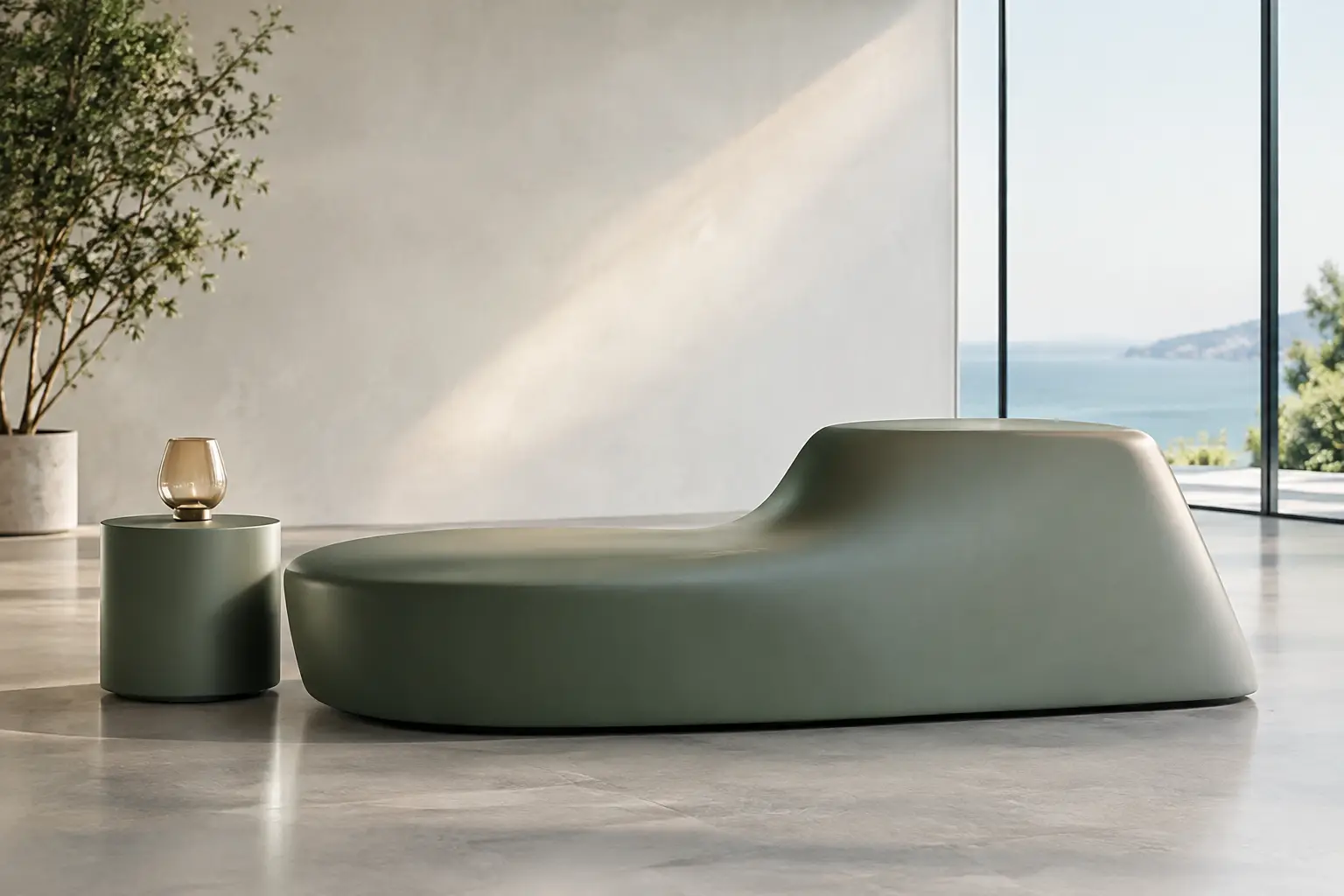
A sweeping lounge form, a monolithic bench, or a playful seating landscape only succeeds when the finish supports the idea rather than forcing it back into familiar geometry. Flexible coating makes that possible. Applied over shaped foam, it creates a continuous, durable skin that can follow curves, soften visual transitions, and give unconventional furniture a finished presence suited to demanding commercial environments.
For architects and designers, the material is not simply a surface treatment. It is a fabrication approach that changes what can be specified. Instead of beginning with the limitations of a rigid shell, upholstered seam, or standard component, a project can begin with silhouette, scale, color, and experience.
What Flexible Coating Does for Design
Flexible coating is a resilient finish engineered to move with a foam substrate. The coating creates a unified exterior over the object, preserving the softness and impact resistance of foam while delivering a more defined, easy-to-maintain surface than conventional upholstery.
That combination has a direct visual effect. A coated object reads as one intentional volume. There are no stitched panels interrupting a curve, no separate parts competing for attention, and no need to disguise the joins required by many traditional furniture constructions. The result can be crisp and graphic, or organic and fluid, depending on the form.
This freedom is especially valuable in hospitality, retail, workplace, education, and public-space projects, where furniture often needs to do more than provide a place to sit. It may establish a brand color, direct circulation, create a social zone, or become the visual anchor of a room. A bright sculptural pouf can make a lounge feel immediate and informal. A long, custom-coated bench can turn an overlooked corridor into an active destination.
The term “flexible” deserves precision. It does not mean the surface is indestructible or that every formulation performs identically under every condition. It means the finish is designed to accommodate normal compression and movement in the foam beneath it without behaving like a brittle painted shell. The performance of the finished piece depends on the coating system, the foam density, the geometry, the application process, and the environment where it will live.
Flexible Coating Versus Conventional Finishes
Upholstery brings warmth, texture, and a wide range of textile expressions. Hard plastic shells provide structure and can suit high-volume seating. Wood, metal, and laminate introduce their own material character. Flexible coated foam occupies a different territory: it is selected when a project needs soft geometry with a continuous, high-impact finish.
Its most obvious advantage is form. Deep radii, bulbous volumes, integrated backrests, sloping surfaces, and oversized sculptural elements can be produced without treating every curve as an upholstery problem. This creates opportunities for furniture that feels closer to an architectural element or an installation than a conventional loose piece.
The second advantage is visual continuity. Color can extend across the full object, supporting wayfinding systems, retail identities, and immersive interiors. A single form can also be developed in different colors and dimensions to create a family of related elements rather than a collection of disconnected products.
There are trade-offs. A coated finish does not replicate the acoustic softness, woven depth, or domestic familiarity of fabric. It can show surface wear differently than a textile, particularly in high-contact areas or where sharp objects are common. Very dark colors may reveal dust or scuffing more readily, while very light colors demand more attentive housekeeping. Material selection should follow the actual behavior of the space, not an assumption that one finish solves every requirement.
From Sketch to Production-Ready Object
Custom work begins with a clear design intention, but it reaches production through technical decisions. The strongest briefs define how an object should be used as well as how it should look: expected occupancy, interior or exterior placement, cleaning routines, required fire performance, access constraints, anchoring needs, and the level of public interaction.
Form Needs to Support Use
A dramatic profile still needs to perform as seating. Seat heights, back support, edge radii, stability, and weight distribution must be resolved early. A low, expansive mound may be ideal for a casual lobby, but it may not suit users who need a more conventional sit-to-stand experience. A long serpentine bench can encourage conversation and movement, yet its geometry must be planned around clear paths of travel.
Foam density and internal construction matter here. They influence how the object feels under load, how well it retains its intended shape, and how it responds to repeated use. This is where coated-foam expertise becomes more than an aesthetic capability. It is the discipline of translating an expressive concept into an object that can withstand real traffic.
Color Is Part of the Specification
Color should be considered in relation to light, cleaning, adjacent finishes, and brand standards. A saturated hue can give a large form remarkable presence, but the same hue will read differently beneath warm hospitality lighting, daylight, or retail spotlights. Samples and mockups are useful because they reveal more than color match. They show gloss level, tactile character, edge definition, and how the finish responds to the scale of the object.
For branded environments, color consistency across multiple pieces can be as important as the form itself. The goal is not merely to apply a familiar color, but to create a coherent spatial signal that remains convincing from close range and across the room.
Scale Is a Technical Decision
Oversized furniture is often easier to draw than to deliver. Door openings, elevators, stairwells, site access, and final placement all affect how a piece should be fabricated. In some cases, sectional construction is the practical answer. The visual language can remain continuous while the production strategy accommodates transport and installation.
Sixinch approaches this stage as a conversation between design ambition and fabrication reality. The most successful custom pieces protect the original idea while making informed decisions about construction, installation, and long-term use.
Where Coated Foam Makes the Strongest Impact
Flexible coated furniture is particularly effective when an environment benefits from objects that are both functional and instantly legible. In hotel lobbies and lounges, it can create informal islands of seating that photograph as strongly as they perform. In retail, it can carry a campaign color or turn a fitting-area wait zone into part of the brand experience.
For workplaces, coated forms can soften large open areas without introducing visually busy furniture. Modular pieces allow teams to gather, pause, or reconfigure a social zone as needs change. In educational and cultural settings, the material is well suited to expressive seating landscapes that invite informal use while remaining visually disciplined.
Exterior applications require more caution and more information. Exposure to sun, temperature swings, moisture, salt air, and localized drainage changes the performance equation. If an object is intended for outdoors, the coating system, substrate, color, installation detail, and maintenance plan must be specified for that setting. A design should never assume that an interior-grade solution can simply be moved outside.
Maintenance Is Part of Material Intelligence
A continuous coated surface can simplify routine care because it avoids the seams and fibers that collect debris in upholstered furniture. In many settings, prompt attention with appropriate mild cleaning methods is enough to preserve the appearance of the piece. The exact cleaning protocol should always follow the finish specification, especially where disinfectants, sunscreen, food service, or high public contact are expected.
Design teams should also plan for the reality of wear. Place high-contact pieces where staff can access them easily for cleaning. Avoid locating light-colored forms beside abrasive edges or uncontrolled luggage traffic. Consider whether movable furniture needs glides, whether fixed elements need floor protection, and how replacement or repair would be handled over the life of the installation.
These details do not diminish creative freedom. They protect it. When maintenance and movement are considered early, a bold object is far more likely to remain bold after years of use.
Specify the Surface, Not Just the Shape
The value of flexible coating lies in the relationship between surface and structure. It allows furniture to be soft without looking conventional, vivid without relying on applied decoration, and complex without becoming visually fragmented. But it works best when the material is specified as a complete system rather than an afterthought added to a sketch.
Start with the moment the object should create: a gathering point, a sculptural landmark, a playful pause, a branded gesture, or a quieter place to land. Then give that moment the technical foundation it deserves. The most memorable spaces are often built around forms that could not have been made any other way.