
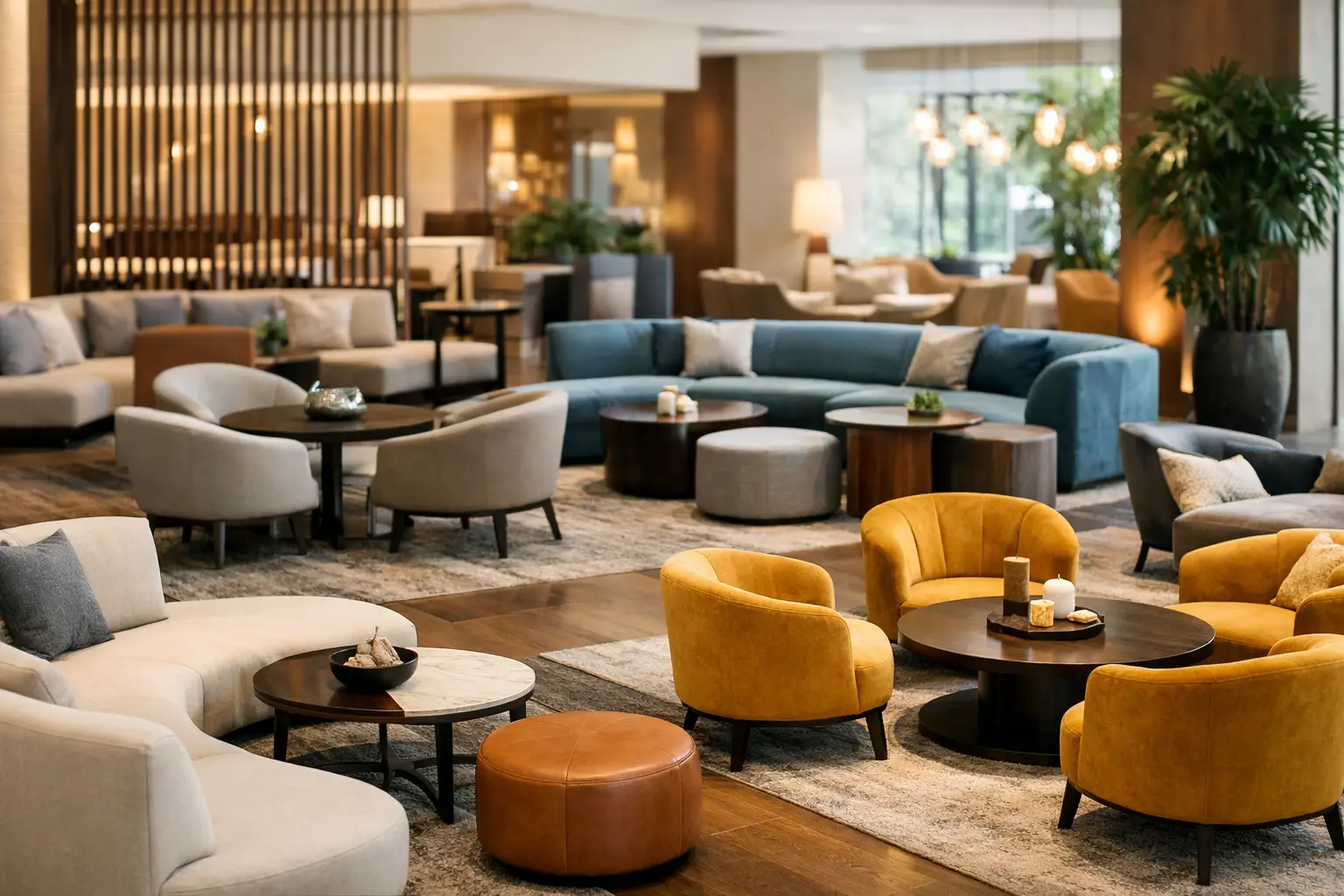
A hotel lobby is judged in seconds. Before the guest reaches the desk, the seating has already done part of the work – signaling whether the space feels social, private, high-energy, relaxed, premium, or forgettable. That is why choosing the best seating shapes for hotel lobbies is not a styling exercise. It is a spatial decision that affects circulation, dwell time, guest behavior, and the visual identity of the property.
In hospitality projects, shape matters as much as finish and upholstery. A lobby may need to handle check-in traffic in the morning, remote workers at noon, informal meetings in the afternoon, and a cocktail crowd in the evening. The right seating geometry helps one room do all of that without feeling overdesigned or overfurnished. The wrong geometry creates dead corners, awkward distances, and furniture that looks good in renderings but underperforms in use.
What makes the best seating shapes for hotel lobbies
The best seating shapes for hotel lobbies are the ones that organize the room without closing it down. They should support movement, create recognizable zones, and offer a mix of postures and social settings. In most projects, that means thinking beyond a row of identical lounge chairs and asking what the furniture is doing architecturally.
Shape affects sightlines first. Low, open forms preserve visual depth and help the lobby feel generous. Higher-backed or more enclosed forms can create welcome intimacy, but too many of them can fragment the room. Scale comes next. Large sculptural seating can anchor a double-height lobby beautifully, while the same form may overwhelm a compact boutique property.
Then there is behavioral logic. People rarely occupy a lobby in one consistent way. Some want to sit alone for ten minutes with luggage nearby. Others want a soft, communal setup for conversation. Some need a semi-work posture with a side table and power access. The most successful layouts blend seating shapes that support different modes without making the floor feel cluttered.
Curved seating shapes create flow
Curved sofas, crescents, arcs, and rounded benches are often among the strongest choices for contemporary hospitality spaces. They soften hard architecture, pull people into the room, and naturally guide movement around them instead of forcing rigid pathways. In large open lobbies, curved forms are especially effective because they create spatial definition without relying on partitions.
There is also a psychological advantage. Curved seating tends to feel more welcoming and less formal than straight-line arrangements. Guests can angle themselves easily, which makes conversation more natural. For hotels that want the lobby to function as a social hub rather than a pass-through, that matters.
That said, curves are not automatically the answer. They demand enough clearance to read properly, and they need to be coordinated with flooring patterns, lighting, and tables. A beautiful circular sofa dropped into a tight rectangular footprint can become an obstacle instead of an invitation. Curved pieces work best when the circulation pattern is already understood and the furniture reinforces it.
Linear seating is precise, but it needs support
Straight benches, rectilinear sofas, and clean modular blocks bring discipline to a lobby. They are useful when the architecture is strong, the plan is narrow, or the design language calls for crisp visual order. Linear seating can also be easier to scale and repeat across larger hospitality programs where consistency matters.
Its limitation is obvious. Used alone, it can feel transactional. A room full of rectangles often reads more like a waiting area than a destination. That is why linear seating usually performs best when paired with another shape language – rounded ottomans, soft-edged lounge chairs, or asymmetrical tables that interrupt the grid.
For specifiers, this is less about choosing between curved and straight and more about calibrating the balance. If the room already has strong angular architecture, straight seating may sharpen the concept. If the architecture is severe, introducing even one generous curved anchor can relax the entire composition.
Circular and island seating for social lobbies
Circular seating arrangements are powerful in hotel lobbies because they create a focal point without assigning a front or back. That makes them ideal for social brands, lifestyle properties, and open-plan arrivals where the furniture needs to hold the room. A circular banquette, ring sofa, or sculptural upholstered island can function almost like a piece of interior architecture.
These shapes also support multi-sided use. Guests can perch briefly, meet casually, or circulate around the piece with ease. In a busy lobby, that flexibility is valuable. Rather than forcing one seating behavior, the furniture allows several.
The trade-off is functional specificity. Circular forms are not always ideal for laptop use, private waiting, or luggage management. They need complementary pieces nearby – smaller lounge settings, side tables, or perimeter seating that supports different postures. The circular element becomes the social center, not the entire answer.
For design-led properties, this is where custom fabrication becomes especially useful. A tailored island can integrate brand language, solve unusual footprints, and introduce a memorable sculptural gesture that standard furniture rarely delivers.
Modular seating handles changing use
If a lobby needs to work hard across the day, modular seating is often the most intelligent shape strategy. Not because it is trendy, but because it gives the designer more control over how the room behaves. Modules can form linear runs, broken clusters, serpentine arrangements, or freestanding islands. That flexibility is practical during planning and valuable long after opening.
The best modular systems do not look temporary. They should feel resolved and architectural, even when the composition is adaptable. This is especially relevant in hospitality environments where event programming, seasonal reconfiguration, and brand activations can all place different demands on the same floor.
Modular geometry also helps with zoning. One composition can signal a communal area, another a quieter edge condition, another an informal work zone. The shapes may share the same material language while performing differently. For architects and interior designers, that creates a strong visual family without repetition fatigue.
Organic and asymmetrical shapes add identity
Some hotel lobbies need more than efficient seating. They need a visual signature. Organic loungers, pebble-like poufs, asymmetrical sofas, and sculptural upholstered forms can deliver that instantly. These shapes are particularly effective in boutique hospitality, resort environments, and branded spaces where the arrival experience is part of the story.
Used well, organic seating breaks away from expected hospitality planning and gives the lobby a more experiential quality. It can make a space feel contemporary, artistic, even playful, while still being highly functional. This is where material and fabrication quality become non-negotiable. Irregular forms only succeed when proportions, comfort, and finish are resolved with precision.
Still, there is a discipline to using expressive shapes. If every piece competes for attention, the room loses clarity. One sculptural family often works better than five different statement moments. Bold form has more impact when it is controlled.
How to choose the right shape for the project
The best starting point is not furniture style. It is traffic. Watch how guests enter, queue, pause, meet, and move toward elevators, bars, and lounges. Seating shapes should support that flow rather than interrupt it. A dramatic form in the wrong place can slow circulation and make the room feel smaller than it is.
Next, consider the social ambition of the property. Is the lobby meant to feel energetic and communal, calm and exclusive, or mixed in use? Curved communal seating may suit a lively urban hotel, while more defined linear groupings may fit a luxury property where privacy matters more.
Then look at posture diversity. Guests do not all want the same experience. Successful lobbies combine lounge depth, perch seating, and flexible pieces that allow short stays and long stays to coexist. Shape is what makes those zones legible.
Finally, think beyond furniture as an object and treat it as built form. The strongest hospitality seating does more than provide a place to sit. It frames movement, creates landmarks, and gives the interior its rhythm. That is where advanced manufacturing becomes a real design advantage. Brands like Sixinch are able to translate unconventional geometries into durable, production-ready seating that holds both its comfort and its visual edge in demanding public environments.
Hotel lobbies do not need more furniture. They need better spatial thinking. When seating shape is chosen with intent, the room feels clearer, stronger, and more memorable from the first step inside.
1 comment