
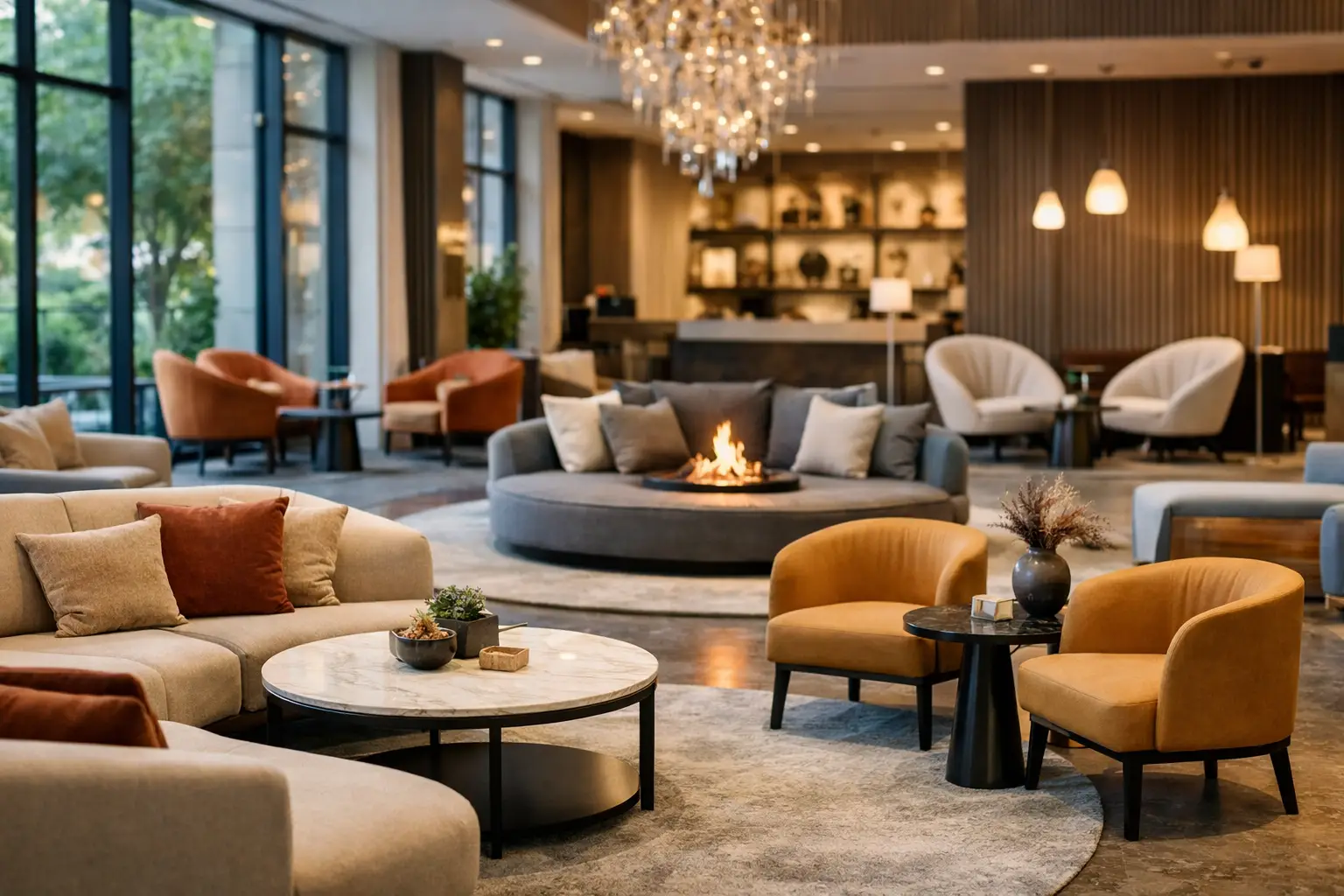
A hotel lobby succeeds or fails in the first ten seconds. Before the guest reaches the desk, scans the signage, or notices the lighting, they read the room through furniture. That is why strong hotel lobby seating design examples matter – they show how seating can direct circulation, define mood, support wait times, and turn an open floor plate into a memorable hospitality experience.
For architects, interior designers, and hospitality developers, lobby seating is never just about filling square footage. It has to work hard. The best schemes manage arrival pressure, accommodate solo travelers and groups, support luggage, tolerate constant use, and still look intentional from every angle. Below are 12 approaches worth studying, not as fixed formulas, but as design moves that can be adapted to brand, traffic, and architectural context.
What the best hotel lobby seating design examples get right
The strongest lobbies use seating as spatial infrastructure. They do not treat it as an afterthought layered onto the architecture. A curved banquette can soften a rigid room and pull guests inward. A field of sculptural poufs can create informal waiting without the heaviness of traditional lounge groupings. A long monolithic bench can organize flow better than multiple armchairs if the lobby is narrow and busy.
This is where trade-offs matter. Highly social layouts often photograph beautifully, but they can reduce privacy. Deep lounge pieces increase comfort for longer stays, but they slow turnover and can make short-wait zones feel sluggish. Modular systems offer flexibility, yet they need discipline in composition or they quickly look accidental. Good specification means deciding what the lobby needs to do first, then building the seating language around that reality.
1. The central sculptural island
A large statement sofa or bench placed at the center of the lobby creates immediate orientation. This approach works especially well in double-height spaces where the furniture needs enough visual weight to hold the room. The best versions use bold geometry, generous proportions, and a silhouette that reads clearly from upper mezzanines and entry doors.
This is a strong move for lifestyle hotels and design-led properties, but it depends on circulation width. If guests are constantly moving around all sides with luggage, the piece must be shaped to avoid becoming an obstacle. Rounded edges and integrated backs usually perform better than sharp rectilinear massing in this scenario.
2. Zoned lounge clusters for mixed dwell times
One of the most reliable hotel lobby seating design examples is the layered cluster strategy. Instead of one dominant seating type, the lobby is divided into several smaller social pockets. A pair of low sofas may serve casual waiting near reception, while deeper lounge chairs and ottomans create longer-stay zones closer to a bar, fireplace, or window wall.
This approach gives the lobby range. It also helps different guest behaviors coexist without visual chaos. The challenge is consistency. If every cluster uses unrelated forms, scales, and finishes, the room loses identity. The best projects maintain a clear design vocabulary even when the seating typologies change.
3. Curved banquettes that shape circulation
Curved banquettes are especially effective in open lobbies that need subtle spatial definition without adding walls or screens. They guide movement, frame gathering zones, and create softer transitions between check-in, lounge, and food service functions. In hospitality environments with a strong architectural axis, a curved seating element can also provide a useful counterpoint to rigid floor lines and structural grids.
From a fabrication standpoint, this is where custom capability matters. Standard furniture dimensions rarely align perfectly with complex lobby geometry. When a banquette is built to fit the plan rather than forced into it, the result feels architectural instead of decorative.
4. Modular seating landscapes
Modular systems are ideal when the lobby needs to support events, seasonal resets, or multiple dayparts. A composition of connected seats, ottomans, and backrests can be configured as a communal lounge in the afternoon and then adjusted for receptions or group arrivals later on.
The risk is that flexibility can dilute intent. Not every hotel team will continuously restage the furniture, and some modular layouts start to drift over time. The solution is to specify modules that still look resolved in semi-fixed arrangements. Sculptural forms help because they retain visual impact even when reconfigured.
5. Hospitality benches with integrated utility
Benches are often underrated in lobby design. A well-scaled bench can handle quick waits, luggage drops, and overflow seating without visually crowding the room. In higher-traffic environments, benches also keep circulation more legible than deep upholstered lounge chairs.
The most effective examples are not generic slabs. They incorporate contour, material contrast, or integrated planters and tables. This gives them enough identity to support the interior concept while keeping the footprint efficient.
6. Social pods for semi-private waiting
Some lobbies need quieter seating moments without building enclosed rooms. High-backed sofas, wraparound banquettes, and soft pod-like forms create a sense of retreat inside a public setting. These are useful near concierge areas, business corners, or elevator lobbies where guests may want to work, talk, or wait without sitting in full view of the entrance.
This approach works best when the pod form is substantial enough to create psychological separation but not so tall that it interrupts sightlines. Hotels that depend on an open, animated lobby atmosphere should use these selectively rather than making the whole floor feel compartmentalized.
7. Pouf fields and movable soft seating
For more casual or younger hospitality brands, a field of poufs or lightweight soft seating can make the lobby feel immediate and informal. It signals flexibility and invites guests to occupy the space in a less scripted way. This can be especially effective in hybrid lobby lounges where check-in, coworking, and social activity overlap.
Movable seating, though, comes with operational questions. Pieces need to be durable, easy to clean, and substantial enough not to feel temporary. In coated foam applications, the advantage is that sculptural forms, saturated color, and soft geometry can be combined with surfaces designed for heavy commercial use.
8. Branded color-block seating
When a hospitality concept relies on visual identity, seating can become one of the clearest branding tools in the room. Bold color-block compositions, custom forms, and oversized lounge elements can make the lobby instantly recognizable. This strategy is particularly effective in boutique hotels, experiential hospitality settings, and mixed-use destinations where the lobby also functions as content backdrop and social magnet.
The key is restraint. A strong palette should still support guest comfort and long-term relevance. Trend-driven color can age quickly if the forms are not grounded in a clear architectural idea.
9. Window-facing lounge lines
Not every successful lobby layout centers inward. In urban hotels with strong street views, waterfront sites, or dramatic landscape settings, linear seating oriented toward glazing can become the main attraction. Guests naturally occupy the edge, using the lobby as an observation lounge.
This sounds simple, but it requires careful depth and spacing. If the line is too shallow, guests do not settle in. If it is too deep, circulation behind the seating becomes compressed. Adding occasional swivel chairs or perpendicular ottomans helps keep the layout from feeling static.
10. Multi-level seating compositions
Changes in seat height can create subtle hierarchy in a large lobby. Standard lounge chairs, lower casual platforms, and bench-height perches each support different postures and dwell times. Used well, this creates visual rhythm and allows guests to choose how they want to occupy the room.
This works especially well in design-forward projects where furniture is expected to behave almost like interior topography. The important point is accessibility. Not every seat can be low and informal. A lobby should always provide options that are easy to enter and exit for a broad guest profile.
11. Soft architectural seating around columns and cores
Columns, structural cores, and awkward central elements often disrupt hospitality layouts. One of the smartest design responses is to wrap them with seating rather than fight them. Circular benches, petal-shaped forms, or radial lounges can convert dead space into active waiting and gathering zones.
This is one of the clearest examples of furniture acting as architecture. It improves use of the floor plate while making the structural condition feel intentional. For custom manufacturers, these are exactly the kinds of moments where unusual geometry can become an asset instead of a problem.
12. Indoor-outdoor continuity in resort lobbies
Resort and warm-climate hospitality projects often blur the edge between lobby, terrace, and landscape. Seating that carries a common language across interior and exterior zones creates a stronger guest experience. Similar silhouettes, color families, or material expressions can make the arrival sequence feel continuous rather than fragmented.
Here, specification gets technical quickly. UV resistance, moisture exposure, cleaning protocols, and slip considerations all shape the final result. The visual concept may be unified, but the construction details may need to shift significantly between indoor and outdoor use.
How to choose among these hotel lobby seating design examples
The right solution depends on what the lobby is being asked to do. A compact business hotel may need crisp circulation and efficient waiting more than dramatic social space. A destination property may want seating that encourages guests to linger for hours. A boutique concept may prioritize visual originality, while a convention hotel may need layouts that absorb volume without feeling chaotic.
This is why seating should be developed in parallel with operational planning, not after it. Arrival peaks, baggage behavior, cleaning cycles, furniture movement, accessibility, and brand photography all affect what will actually perform. The strongest hospitality projects do not separate these questions from aesthetics. They resolve them in one language.
For designers pushing beyond standard hospitality furniture, custom fabrication opens up more than visual novelty. It allows seating to fit architecture precisely, carry brand identity more convincingly, and answer technical demands without reducing the concept to the nearest catalog option. That is where a partner like Sixinch becomes valuable – not simply as a supplier of bold forms, but as a way to turn ambitious lobby ideas into production-ready pieces that hold up in real use.
The most memorable lobby seating is rarely the safest. It is the seating that makes the room legible, gives guests confidence about how to use the space, and leaves a clear impression before a single word is spoken.