
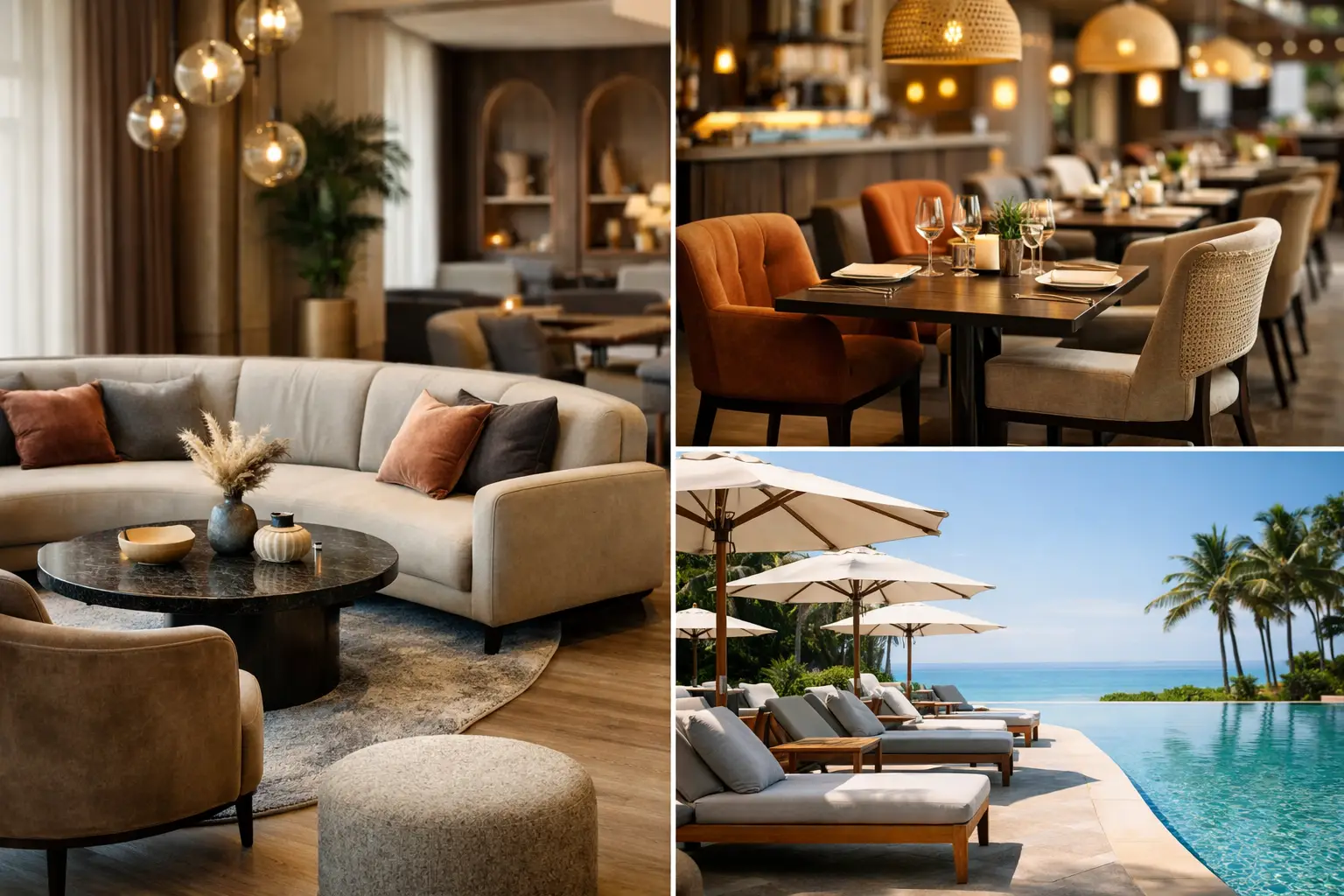
A lobby tells you what a property values before reception says a word. The curve of a lounge seat, the scale of a banquette, the finish on a planter, even the spacing between pieces all shape how guests read a space. Right now, hospitality furniture design trends are moving decisively away from generic contract solutions and toward furniture that carries identity, supports fluid use, and performs under real commercial pressure.
For architects, interior designers, and hospitality developers, that shift matters. Guests expect memorable environments, but operators still need durability, maintenance control, and layouts that can adapt to changing traffic patterns. The most relevant trends are not just visual. They sit at the intersection of experience, brand expression, and fabrication intelligence.
Hospitality furniture design trends are becoming more architectural
Furniture is no longer being treated as a finishing layer added after the concept is approved. In stronger hospitality projects, it is part of the spatial language from the beginning. Seating, planters, dividers, and sculptural volumes are being used to define circulation, zone large footprints, and create visual rhythm across lobbies, rooftop terraces, restaurants, and wellness areas.
This is why monolithic forms, integrated seating landscapes, and oversized soft geometry continue to gain ground. A freestanding bench can now function as wayfinding. A planter can shape privacy without closing off the room. A curved sofa can soften a hard architectural envelope while also controlling guest flow. The result is furniture with a stronger presence and a more active role in the plan.
The trade-off is obvious. Architectural furniture needs more coordination early in the process. It often demands custom dimensions, material testing, and close collaboration between designer and manufacturer. But when done well, it delivers a space that feels authored rather than furnished.
Soft forms are replacing rigid contract aesthetics
One of the clearest hospitality furniture design trends is the move away from sharp, conservative profiles. Hospitality spaces increasingly favor rounded silhouettes, generous radii, and sculptural softness. This is partly aesthetic, but it is also emotional. Guests read curved forms as more approachable, more relaxed, and more premium.
In boutique hotels and design-led public spaces, that softness creates contrast against hard architectural surfaces like stone, glass, and polished concrete. In larger commercial settings, it helps reduce the institutional feel that traditional contract furniture can bring. Soft geometry also works well in social environments where designers want to encourage lingering rather than turnover.
That does not mean every project should be full of bulbous statement pieces. Too much softness without structure can make a space feel visually loose. The strongest compositions balance expressive forms with disciplined planning, especially in high-traffic areas where comfort and clarity need to coexist.
Sculptural seating is doing more than making a visual statement
Sculptural seating earns attention, but attention alone is not enough in hospitality. The most effective pieces combine bold shape with usability, cleanability, and layout flexibility. Designers are specifying pieces that look custom because they often are custom – tailored to a footprint, a branding concept, or a guest journey rather than selected from a standard catalog and forced into place.
This is where fabrication capability becomes critical. Unconventional profiles only work commercially when they can be produced with consistency and finished to withstand repeated use. Expressive design has become more viable because manufacturing methods now allow for greater formal freedom without giving up performance.
Flexible layouts are replacing fixed furniture logic
Hospitality spaces have become more hybrid. A hotel lobby may operate as a workspace in the morning, a casual meeting zone in the afternoon, and a social venue at night. A rooftop can host private events one day and general guest seating the next. Furniture needs to support that range without making the space feel temporary.
Modular seating, movable elements, and multi-use forms are central to this shift. Designers are favoring pieces that can cluster, separate, or reorient as operational needs change. Ottomans become informal seating. Benches become dividers. Lounge systems become event-ready layouts with minimal intervention.
There is a practical nuance here. Flexibility is valuable, but only when it is designed into the space with intention. If every piece is mobile and nothing has visual weight, the environment can lose coherence. Good hospitality design usually mixes anchor elements with adaptable components, creating both identity and operational agility.
Outdoor and indoor aesthetics are converging
The line between interior hospitality spaces and exterior amenity areas is getting thinner. Terraces, pool decks, courtyards, and entrance zones are being designed as extensions of the brand experience rather than separate utility zones. As a result, furniture language is becoming more continuous across inside and outside environments.
This trend shows up in matching forms, shared color strategies, and materials selected for both visual impact and weather resistance. Hospitality designers want fewer abrupt transitions. They are looking for furniture that can maintain a strong design signature whether it sits in a lounge, on a rooftop, or in a landscaped public-facing zone.
For specifiers, this raises the bar on material performance. UV resistance, drainage, cleanability, and coating durability matter just as much as silhouette. Some forms that look perfect indoors do not translate well outside without significant material adaptation. The challenge is to preserve the design intent while meeting environmental demands.
Bold color is returning, but with more discipline
Neutral hospitality interiors are not disappearing, but they are no longer the only safe option. Designers are using stronger color to create recognition, support brand identity, and punctuate large volumes. What has changed is the way color is applied. Instead of treating it as decoration, teams are using it strategically through key furniture elements that hold the room together.
A saturated banquette, a monolithic planter, or a custom lounge element can become the visual anchor that gives a project distinction. This is especially relevant in hospitality environments competing for social visibility and guest recall. Generic palettes rarely create memorable experiences.
Still, bold color works best when backed by confidence and restraint. One strong gesture often has more impact than ten competing ones. The right finish, texture, and light conditions all affect how color reads in use, which is why mockups and material review remain essential.
Customization is no longer a luxury add-on
Across hospitality categories, custom furniture is shifting from exception to expectation. Developers and designers want spaces that cannot be mistaken for another property, another brand, or another chain renovation. Furniture is one of the clearest ways to achieve that distinction.
Customization may involve form, dimensions, integrated branding, color matching, or project-specific functionality. In some cases, it means developing a signature seating type that becomes part of the guest experience. In others, it is about solving technical constraints in a difficult footprint or a mixed-use public area.
The key issue is not whether custom is desirable. It is whether the manufacturing partner can take a concept from sketch to production without flattening what made it compelling in the first place. That requires technical fluency, material knowledge, and a production process built for non-standard outcomes. For design teams pushing beyond conventional hospitality typologies, that capability can shape the entire project.
Durability is becoming part of the aesthetic brief
Performance has always mattered in hospitality, but it is increasingly being evaluated alongside design impact rather than after it. Specifiers want furniture that looks precise and stays that way under heavy use. Surfaces need to resist abrasion, moisture, staining, and repeated cleaning. Shapes need to hold their integrity. Finishes need to support the concept long after opening photography is done.
This has led to greater interest in materials and fabrication methods that can deliver a smooth, unified appearance with commercial resilience. In that sense, technical construction is becoming visible in a positive way. The market is rewarding furniture that feels crafted, not fragile.
Sixinch has built its reputation in exactly this territory – translating bold forms into coated, durable objects that can handle public and hospitality use while keeping a strong visual identity. That combination is becoming more relevant as designers ask more from every piece they specify.
What these trends really signal
The bigger story behind hospitality furniture design trends is that furniture is being asked to do more. It must communicate brand, shape experience, support flexible programming, and withstand constant use – all without slipping back into generic contract language. That pushes the conversation beyond style and into execution.
For designers, this creates a clear opportunity. The most successful hospitality spaces will not come from copying familiar looks with slightly different finishes. They will come from using furniture as a design tool with real spatial, emotional, and operational value.
The question is no longer whether guests notice furniture. They do. The question is whether the furniture gives them anything worth remembering.