
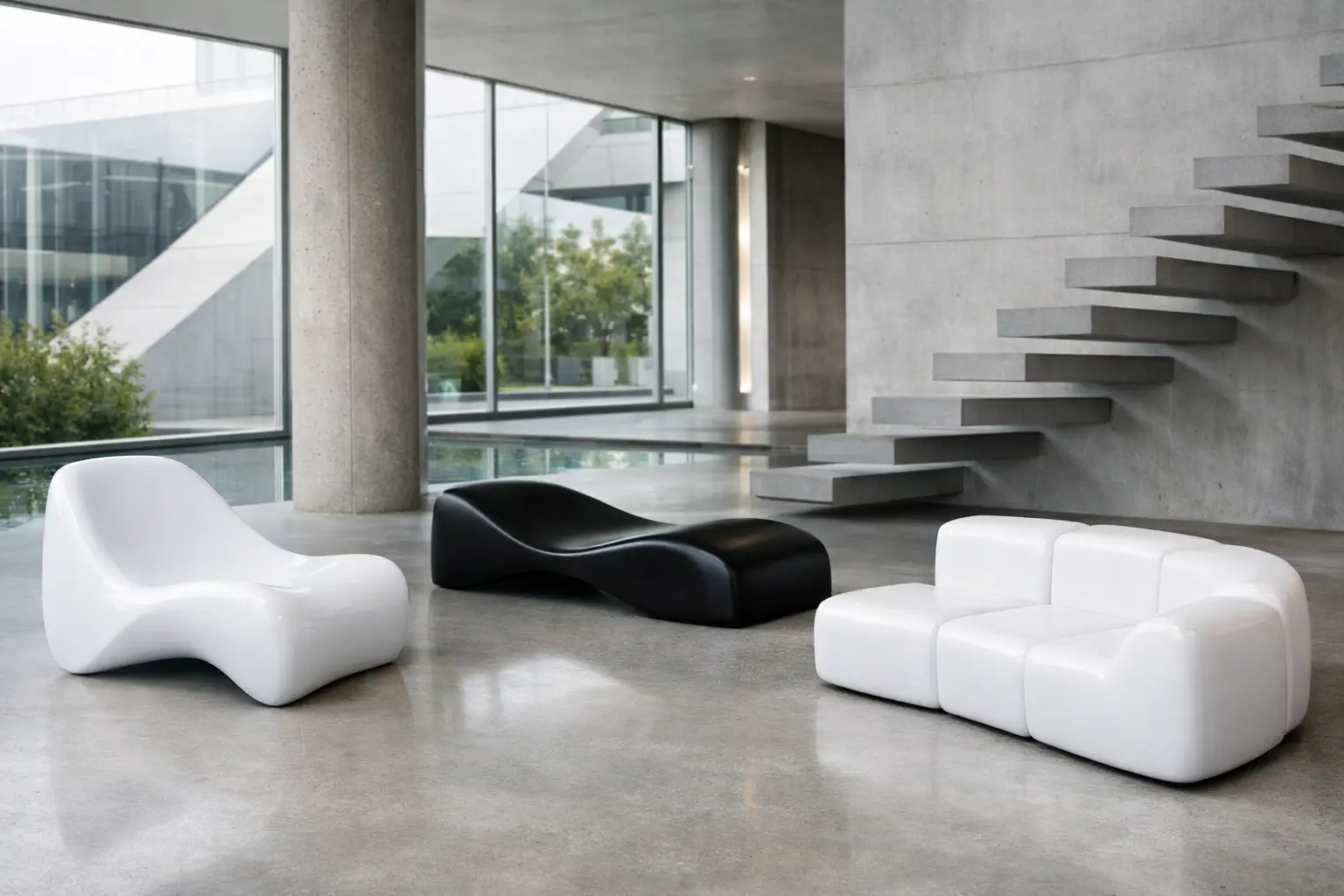
A curved banquette that appears to rise from the floor. A planter that doubles as a spatial divider. A reception seat shaped around a brand gesture rather than a conventional furniture typology. The future of coated architectural furniture is being defined by these moments, where furniture does more than fill a room. It gives identity, rhythm, and physical presence to an environment.
For architects and designers, the appeal is not novelty for novelty’s sake. Coated foam fabrication offers a practical route to forms that would otherwise demand multiple materials, complex assembly, or costly one-off construction. As hospitality, retail, workplace, and public-space projects ask more from every square foot, furniture is becoming architectural in both scale and intent.
Why Furniture Is Becoming More Architectural
The boundary between furniture and architecture has always been porous. Built-in seating, reception counters, platforms, and landscape elements have long shaped how people move through a space. What is changing is the expectation that these elements can be expressive, soft-edged, movable when necessary, and developed with the visual authority of a permanent installation.
Conventional furniture production is often organized around repeatable components: frames, panels, upholstery patterns, standardized dimensions, and hardware. That logic is efficient, but it can restrict a concept once it moves beyond rectilinear forms. A sculptural lounge island, a continuous serpentine bench, or a playful branded object may be difficult to produce without adding visible joints, multiple subcontractors, and compromises to the original design.
Coated architectural furniture shifts that equation. A shaped foam core can create volume, ergonomic contour, and generous geometry. A specialized coating then forms a continuous, tactile skin around the object. The result can read as a single designed gesture rather than an assembly of parts.
This matters particularly in spaces where first impressions carry commercial value. A hotel lobby needs a social center, not merely a collection of seats. A flagship store needs objects that reinforce its visual language. A workplace needs zones that invite informal exchange without looking like an afterthought. In each case, furniture can become the element that makes the concept legible.
The Future of Coated Architectural Furniture Is Specifiable Freedom
Design freedom is only useful when it can be specified, fabricated, installed, and maintained. The next phase of coated furniture is not about making ever stranger objects. It is about giving expressive forms the technical discipline required for real projects.
That begins with a more integrated design process. Rather than selecting furniture after the architecture is resolved, designers are increasingly developing seating, planters, soft barriers, and landscape forms alongside the plan. This allows an object to follow circulation, support a program, respond to sightlines, or create a destination within a larger open area.
A curved bench, for example, may need to accommodate a precise radius, seat height, back angle, and access route. It may need a color that relates to a brand palette, a finish appropriate for intensive public use, and sections sized for delivery constraints. These are not secondary questions. They determine whether an ambitious form performs as intended once it leaves the rendering.
The best custom fabrication partners bring those constraints into the conversation early. They understand where a form can be refined without losing its character, how transitions affect the final finish, and when a large object should be divided for transport or installation. The goal is not to standardize the design. It is to make originality buildable.
A finish that supports the form
The coating is central to this opportunity. Unlike traditional upholstery, which introduces seams, tension, and pattern limitations, a coated surface can follow broad curves and integrated volumes with visual continuity. It gives designers a way to create objects that feel graphic, monolithic, or almost digitally modeled, while retaining the comfort and lightweight advantages of foam.
Surface choice still requires judgment. A soft-touch finish may suit an interior lounge where tactile comfort and a refined matte appearance are priorities. More durable technical coatings may be better suited to high-traffic public interiors, food-service environments, or outdoor applications. Texture, gloss level, color, and cleanability all influence how the object will age in its setting.
There is no universal best finish. A dramatic white seating landscape may be exactly right for a controlled gallery setting and impractical for a heavily used transit-adjacent lounge. Good specification aligns the visual ambition with the expected level of contact, cleaning routine, exposure, and replacement strategy.
Customization Is Moving Beyond Color and Size
For years, customization in commercial furniture often meant choosing a fabric, changing a finish, or adjusting a dimension. Those options remain useful, but contemporary projects are asking for a deeper level of authorship.
The most compelling custom pieces begin with an idea that has a job to do. It might translate a logo into a three-dimensional social object, soften a rigid architectural grid, establish a playful zone in a family-oriented venue, or create a sequence of seating and planters across a terrace. In these cases, the form is not decoration applied after the fact. It is part of the project’s spatial and brand strategy.
This is why coated foam has particular relevance for experiential environments. It can support inflated-looking volumes, organic silhouettes, oversized geometries, and clean integrated details that conventional construction may make laborious. Yet the material should not be treated as an excuse to abandon function. Scale, comfort, stability, access, and user behavior remain fundamental.
A memorable object that cannot support the way people actually sit, wait, gather, or move around it will not sustain its impact. The strongest work combines an immediate visual statement with an intuitive physical experience.
From object design to systems thinking
The future is also less about isolated hero pieces and more about coordinated systems. A designer may create a family of related forms: benches, low seats, planters, leaning elements, and acoustic or spatial dividers that share proportions and color logic. Together, these components can organize a large lobby, campus, retail floor, or outdoor amenity area without making the space feel repetitive.
This approach gives projects flexibility over time. Modular or repeatable forms can be reconfigured as programming changes, while custom anchor pieces define the identity of key zones. The balance depends on the project. A permanent hospitality concept may benefit from a site-specific centerpiece, while a flexible workplace or event venue may need forms that can be repositioned.
Durability Will Be Defined by Real Use, Not Marketing Claims
As coated furniture becomes more prominent in commercial settings, durability will become a more precise conversation. Designers and clients are right to ask how a surface responds to abrasion, impact, spills, UV exposure, cleaning products, and daily contact. But durability is not a single number. It is the fit between material, location, maintenance, and behavior.
An indoor reception area, an outdoor pool deck, a school commons, and a luxury retail fitting lounge place very different demands on a product. The right question is not simply, “Is it durable?” It is, “Durable for what, and under which conditions?”
This calls for earlier coordination among the design team, operator, and manufacturer. Specify the anticipated environment honestly. Consider who will clean the furniture, how often it will be moved, whether it will be exposed to direct sun, and whether the project needs a finish that minimizes visible scuffing. A dark saturated color may conceal daily wear differently than a pale neutral. A highly textured surface may change the maintenance routine. These choices belong in the design conversation, not in a last-minute facilities manual.
At Sixinch, this material-led approach is what turns bold visual concepts into production-ready architectural objects. The design can be expressive, but the execution must remain exact.
A More Responsible Case for Long-Lasting Design
The environmental conversation around furniture is also pushing designers away from disposable visual trends. A distinctive object is not automatically responsible, and a simple object is not automatically low impact. Longevity comes from relevance, repairability where possible, appropriate material selection, and a design strong enough to remain valued after the opening photographs have passed.
Coated architectural furniture can support that goal when it is designed for a specific place and expected use. A well-resolved custom bench that anchors a lobby for years may offer more lasting value than a sequence of generic replacements. At the same time, customization should be disciplined. Producing a unique form without a clear functional or spatial purpose can create waste disguised as creativity.
The responsible direction is not less imagination. It is imagination with intent: fewer compromises in the design, clearer performance expectations, and forms that deserve to remain part of a space.
What Designers Should Ask Earlier
The highest-value decisions happen before a model is finalized. Begin by defining the object’s role: Is it seating, a boundary, a landmark, a planter, or several of these at once? Then establish the human requirements, including seat heights, circulation clearances, accessibility, stability, and likely patterns of use.
Next, test the visual and technical conditions together. What scale gives the form presence without overwhelming the room? Where will joints or sectional divisions be least visible if they are needed? Which color and surface quality will support the concept under real lighting? How will the object enter the site, and what will ongoing care look like?
These questions do not dilute creative ambition. They protect it. They give a complex form the information it needs to survive contact with construction schedules, freight routes, public use, and daily maintenance.
The most exciting projects ahead will treat coated furniture as a serious architectural medium: capable of comfort, drama, color, and precise spatial work. Start with the gesture people will remember, then give it the material intelligence to remain meaningful long after the space opens.