
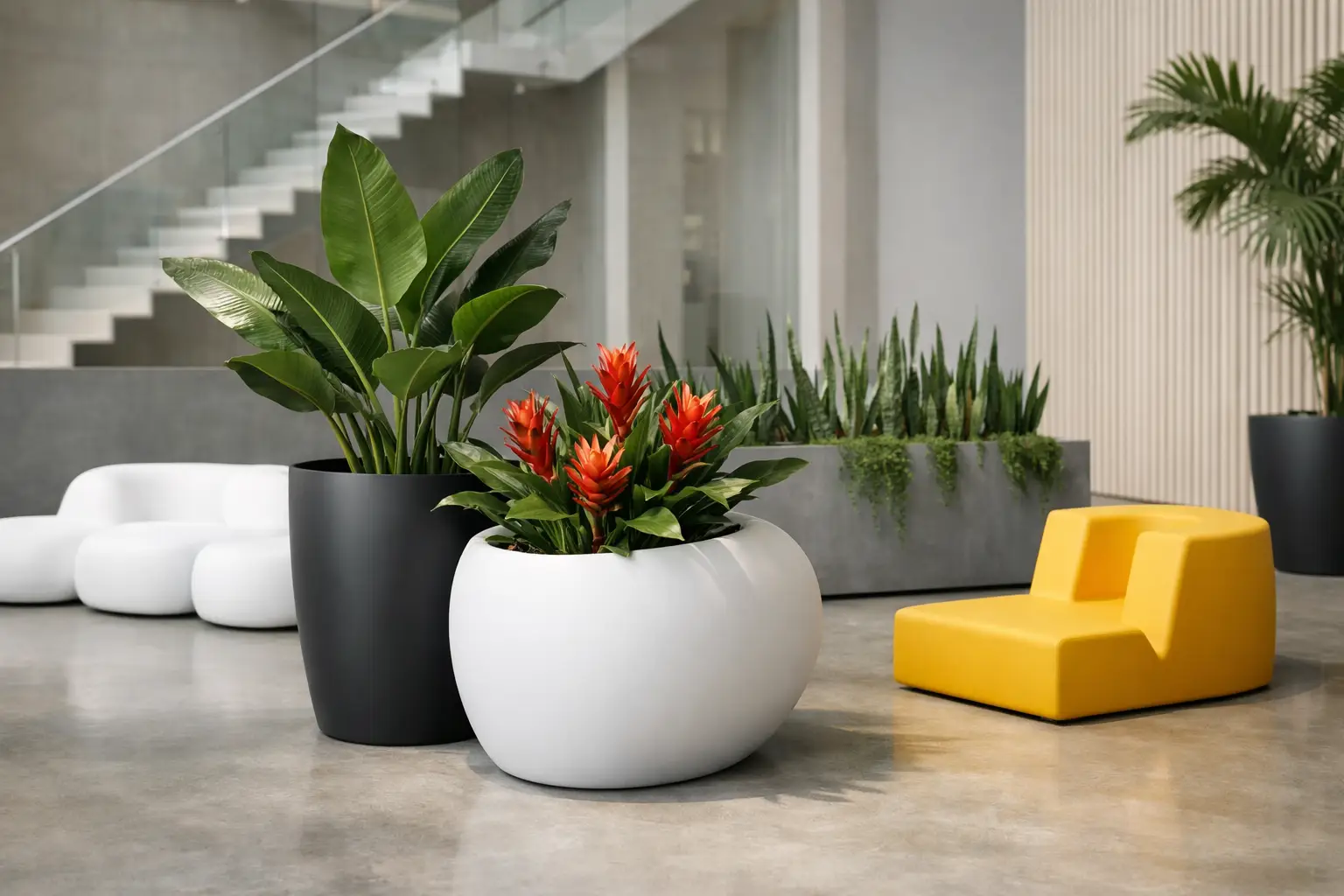
A planter can do far more than hold planting. In a hotel arrival sequence, it can establish scale before a guest reaches the door. In a workplace lounge, it can divide zones without building a wall. In a retail environment, it can carry the same sculptural language as the fixtures, seating, and brand identity. Knowing how to source custom planters means treating them as architectural objects from the first conversation, not as a finishing accessory selected at the end.
For design-led commercial projects, the strongest results come from aligning design intent, planting requirements, material performance, and manufacturing reality early. The goal is not simply a planter in a custom size. It is a piece that makes the intended visual statement, survives its setting, and arrives ready to integrate into the space.
Start With the Planter’s Job in the Space
Before requesting drawings or pricing, define what the planter needs to accomplish. Is it a freestanding focal point, a low landscape edge, a privacy screen, a circulation guide, or a sculptural feature that happens to support planting? Each role affects proportion, stability, access, and the way people will experience the object.
Scale is often the first critical decision. A planter that looks substantial in a material sample or rendering can disappear in a double-height lobby. Conversely, an oversized piece in a tight hospitality setting can compromise circulation. Share floor plans, elevations, key sightlines, ceiling heights, and adjacent furniture dimensions with the fabricator. These inputs allow the object to be designed in relation to the room rather than in isolation.
Also consider whether the planter will be viewed from every side. A wall-adjacent unit may need a different rear finish, reduced depth, or concealed service access. A central island planter needs a resolved 360-degree silhouette and enough visual weight to hold its own from across the space.
How to Source Custom Planters From a Capable Partner
The right fabrication partner should be able to discuss more than a catalog of standard vessels. They should ask intelligent questions about geometry, planting systems, installation conditions, maintenance, and production tolerances. Custom work succeeds when the manufacturer can translate a concept into a buildable object without flattening the design.
Bring the strongest available starting material to the conversation. This may be a dimensional sketch, a CAD model, a mood board, a finish reference, or a physical maquette. Even an early concept can be enough to begin, provided the intended shape, scale, use, and project constraints are clear.
Ask how the proposed form will be engineered. A tall, narrow planter may need internal ballast or a widened base. A long, continuous planter may require modular sections for transportation and site access. An organic form may need subtle changes to wall thickness or internal reinforcement to maintain its profile and durability. These are not compromises when handled well. They are the technical decisions that make expressive forms viable.
A design-and-manufacturing partner such as Sixinch can be particularly valuable when the brief calls for monolithic forms, soft radii, oversized silhouettes, or custom geometries that conventional planter construction struggles to deliver. Coated foam fabrication offers considerable freedom for creating lightweight-looking, sculptural objects with a durable finished surface.
Specify the Material for Its Real Environment
Custom planters are exposed to a demanding mix of forces: moisture, irrigation, soil weight, impact, cleaning, UV exposure, and frequent contact from guests or the public. Material selection should reflect where and how the piece will live.
For interiors, the finish must support the visual language of the space while standing up to cleaning and daily use. A refined matte surface may suit a gallery-like lobby, while a saturated color can reinforce a branded retail concept or energize a social workspace. Texture matters as well. It changes how light travels across curves, how the object feels at close range, and how small marks are perceived.
For exterior applications, weather exposure becomes central. Confirm the expected performance under direct sun, temperature swings, rain, and local seasonal conditions. If the planter will be placed in a public setting, discuss resistance to abrasion and incidental impact. A finish that is appropriate for a covered terrace may not be the right choice for an exposed rooftop or streetscape.
Do not assume that a heavier planter is automatically better. Weight can support stability, but it can also complicate freight, handling, roof-load calculations, and future relocation. The best solution depends on the form, location, planting medium, wind exposure, and installation method.
Treat Drainage as a Design Requirement
Drainage should be resolved before fabrication begins, not improvised on site. Standing water can damage plants, add unnecessary weight, stain surrounding surfaces, and shorten the life of the planter system.
Clarify whether the design will use a fully planted cavity, removable liners, or individual nursery pots concealed within the form. A removable liner can simplify planting changes and maintenance, while an integrated cavity may better support a continuous landscape expression. The choice depends on the planting strategy and who will care for the installation after handover.
For indoor projects, determine where irrigation runoff will go and how it will be contained. For exterior work, define drainage-hole locations, drainage layers, and whether the site surface can accept runoff. If planters sit on finished flooring, consider feet, recessed bases, or an integrated drainage approach that protects the surface and preserves a clean visual line.
Design for Installation, Not Just the Render
The most memorable planter is of little use if it cannot get through the loading dock, elevator, doorway, or landscape gate. Early coordination with the project team prevents expensive last-minute redesigns.
Measure access routes and identify the narrowest clear opening, turning points, elevator capacity, floor loading, and staging area. Large custom planters can often be produced as precisely joined sections, but module lines must be planned around the geometry rather than added as an afterthought. On a curved or faceted object, a poorly placed joint can interrupt the entire visual effect.
Installation details also deserve attention. Will the planter sit loose, be mechanically fixed, or integrate with a millwork base? Does it need concealed leveling feet for uneven floors? Is power required for integrated lighting, or should irrigation lines be routed through the base? These questions place the planter within the broader construction sequence and protect the design intent during installation.
Request Samples, Drawings, and Honest Production Feedback
A color chip is useful, but it cannot fully communicate the effect of a finish on a large curved object. Request finish samples at a meaningful scale when possible, especially for distinctive colors, textures, or coatings. View them under the project’s expected lighting conditions. Warm hospitality lighting, daylight from a storefront, and exterior sun can each alter the perceived color and surface character.
For bespoke forms, review dimensional drawings before production. Check overall dimensions, planting openings, wall thicknesses, base details, drainage provisions, join locations, and any required service access. This is also the time to confirm whether the planter needs to align with flooring patterns, columns, banquettes, or architectural reveals.
Welcome direct feedback from the manufacturer. If a radius is too tight to finish cleanly, if a profile needs reinforcement, or if a proposed module size will create handling risk, those observations protect the project. The best custom pieces are developed through a disciplined exchange between creative ambition and fabrication expertise.
Build Time Into the Specification Process
Custom fabrication has a different rhythm from purchasing a ready-made planter. Design development, engineering, finish approval, prototyping, production, freight, and installation coordination all require time. The more unusual the form or finish, the more valuable it is to engage the manufacturer early.
Avoid issuing a custom planter brief with only a final rendering and a fixed delivery date. Instead, establish a decision schedule: when geometry must be approved, when finish samples will be reviewed, when planting details are confirmed, and when site access information is available. This gives the fabricator room to solve technical issues before they become site problems.
Budget should be approached with the same clarity. Custom cost is shaped by dimensions, complexity, quantity, finish, internal systems, shipping requirements, and installation constraints. Repeating a family of related forms can create a more efficient production approach than making every unit completely different. That does not mean sacrificing originality. It means using repetition strategically, with variation in scale, color, or planting to create impact.
Give the Landscape Team a Clear Handoff
A custom planter is only complete when the planting and maintenance approach support the object. Provide the landscape contractor or maintenance team with cavity dimensions, liner details, drainage information, weight limits, irrigation guidance, and recommended cleaning practices. They need to understand where to access plants, how to prevent water buildup, and what tools or chemicals could damage the finish.
Planters that look effortless usually have a carefully considered operating logic behind them. The planting can be changed without disrupting adjacent finishes. The irrigation is discreet. The object remains stable, clean, and visually powerful after months of public use.
The most compelling custom planter projects begin with a strong idea, then give that idea the technical attention it deserves. When form, finish, planting, and fabrication are developed as one system, the result is not background greenery. It is a defining piece of the environment.